









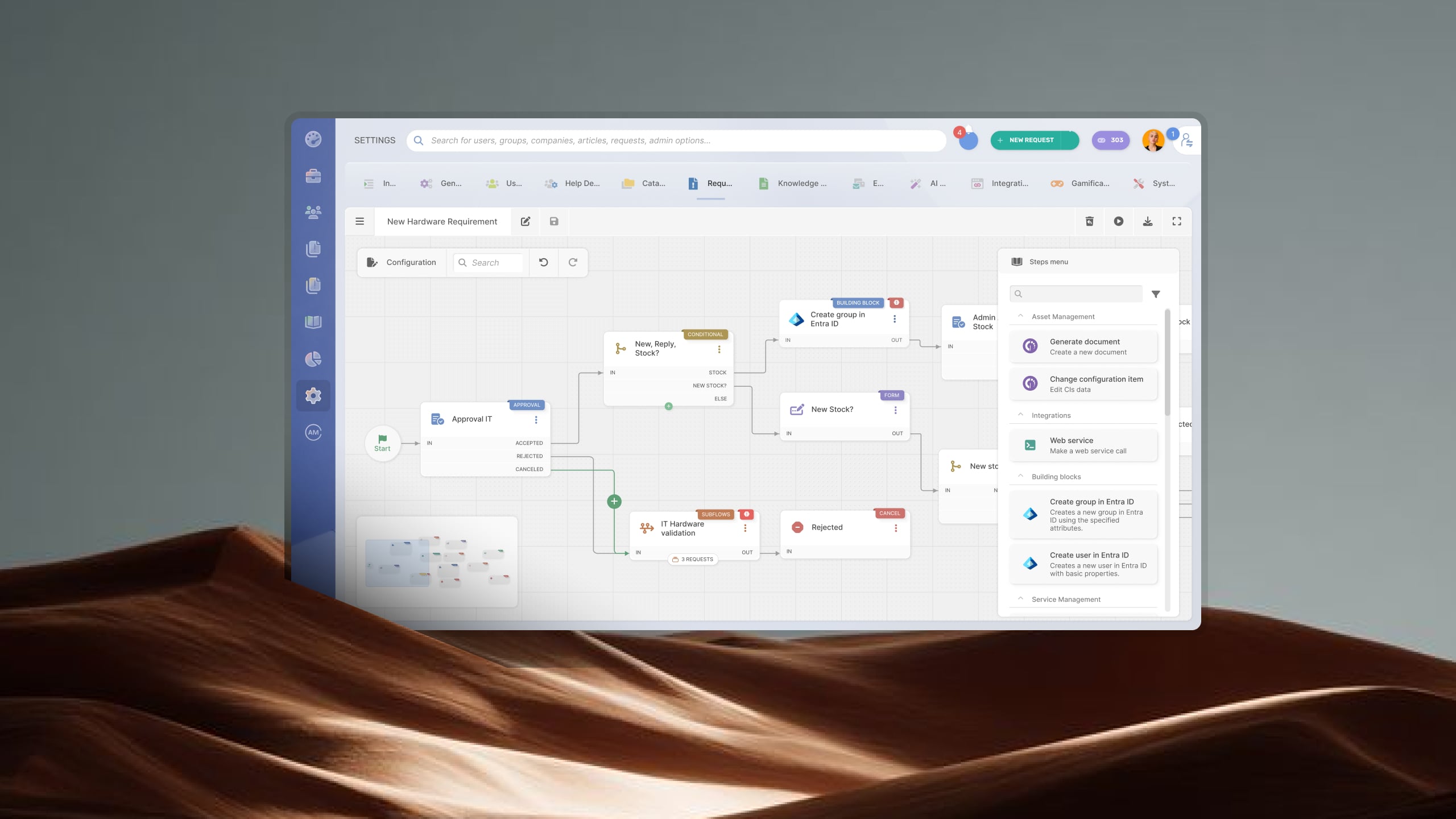

Many IT support tasks are simple but repetitive, and they can add up to a significant use of agents’ time. IT support automation helps standardize these processes, reduce errors, and free resources for more complex work.
Still, not every task is convenient to automate, so identifying the areas where automation has the most impact is important. That’s why we bring you some service desk automation ideas to improve your service delivery.
This post covers 8 concrete service desk automation ideas, each with context on what problem it solves and how you can use InvGate Service Management to take them to the next level.
Service desk automation refers to the use of rules, triggers, and workflows to execute recurring support tasks automatically. The system can route requests, track SLA deadlines, send notifications, update ticket statuses, and handle repetitive processes without requiring agent intervention for each action.
There are two main types of automation:
Rule-based automation works through predefined logic. The system evaluates conditions and executes actions according to fixed rules and workflows.
AI-assisted automation works through pattern recognition and historical data. The system analyzes past activity to support decisions such as categorization, prioritization, and recommendations in situations where static rules are harder to maintain.
This process typically involves the use of intelligent ticketing systems, self-service portals, and workflow automation tools. These technologies enable the automatic routing and categorization of support tickets, automated responses to frequently asked questions, and the orchestration of various tasks and approvals.
The ultimate goal of service desk automation is to increase the efficiency of incident resolution.
Not every service desk process should be automated
Good candidates for automation usually have three characteristics:
Processes that depend heavily on context, approvals, exceptions, or sensitive communication often still require human handling. A common problem is automating workflows that are already inconsistent. If teams follow different routing rules or handle requests differently, automation will repeat those inconsistencies at a larger scale.
The possibilities of automation are wide, and it’s key to go step by step and not try to do everything at once. We recommend starting with a defined scope of automated tasks and learning the trick before taking on more.
To guide you through the process, we have put together a list of ideas to start implementing automation in your Help Desk. And, you can try all of them with the free trial of InvGate Service Management.
The problem: Agents spend time at the start of every shift triaging and manually assigning incoming tickets. In high-volume environments, this creates a bottleneck before any actual work begins — and introduces inconsistency when different people make different routing decisions.
What to automate: Assignment of incoming tickets to the right agent or team based on category, keywords, request type, or workload.
In InvGate Service Management: Navigate to Settings > Requests > Automations. From there, you can define assignment rules based on ticket attributes and choose between three distribution methods:
You can also configure escalation rules here: if a ticket remains unassigned past a defined threshold, it automatically escalates to a supervisor or a different team.
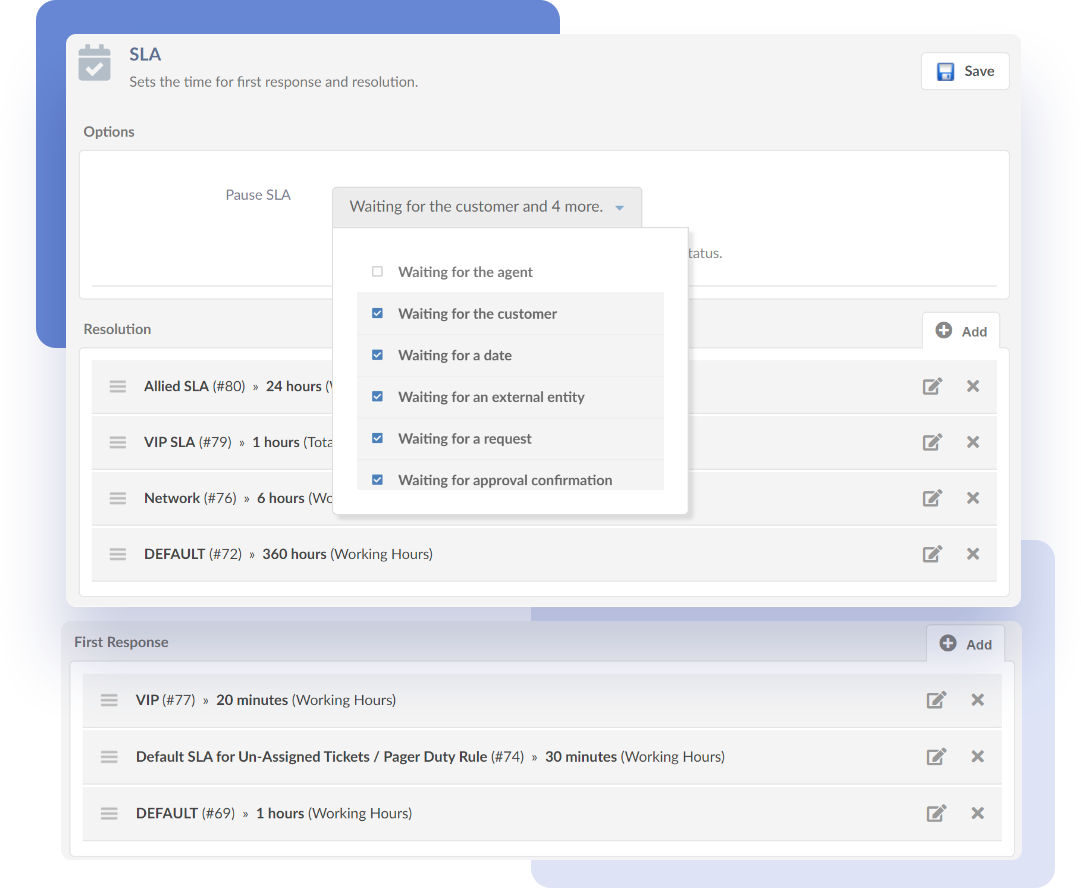
The problem: SLA breaches often aren't caught in time — not because teams don't care, but because no one is watching the clock on every open ticket simultaneously. By the time someone notices a breach, it's already happened.
What to automate: Proactive alerts that trigger before a breach occurs, and automatic escalation actions if the ticket hasn't been updated or resolved by a defined threshold.
In InvGate Service Management: From the automation engine, configure time-based triggers tied to your SLA parameters. Define response and resolution time targets, then set up actions that fire at defined percentages of elapsed time — for example, a notification to the assigned agent at 50% elapsed, an alert to the team lead at 80%, and an automatic priority escalation at 90%. This turns SLA management from a reactive exercise into a proactive one.
The problem: Agents write the same responses over and over. "Your ticket has been received and assigned to the network team." "We need your employee ID to proceed." "Your request has been resolved — please let us know if you need further assistance." Multiply this by 30 tickets a day, and it's a significant time sink that also introduces inconsistency.
What to automate: Pre-written responses that agents can insert in one click, with variables that populate automatically from ticket data.
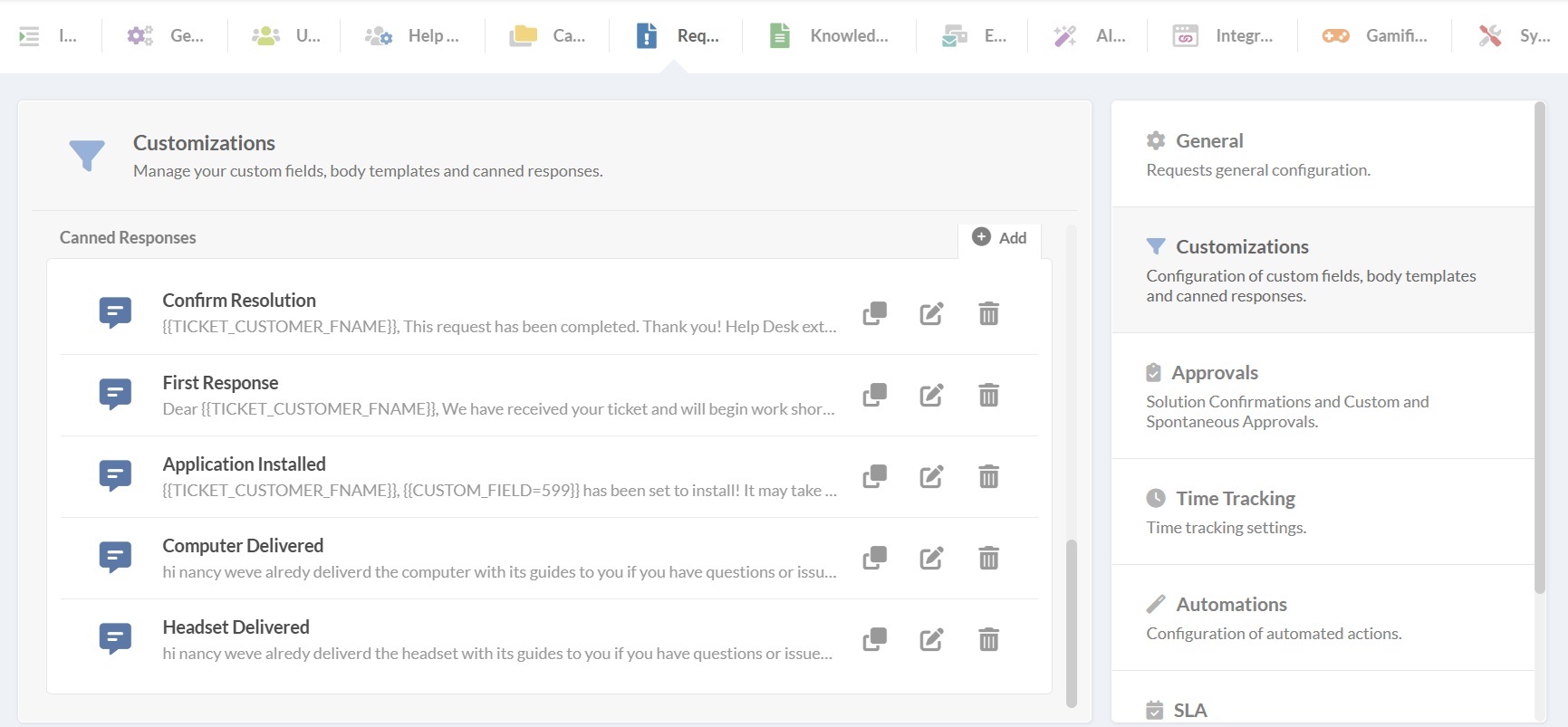
In InvGate Service Management: Go to Requests > Customizations > Canned Responses. Admins can create shared canned responses available across help desks or scoped to specific categories. Agents can also create personal responses for their own use. Variables embedded in the template — like or {{ticket.id}} — are replaced dynamically when the response is inserted, so the message looks personalized without requiring any manual editing.
This is one of the simplest automations to implement and one of the fastest to deliver visible time savings.
The problem: Generating and distributing service desk performance reports is manual work that typically falls on a team lead or manager. It happens inconsistently, takes time away from actual analysis, and stakeholders who need the data often have to ask for it.
What to automate: Scheduled generation and delivery of reports with the metrics that matter — ticket volume, resolution time, SLA compliance, first contact resolution rate — sent automatically to the right people at the right cadence.
In InvGate Service Management: Configure scheduled reports from the reporting module. Select the metrics, define the frequency (daily, weekly, monthly), and set the recipients. Reports go out automatically without anyone having to remember to run them. This also supports a regular review rhythm: when the data shows up in inboxes on schedule, teams are more likely to act on it.
The problem: Users submit requests through whatever channel is convenient for them — email, a chat message in Teams, a WhatsApp message, or the self-service portal. Without automation, someone has to monitor all of those channels and manually create or update tickets from each source. Context gets lost, requests slip through the cracks, and the queue doesn't reflect reality.
What to automate: Automatic conversion of incoming messages from any channel into properly structured tickets, with context preserved.
In InvGate Service Management: The platform integrates with email, Microsoft Teams, WhatsApp, the self-service portal, and a REST API. Regardless of where the request originates, it becomes a ticket with the relevant metadata — source channel, requester information, message content — automatically. Agents work from a single queue without having to monitor multiple inboxes.
The problem: A significant portion of incoming tickets are requests users could resolve themselves — password resets, software installation guides, VPN setup instructions — if they knew where to look. Without a self-service layer, every one of those requests lands in the agent queue.
What to automate: Surfacing relevant knowledge base articles at the moment a user starts creating a ticket, before they submit it.
In InvGate Service Management: When a user starts typing their request in the self-service portal, the platform automatically suggests knowledge base articles that match the content. If the user finds the answer, they close the browser without submitting a ticket. If they don't, they continue and the ticket is created. This deflection happens without any agent involvement, and the reduction in L1 ticket volume is typically one of the most measurable outcomes of automation.
For teams exploring the next layer — conversational interfaces on top of the knowledge base — see service desk chatbot.
The problem: Not every ticket stays at the same priority level throughout its lifecycle. A request that starts as routine can become urgent if it's not resolved within a certain window, or if specific signals appear — an email with "outage" or "down" in the subject line, a request from a VIP user, or a cluster of related tickets pointing to a wider incident.
What to automate: Dynamic escalation rules that respond to changing conditions and update ticket priority, assignment, and visibility automatically.
In InvGate Service Management: Go to Settings > Requests > Automations and configure condition-based escalation rules. A concrete example: an incoming email with "outage alert" in the subject line automatically triggers a category change to Incident, sets priority to Critical, and adds the team lead as an observer. The rule fires the moment the ticket is created, without waiting for a human to read and triage it. Multiple conditions can be combined — priority level, elapsed time, requester role, keyword matching — to handle the escalation scenarios most relevant to your environment.
The problem: Employee onboarding and offboarding involve multiple teams (IT, HR, Facilities), multiple tasks with dependencies, and a tight timeline. When managed manually, steps get missed — access isn't provisioned in time, or worse, access isn't revoked when someone leaves.
What to automate: Multi-stage workflows that coordinate provisioning, approvals, and notifications across teams, triggered by a single request.
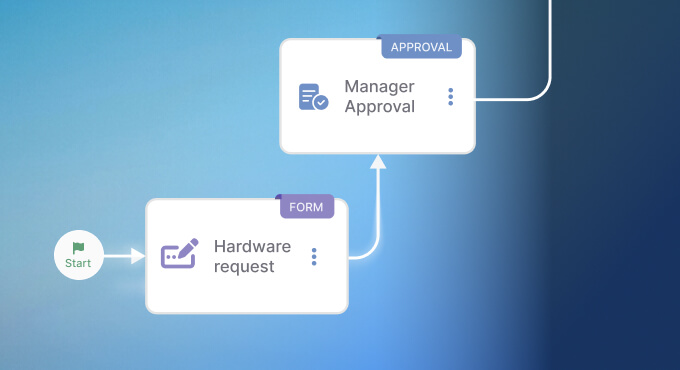
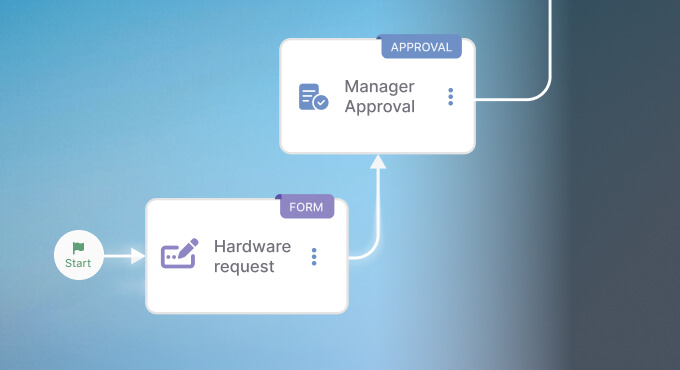
In InvGate Service Management: Navigate to Settings > Requests > Workflows and select a pre-built onboarding or offboarding template. You don't need to build these from scratch. The template includes stages for user creation, equipment provisioning, HR approvals, and access revocation, with each step assigned to the relevant team. Conditions and dependencies ensure that steps execute in the right order, and nothing falls through the cracks because a task was waiting for a handoff that never happened.
AI adds another layer to service desk automation. Earlier, we looked at rule-based workflows and process automation. AI in ITSM focuses on a different type of support: helping agents work faster, identifying patterns across service activity, and responding based on context inside the platform itself.
One of the advantages of embedded AI is that it works directly inside the service desk environment. Ticket activity, knowledge, incident data, and self-service interactions already exist there, so teams can apply AI without moving work into separate tools.
With InvGate Service Management, AI can support automation in several ways:
Together, these features allow IT teams to focus on higher-value work while ensuring consistent, reliable service delivery.
InvGate Service Management includes a wide range of automated tasks that can aid you through whichever path you choose. Ask for a 30-day free trial and see for yourself!
Automation significantly improves the efficiency of a service desk by reducing manual tasks, increasing productivity, and enabling faster ticket resolution, leading to improved response times and customer satisfaction.
Automation is crucial for the service desk as it enables streamlined processes, cost savings, scalability, and improved agent retention, allowing organizations to handle a higher volume of tickets effectively and deliver faster and more efficient support.
You should consider automating standardized tasks such as ticket assignment, onboarding/offboarding processes, periodic reporting, ticket categorization/prioritization, and communication, as well as implementing self-service options and knowledge management automation.
Certain tasks that require complex decision-making, creative problem-solving, or personal interactions (such as high-level troubleshooting, strategic planning, and Customer Relationship Management) may not be suitable for automation and require human intervention.


