










A Lenovo warranty check takes about ten seconds for one laptop: find the serial number, paste it into Lenovo's lookup page, read the dates. The problem starts at the second machine, and by the time you are looking at a fleet the ten seconds have turned into an afternoon.
This article covers the whole path: where the serial number lives, what Lenovo actually returns, how to check hundreds of machines in one pass, and how to keep those dates from going stale a month later. Lenovo gives you more tooling here than most manufacturers do, and it is worth knowing what each piece is for.
Lenovo identifies a machine by two pieces of information: the serial number and the machine type, a short code that identifies the product line and configuration. The single lookup page accepts the serial number on its own, which is why most guides mention nothing else.
The distinction matters as soon as you go past one device. Lenovo's bulk tooling asks for both, and knowing that in advance saves you assembling a list twice.
Both are printed on the same label, on the bottom cover of a laptop or on the chassis of a desktop or server. Lenovo Vantage also shows them on machines that already have it installed, and Lenovo documents the location for each product family.
Lenovo Service Bridge is the option that avoids looking anything up by hand. It is a small helper that lets Lenovo's support site detect the machine you are browsing from and open its product page directly, which works well for one device and not at all for a fleet.
Reading both values from the operating system is faster than handling hardware, and it is what makes a list of a thousand machines possible. The serial number Lenovo asks for is the one the machine reports through its basic input/output system (BIOS), and the machine type comes from the product information the firmware exposes alongside it.
The command most guides still publish stopped working. Microsoft disabled WMIC by default in Windows 11 versions 23H2 and 24H2 and removed it from supported versions in August 2026, pointing to Get-CimInstance as the replacement, so wmic bios get serialnumber fails on current builds, and Get-WmiObject does not exist in PowerShell 6 and later either. Lenovo still documents the wmic form of both commands, so the two Windows lines below read the same two classes through PowerShell instead:
Get-CimInstance -ClassName Win32_BIOS | Select-Object SerialNumberGet-CimInstance -ClassName Win32_ComputerSystemProduct | Select-Object Namesudo dmidecode -t system | grep SerialThese commands only read values the firmware already reports and leave the machine unchanged, though the Linux one needs root privileges through sudo. On servers the values live somewhere else: Lenovo documents reading them from UEFI Setup or from the management module over SSH, two routes that belong to whoever administers that hardware. If a command comes back empty, the value is still on the printed label.
With the serial in hand, Lenovo's warranty lookup page returns the coverage for that unit. You can type the serial number directly or use the detect option, which relies on Service Bridge being installed. That page covers PCs and ThinkPads, while servers and storage resolve through Lenovo's data center lookup instead.
This is the right tool for one machine and the wrong one for forty. It has no field for a list, which is what the bulk section below is about.
The lookup returns a small set of facts about one machine, and each of them answers a different operational question. Read together they tell you whether a failure today costs you anything.
What it does not tell you is anything about the rest of your fleet, or whether the dates shown match what your company actually bought. Both of those come later.
You get the current warranty status, the time remaining on the coverage, and the date the coverage ends. Alongside those, Lenovo shows the options available to extend the warranty or move the machine to a higher service level.
The end date is the field that drives everything downstream. It is what a renewal decision hangs on, what an alert fires against, and what makes the difference between a repair the manufacturer absorbs and one that lands on your maintenance budget.
A blank result usually means the identifiers do not match a record on Lenovo's side. Lenovo states this directly for bulk queries: if the warranty information comes back empty, the machine type and serial combination was not found in their database.
The first thing to check is the pairing rather than the machine. Running the serial number on its own through the single lookup page confirms whether the unit is known to Lenovo at all, which separates a typo in your list from a device Lenovo has no coverage record for.
This is where Lenovo is more generous than most manufacturers. Rather than pushing you toward a partner agreement for anything past one device, it publishes a bulk tool that anyone can use.
There are two routes depending on what you need. A bulk tool produces a file you read once, and an API (application programming interface) feeds the answers into another system continuously.
Lenovo's batch warranty lookup takes a filled-in template and returns coverage for every row. Each batch query accepts up to 1,000 serial numbers, and the results page has an Export Results option that saves them in the format you choose.
The template is where the machine type becomes mandatory. Every row needs both the machine type and the serial number, and Lenovo is explicit that a machine type on its own will not return anything. Rows that come back empty point at that pairing rather than at a problem with the tool.
The API is the route when the answer has to land somewhere other than a spreadsheet. Unlike manufacturers that run a self-service developer portal, Lenovo issues warranty API access through your account manager, or through your reseller if you do not have one assigned.
Lenovo does not publish that form, so what follows comes from having filled it in rather than from documentation. Two of its fields catch people out because they sound like they need engineering input: Max Concurrency Estimation is reasonably answered with the number of Lenovo devices you own, and API Usage Description is asking what the integration does, which for warranty tracking is internal use to retrieve warranty and acquisition information for equipment your company owns.
Everything above produces an answer that was true when you ran it. A batch export is a photograph, and the fleet keeps moving after the shutter closes: machines get added, extensions get purchased, and coverage quietly runs out on units nobody looked at this quarter.
There is a second problem underneath, and it catches teams who did everything correctly. The dates Lenovo reports are not always the dates your company is entitled to.
Lenovo starts the base warranty when the retailer, business partner or reseller buys the shipment from Lenovo, as its guide to correcting an incorrect warranty date explains. Buying direct, that lines up closely enough with your purchase, but most business hardware goes from Lenovo to a reseller to you, and the start date belongs to the first leg.
A machine that spent two months in a reseller's warehouse shows coverage starting two months before your company owned it, and the extra month Lenovo generally adds to the base warranty covers only part of that gap. For a new system, the fix is a warranty support request to Lenovo's Warranty & Registration team, with the purchase documentation at hand. If you bought an extension and the end date hasn't moved, the service still needs to be registered, which Lenovo recommends doing within 15 days of purchase.
Running a batch query once a quarter tells you where things stood on the day you ran it. What holds up is a scheduled sync into the inventory, so coverage becomes an attribute of each machine that refreshes on its own.
That also puts the warranty date next to everything else you know about the asset, which is what makes it usable for Warranty Management decisions such as extending coverage or replacing the unit. The same reasoning applies to every other manufacturer in the IT inventory.
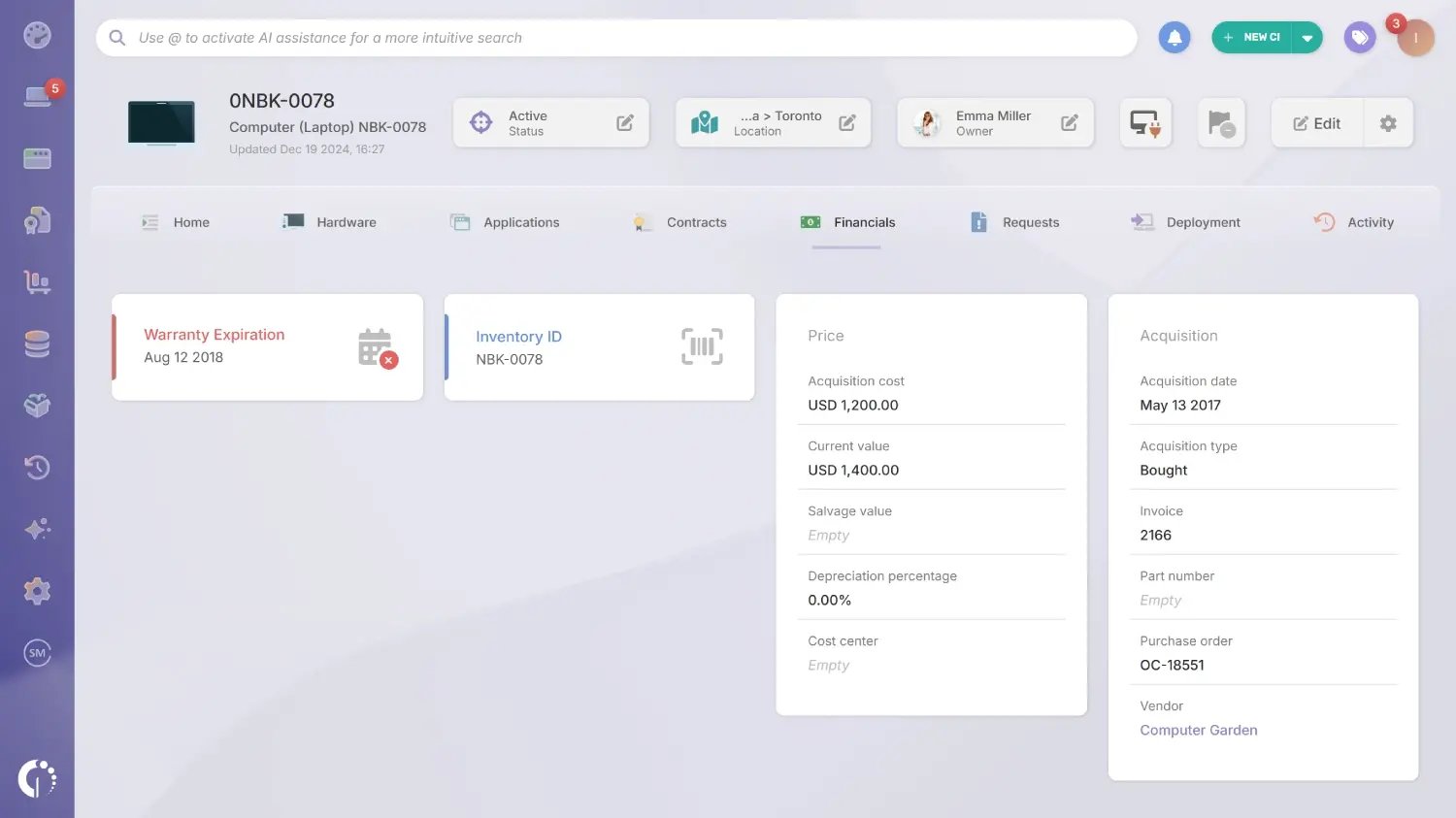
InvGate Asset Management is an IT Asset Management (ITAM) platform that discovers hardware, software, cloud assets and any other IT resource into a single inventory, with no-code automation, custom dashboards, and cloud and on-premises deployment. It covers the asset lifecycle from discovery through disposal, and warranty data lives as an attribute of the assets themselves.
Its Lenovo integration removes the step that makes bulk checking tedious, which is assembling the list. Discovery already records each machine's serial number, so the platform holds the lookup key for every Lenovo you own before anyone opens a template.
That also explains why the integration asks for less than the batch tool does. A batch query processes a spreadsheet with no other context and needs the machine type to disambiguate, while the integration queries one asset at a time, where the serial number resolves on its own.
Start by asking your Lenovo account manager for warranty API access, or your reseller if you work through one. This is the part that takes the longest, so it is worth starting before you touch any configuration.
When the request form asks for a concurrency estimate and a usage description, the answers are straightforward: the number of Lenovo devices in your inventory, and internal use to retrieve warranty and acquisition information for equipment your company owns. Lenovo returns a single token, and unlike some other manufacturers there is no separate client secret to store.
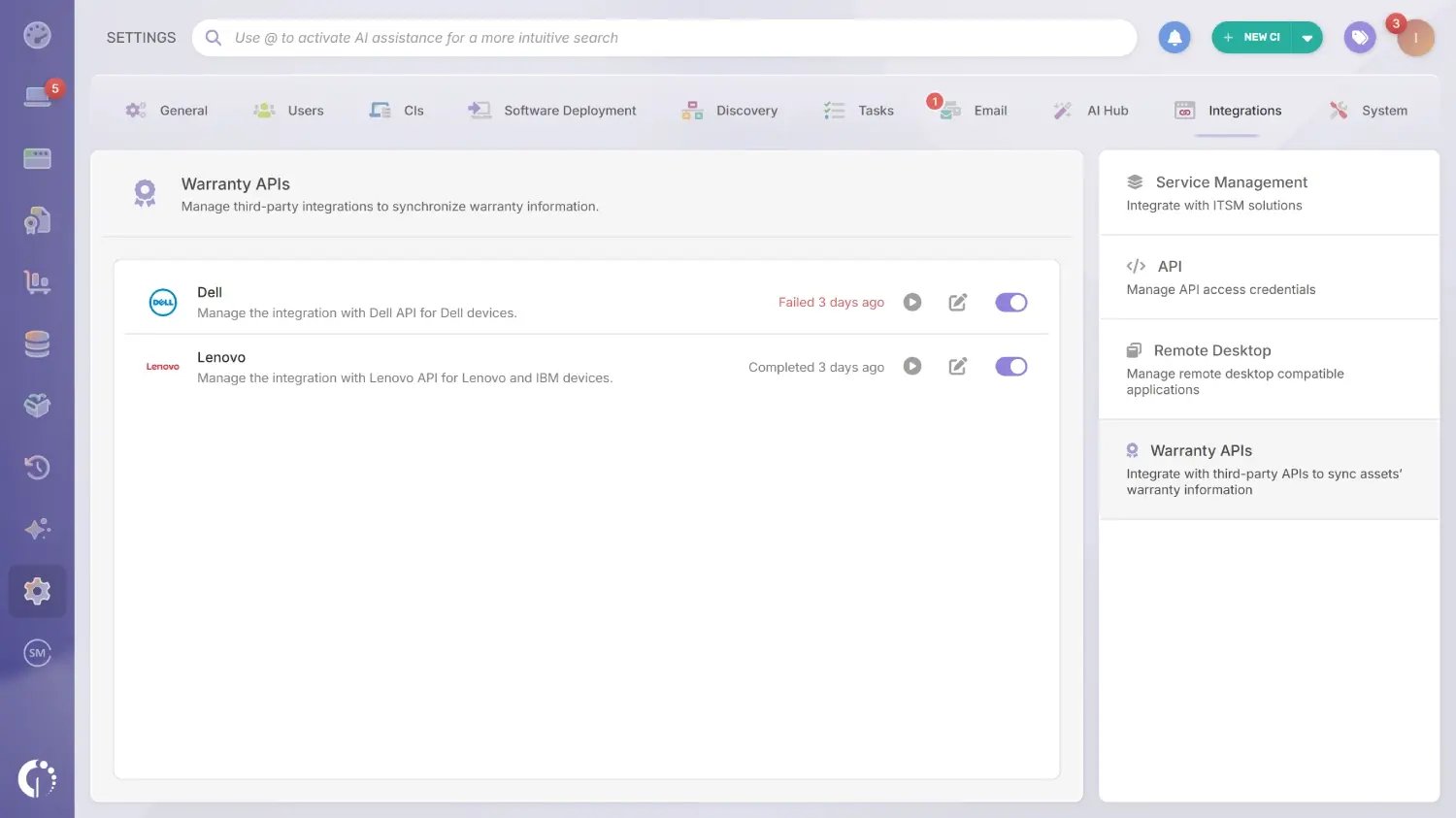 In InvGate Asset Management, go to Settings > Integrations > Warranty APIs and enable a new integration. Paste the token as the client ID, choose whether existing values should be overwritten, optionally exclude assets carrying a given tag, and click Save and run.
The configuration screen is the same one used for other manufacturers, so if you also run Dell hardware the Dell warranty check setup covers the same fields from that side. The same integration also resolves IBM-branded devices, which share Lenovo's warranty API.
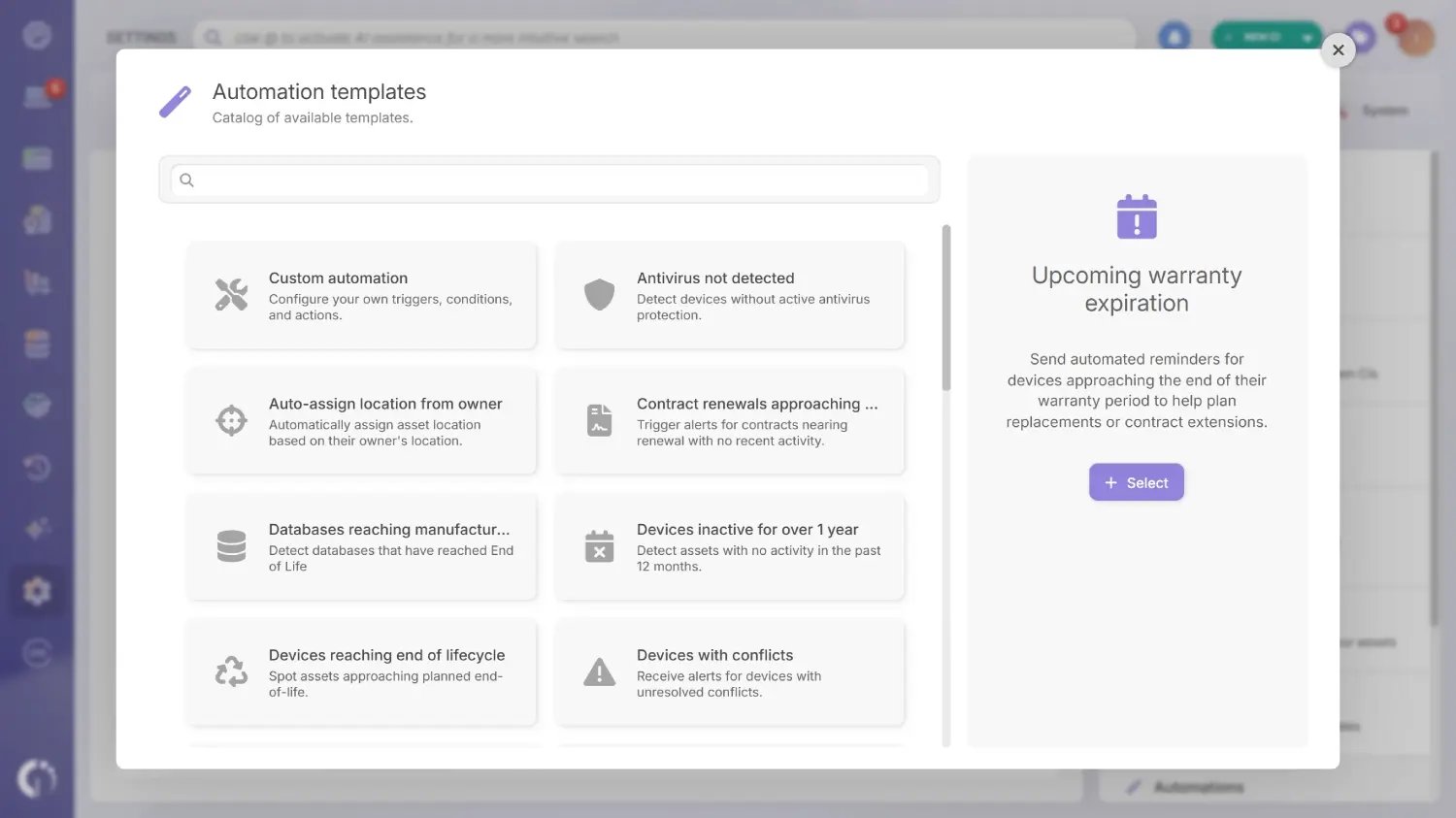 Once Acquisition Date and Warranty Expiration populate, staying ahead of expirations stops being something anyone runs and turns into a notification problem. Upcoming warranty expiration is a native automation that ships ready to use, sending reminders for devices approaching the end of their warranty period so a replacement or a contract extension gets planned ahead of the date.
You will find it under Settings > CIs > Automations, alongside the ones you build yourself. A custom automation can watch any condition you define and email a named team with the asset details and a link to the asset profile.
The automations tell you when something is about to change. Health rules evaluate warranty expiration alongside criteria such as antivirus status and pending updates, so a machine drifting out of coverage appears in the same view as everything else needing attention.
InvGate Asset Management's Smart Tags handle the grouping, applying themselves to any asset matching a rule you define, such as Lenovo machines whose coverage ends inside the next ninety days. Dashboards and scheduled reports turn those groups into something you can hand to whoever approves the hardware budget.
A Lenovo warranty check is straightforward for one machine and gets interesting at scale. Lenovo does more than most manufacturers to help, with a batch tool that handles a thousand serial numbers at a time, and that tool answers the question well for the day you run it.
What it cannot do is keep answering. Once the serial numbers live in your inventory and something resolves them against Lenovo on a schedule, warranty status becomes a field you read rather than a task you remember. You can set that up against your own fleet with a 30-day free trial, or talk to Sales about what it looks like at your device count.
These are the questions that come up most often when teams start checking Lenovo warranties across a fleet. Each answer assumes business hardware rather than consumer models.
On the label on the bottom cover, usually alongside the machine type. You can also read it without handling the machine by opening Lenovo Vantage, or by running Get-CimInstance -ClassName Win32_BIOS | Select-Object SerialNumber in PowerShell.
The serial number identifies one specific unit, while the machine type identifies the product line and configuration that unit belongs to. Lenovo's single warranty lookup accepts the serial number alone, but its batch tool requires both on every row.
Yes. Lenovo publishes a batch warranty lookup that accepts up to 1,000 serial numbers per query using a downloadable template, and lets you export the results. For anything that needs to feed another system continuously, warranty API access is requested through a Lenovo account manager or reseller.
Because Lenovo starts the base warranty when the retailer, business partner or reseller buys the shipment from Lenovo. On hardware bought through a reseller those dates can be weeks or months apart, and corrections go through a warranty support request to Lenovo's Warranty & Registration team.
Most often the machine type and serial number combination does not match a record on Lenovo's side. Checking the serial number on its own through the single lookup page tells you whether the unit is known to Lenovo at all, which separates a bad row in your list from a device with no coverage record.

