











A Dell warranty check starts with one piece of information: the Service Tag, the seven-character code Dell uses as a machine's identity. Find that code and the rest is a lookup, which is easy for one laptop and slow for the four hundred sitting in your inventory.
This article covers the whole path: where to find the Service Tag, how to read what Dell sends back, how to check hundreds of machines instead of one, and how to keep the answer from going stale a month later. It also covers two things Dell's dates do not tell you outright.

Every Dell warranty lookup needs the same input. The Service Tag is a seven-character alphanumeric code assigned to each machine at the factory, and it is what Dell uses to find the support entitlements attached to that specific unit.
You will also see the Express Service Code alongside it. Dell describes it as a numeric conversion of the Service Tag, so it carries no information the Service Tag does not already have.
On a laptop, the Service Tag sits on the bottom cover, either printed on a label or etched directly into the case. On desktops and servers it moves around by form factor, and Dell documents the location for each product line.
Two options avoid turning the machine over. Restarting and pressing F2 to enter the basic input/output system (BIOS) setup shows the Service Tag under System Information, and the Dell SupportAssist application displays it on its main screen if the machine already has it installed.
Reading the Service Tag from the operating system is faster than handling hardware, and it is the only approach that scales past a handful of machines. On a Dell, the Service Tag is what the BIOS reports as the serial number, so any command that reads the system serial number returns it.
The command most guides still publish no longer works. Microsoft disabled WMIC by default in Windows 11 versions 23H2 and 24H2 and removed it from supported versions in 2026, so wmic bios get serialnumber fails on current builds. Dell's laptop Service Tag guide documents Get-WmiObject win32_bios | Select-Object SerialNumber for PowerShell, and the Windows line below reads the same class with Get-CimInstance, the replacement Microsoft points to, while the Linux and ChromeOS lines come straight from that guide:
Get-CimInstance -ClassName Win32_BIOS | Select-Object SerialNumbersudo dmidecode -s system-serial-numberWith the code in hand, Dell's support services page returns the warranty status. It accepts the Service Tag, the Express Service Code, or an EMC Product ID for enterprise storage and networking hardware, and it can also detect the machine you are browsing from.
The page returns coverage status, expiration, and the renewal or upgrade options available for that unit. It handles one identifier at a time, which is the constraint that makes the rest of this article necessary.
Dell does not attach one warranty to a machine. It attaches a list of entitlements, where an entitlement is a single purchased line of service with its own start date, end date and service level.
A typical business laptop carries several at once: the hardware support it shipped with, any extension bought afterward, and any add-on such as accidental damage coverage. Each of those arrives as a separate record, which is why the question "when does this warranty expire" has more than one defensible answer.
Every entitlement carries a start date, an end date, and a service level expressed as both a short code and a description. A description reading NBD ONSITE means next business day onsite service, and that string is what distinguishes one line of coverage from another.
The service level is the part that matters operationally, because it sets what actually happens when a machine fails. In Dell's ProSupport Plus for PCs service description, onsite response runs from four hours through same business day and next business day, plus a separate arrangement for locations outside the contiguous United States (OCONUS) where arrival depends on the customer's location and parts availability.
Standard hardware support covers defects. Dell's Basic Hardware Service description excludes cosmetic repairs, data recovery, third-party products in versions the manufacturer no longer supports, installation work, and repairs needed because of improper treatment or use.
Accidental damage coverage comes from an add-on or from a higher tier such as ProSupport Plus, which includes it, and each one purchased shows up as its own entitlement. An accidental damage entitlement sitting next to a hardware support entitlement means the machine has both, on whatever dates each was sold.
Because a machine holds several entitlements with different end dates, picking a single expiration date is a decision rather than a lookup. Taking the furthest end date across all of them is the simplest rule and the most generous one.
It is also the one that can mislead. An add-on that outlives the hardware support entitlement will keep the machine looking covered after the coverage that pays for repairs has already lapsed, so the service level fields are what let you separate a repair entitlement from everything else before you decide which date to trust.
Dell's lookup page has no field for a list, so it handles one Service Tag at a time. Checking several hundred at once runs through a command line tool and an API (application programming interface).
Every one of those tools needs the same thing first, which is the list of Service Tags itself. Collecting the codes is the real work; querying Dell with them is the easy part.
If you already run an inventory that discovers hardware, the Service Tags are in it, filed as serial numbers. Exporting the serial number column for every Dell in the IT inventory gives you the input list without touching a single device.
Without an inventory, the fallback is running the PowerShell command above across the fleet through your management tool of choice and collecting the output. That works, though it only reaches machines that are powered on and reachable at the moment the script runs.
Dell publishes a command line tool for exactly this job. Dell Command | Warranty reads a list of Service Tags from a CSV (comma-separated values) file or straight from a Configuration Manager database, queries Dell, and writes the results back out as a CSV.
It also filters on the way out, so you can ask it for the machines whose coverage is active, expired, or expiring within thirty days. Dell's documentation covers the syntax and the Configuration Manager requirements, and the user guide notes that any invalid tags in the input file land in a separate error output file, which makes it a reasonable way to find the bad serial numbers in your own records.
For anything that needs to feed another system, Dell exposes a warranty API through TechDirect. You register with a Dell business account, request a key against the Warranty API, and query entitlements programmatically.
The Warranty Management API accepts up to 100 Service Tags per request, so a fleet of a thousand machines takes ten calls. Either route returns a snapshot of the fleet on the day the query runs.
A warranty check is a snapshot, and snapshots decay. New machines arrive with no coverage data recorded, extensions get purchased and never written down, and the spreadsheet from last quarter quietly stops matching reality.
There is a second problem underneath that one, and it catches teams who did everything right. The dates only help when the machine is registered to your company, and that registration is automatic only for hardware bought directly from Dell.
Dell's Basic Hardware Service description says the service term starts on the date listed on the invoice. When the machine came through a distributor or a retailer, the first thing to check is that it is registered to your company: products bought directly from Dell are registered automatically, and Dell recommends registering the ones bought at a retail point of sale to ensure access to warranty support.
If the distributor did not report your company as the end user at the time of sale, the route is an ownership and warranty transfer, which Dell's ownership transfer and product registration guide describes, and Dell may ask for proof of purchase to process it. Renewals follow similar lines, since Dell notes that they are not available in every country and that a reseller partner may need to handle them.
Running a bulk check once tells you where the fleet stands today and nothing about next quarter. The version of this that holds up is a scheduled sync into the inventory, so coverage becomes an attribute of each asset that refreshes on its own rather than a report someone remembers to rebuild.
That also puts warranty data next to everything else you know about the machine, which is what makes it usable for Warranty Management decisions such as whether to extend coverage or replace the unit. The same logic applies to every other manufacturer you own, so the warranty check process for Lenovo and other vendors belongs in the same place.
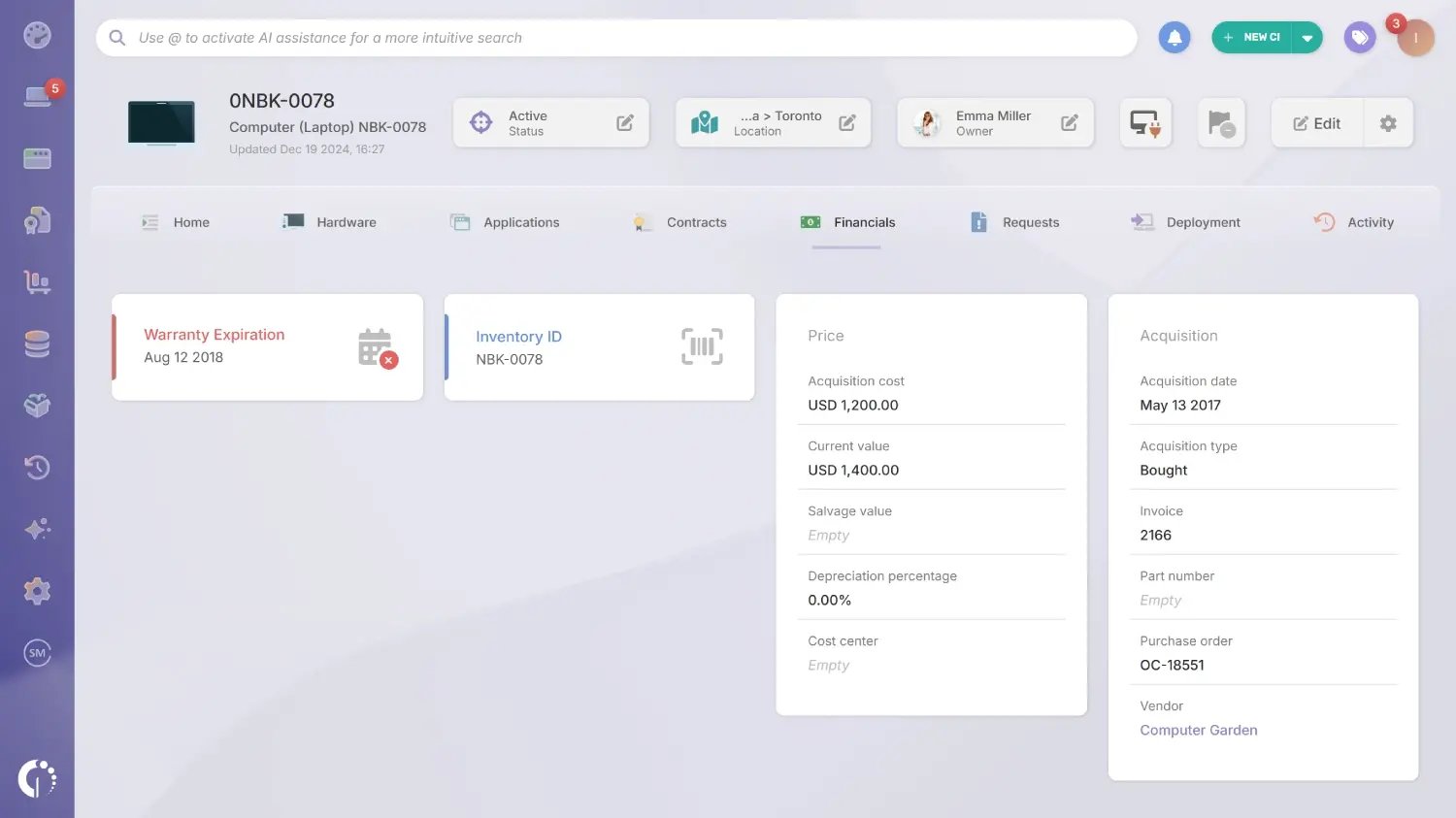
InvGate Asset Management is an IT Asset Management (ITAM) platform that discovers hardware, software, cloud assets, and any other IT resource and keeps them in a single inventory, with no-code automation, custom dashboards, and cloud and on-premises deployment. It covers the asset lifecycle from discovery through disposal, and warranty data lives as an attribute of the assets themselves.
Its Dell integration turns the warranty check into something nobody has to run. Discovery already collects each machine's serial number, which on a Dell is the Service Tag, so the platform holds the lookup key for the entire fleet before anyone asks a question about coverage.
What the integration adds is the resolution step: it sends those Service Tags to Dell on a schedule and writes the acquisition date and warranty expiration back onto each asset profile. The three sections below cover how to set it up and what changes once it runs.
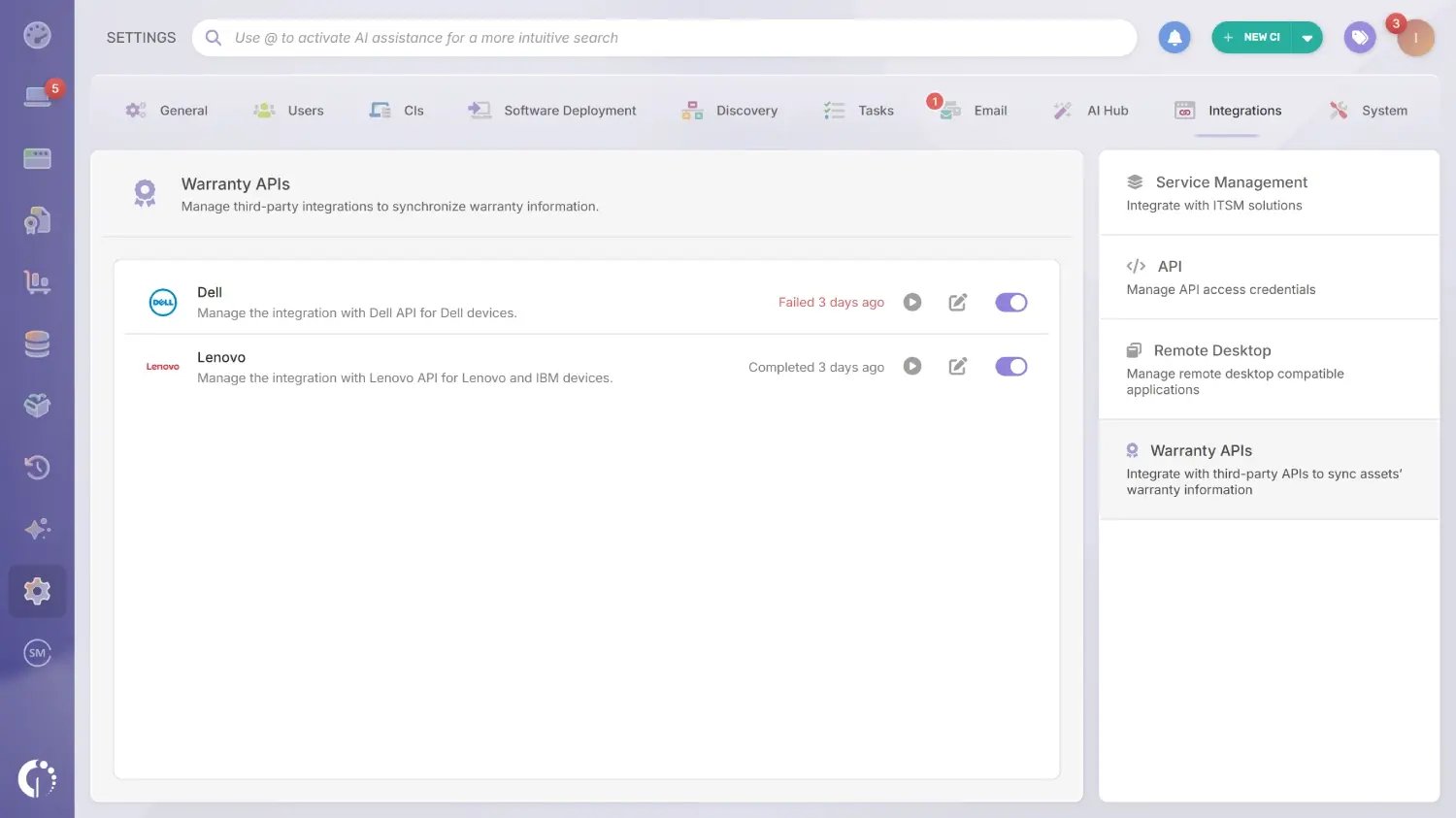 The integration needs a Dell API key, requested from TechDirect with a Dell business account. In the APIs section you request a new key, associate it with the Warranty API on the Project tab, declare internal company use, and select support for REST and SOAP on the Resources tab.
Once Dell generates the key, the Manage API keys section shows the two values you need, and this is where most setups stall: the Client ID is the value in the "API Key" field, and the Client Secret Key is the value in parentheses immediately to its right. In InvGate Asset Management, go to Settings > Integrations > Warranty APIs, enable a new integration, paste both values, and click Save and run.
Acquisition Date and Warranty Expiration populate on every Dell asset profile that returned a match, and those two fields also become visible in the explorers and available during CSV import. Assets that arrive later with those fields empty get filled on the next synchronization run.
Two behaviors are worth knowing before the first run. Synced fields are no longer editable by hand, and the way around that is to add the asset to a tag and exclude that tag from the synchronization; and a CSV update will not overwrite data that came from the integration. The configuration screen also carries an "Overwrite current information" option that decides whether Dell's values replace what is already stored, which matters if your team entered dates manually first.
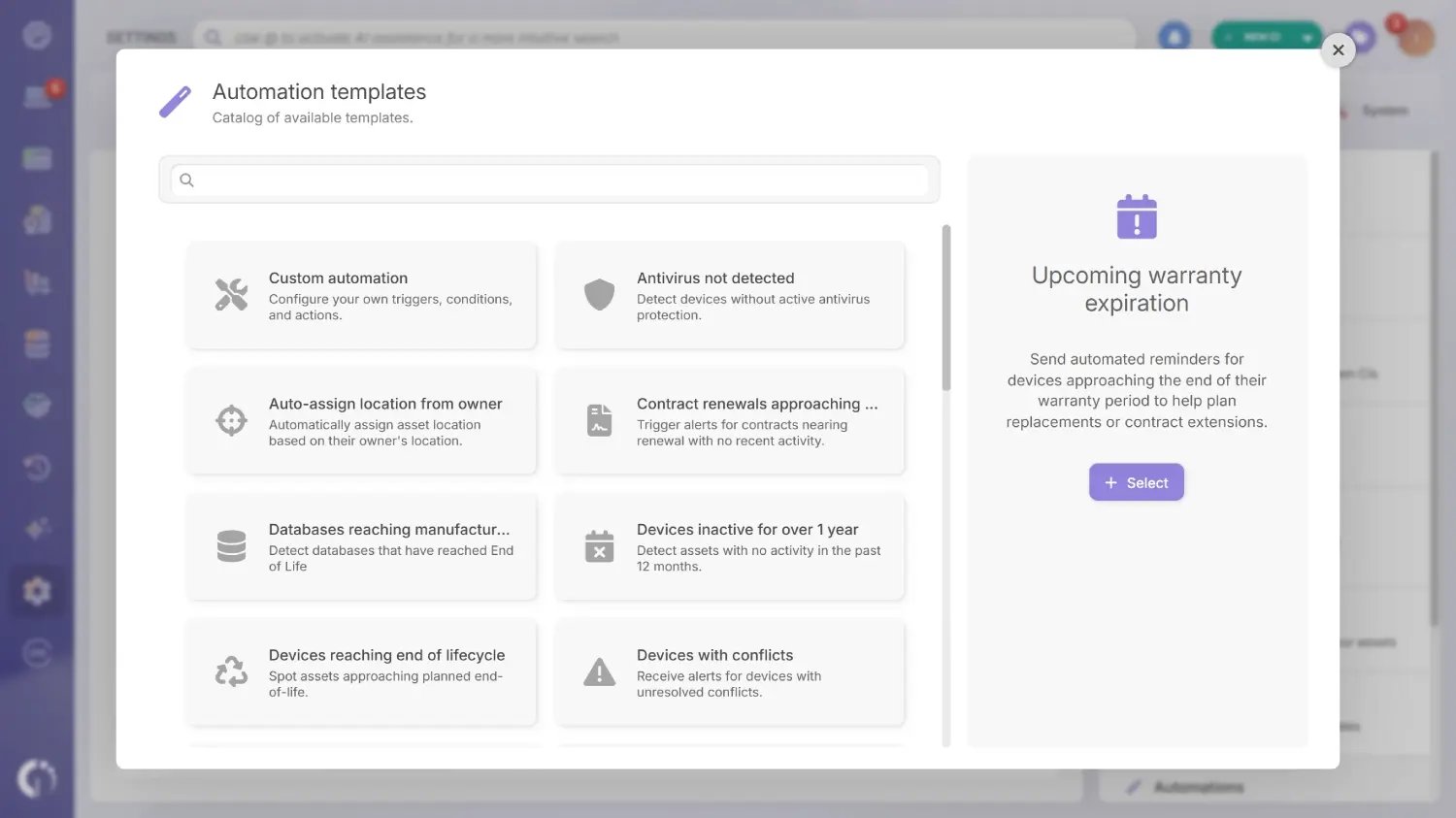 Once the dates sit on the assets themselves, staying ahead of expirations stops being a lookup task and turns into a notification problem. Upcoming warranty expiration is a native automation that ships ready to use, sending reminders for devices approaching the end of their warranty period so a replacement or a contract extension gets planned ahead of the date.
It lives under Settings > CIs > Automations, which is also where you build your own. Custom automations cover any other condition worth watching and email a named team with the asset details and a link to the asset profile.
Alerts cover the dates that are about to move. Health rules evaluate warranty expiration alongside criteria like antivirus status and pending updates, so a machine drifting out of coverage shows up in the same health view as everything else that needs attention.
Smart Tags handle the grouping, applying themselves to any asset matching a rule you define, such as Dell machines whose coverage ends inside the next ninety days. Dashboards and scheduled reports turn those groups into something you can hand to whoever approves the hardware budget, broken down by location, asset type or expiration quarter.
A Dell warranty check is a two-step job: get the Service Tag, then ask Dell what is attached to it. The part that trips teams up is scale, because the manual page handles one machine while the fleet has hundreds, and the part that trips them up twice is that the answer expires.
Both problems have the same fix. Once the Service Tags live in your inventory and something resolves them against Dell on a schedule, warranty status becomes a field you read rather than a task you run. You can set that up against your own Dell fleet with a 30-day free trial, or talk to Sales about what it looks like at your device count.
These are the questions that come up most often when teams start checking Dell warranties at scale. Each answer assumes you are working with business hardware rather than consumer models.
On the bottom cover, printed on a label or etched into the case. You can also read it without handling the machine by entering the BIOS setup with F2 and looking under System Information, by opening Dell SupportAssist, or by running Get-CimInstance -ClassName Win32_BIOS | Select-Object SerialNumber in PowerShell.
For practical purposes, yes. Dell labels the machine with a Service Tag rather than a serial number, but the BIOS reports that same string in the serial number field, which is why serial-number-based inventory tools and scripts return it.
Not on Dell's public lookup page, which handles one identifier at a time. Dell Command | Warranty reads a list from a CSV file, and the TechDirect Warranty Management API accepts up to 100 Service Tags per request.
Dell starts the service term on the invoice date, and on a purchase made through a distributor or retailer the first check is that the machine is registered to your company. If the distributor did not report your company as the end user, Dell handles it through an ownership and warranty transfer.
An entitlement is one purchased line of service, with its own start date, end date and service level. Hardware support covers defects, and Dell's Basic Hardware Service excludes cosmetic repairs, data recovery and unsupported third-party products. Accidental damage coverage comes from an add-on or a higher tier such as ProSupport Plus, and each one shows up as a separate entitlement on the same machine.

