









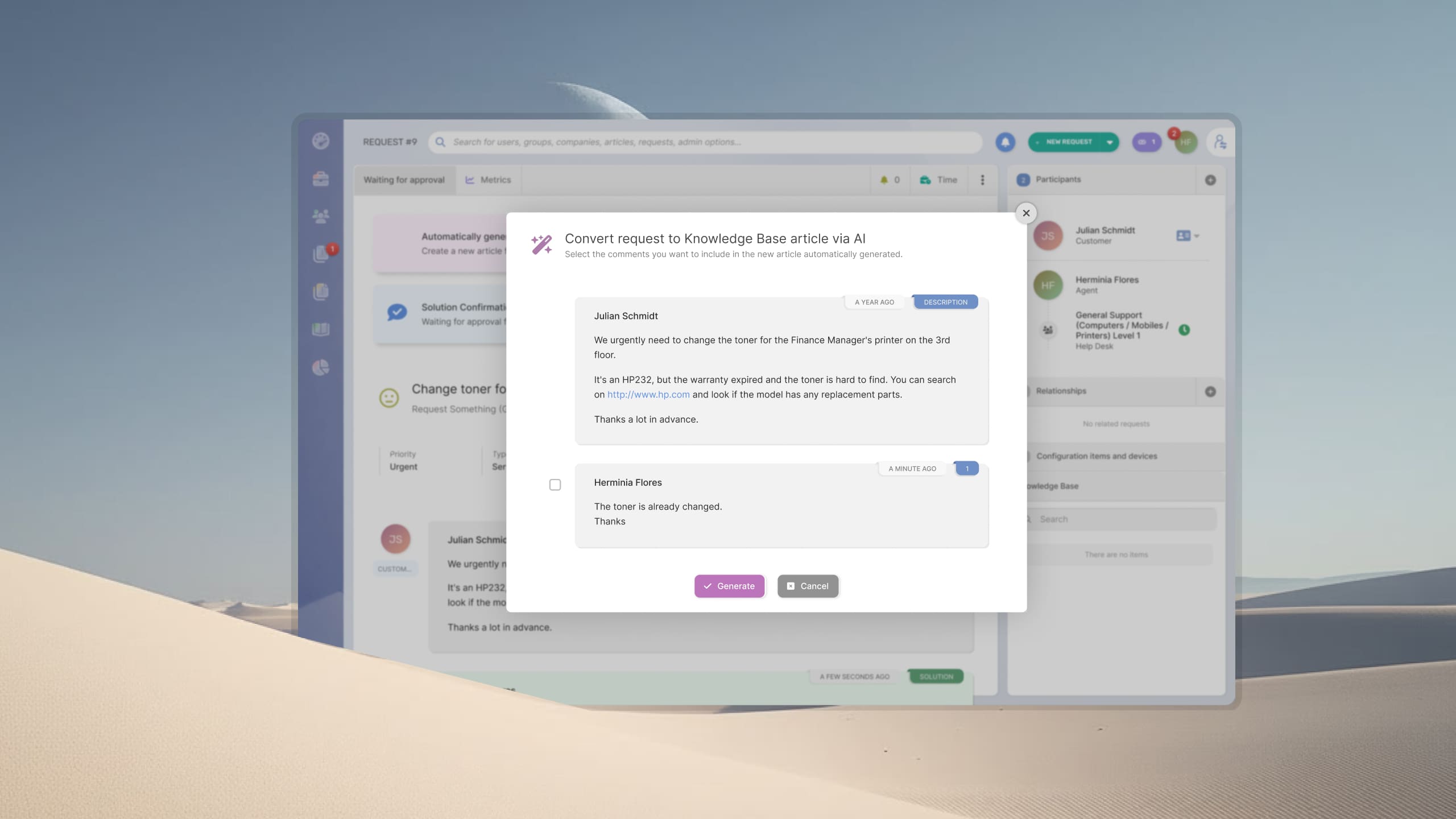

A knowledge base is only as useful as it is current, and keeping it current has always been the hard part. Knowledge stays trapped inside resolved tickets, documentation falls behind every new service, and the people who could write articles rarely have the time.
Artificial intelligence changes the economics of that work. Instead of treating Knowledge Management as a publishing project that depends on discipline and spare hours, AI lets you capture, structure, and deliver knowledge from the work your team already does
This guide walks through how AI supports each stage of the knowledge lifecycle, and then shows how those stages map to real capabilities in InvGate Service Management: generating articles from tickets, surfacing knowledge with Knowledge Discovery, delivering answers through a conversational experience, and measuring the results.
AI in Knowledge Management is the use of generative AI, natural language processing, and predictive analytics to help create, organize, surface, deliver, and improve organizational knowledge.
The difference today isn't simply that AI can write an article. People can already open a general-purpose LLM and ask it to summarize documentation or answer a question. The bigger opportunity is to connect AI to the knowledge and operational context your organization already manages, so people can create and access knowledge within the same system they use for their work.
That means AI can turn resolved work into reusable knowledge, find relevant information across existing content, interpret questions in natural language, recommend solutions to agents, and answer employees through self-service. Knowledge becomes part of the service workflow rather than a separate destination people have to maintain or consult.
AI can support Knowledge Management at four points. Thinking in these four stages makes it easier to see where AI adds value and where an integrated platform matters.
The four stages work as a loop. A tool that only generates articles addresses one part of Knowledge Management. An integrated approach connects creation with the knowledge already in your operations, delivers it where work happens, and uses real usage data to improve what comes next.
The benefits follow from that loop: less manual documentation work, faster access to answers, AI ticket deflection, and knowledge that can keep pace with changing services.
AI also introduces new requirements. The quality of its output depends on the knowledge it can access, so incomplete or outdated information can lead to poor answers. Governance matters when AI-generated or AI-surfaced knowledge reaches end-users, and human review remains important for deciding what should become trusted organizational knowledge.
A strong Knowledge Management approach therefore isn't about handing the job to AI. It's about connecting AI to the right knowledge, workflows, people, and feedback so that knowledge can be created, used, and improved as part of everyday service operations.
InvGate Service Management covers the full lifecycle through the AI Hub, a set of purpose-built capabilities embedded directly in the platform. Each one is scoped to a specific job, runs inside your existing workflows, and is auditable by default. You can turn them on from Settings > AI Hub, and the AI Hub is available across InvGate Service Management plans for both cloud and on-premise customers.
Here is how the create, surface, deliver, and measure stages map to the product.
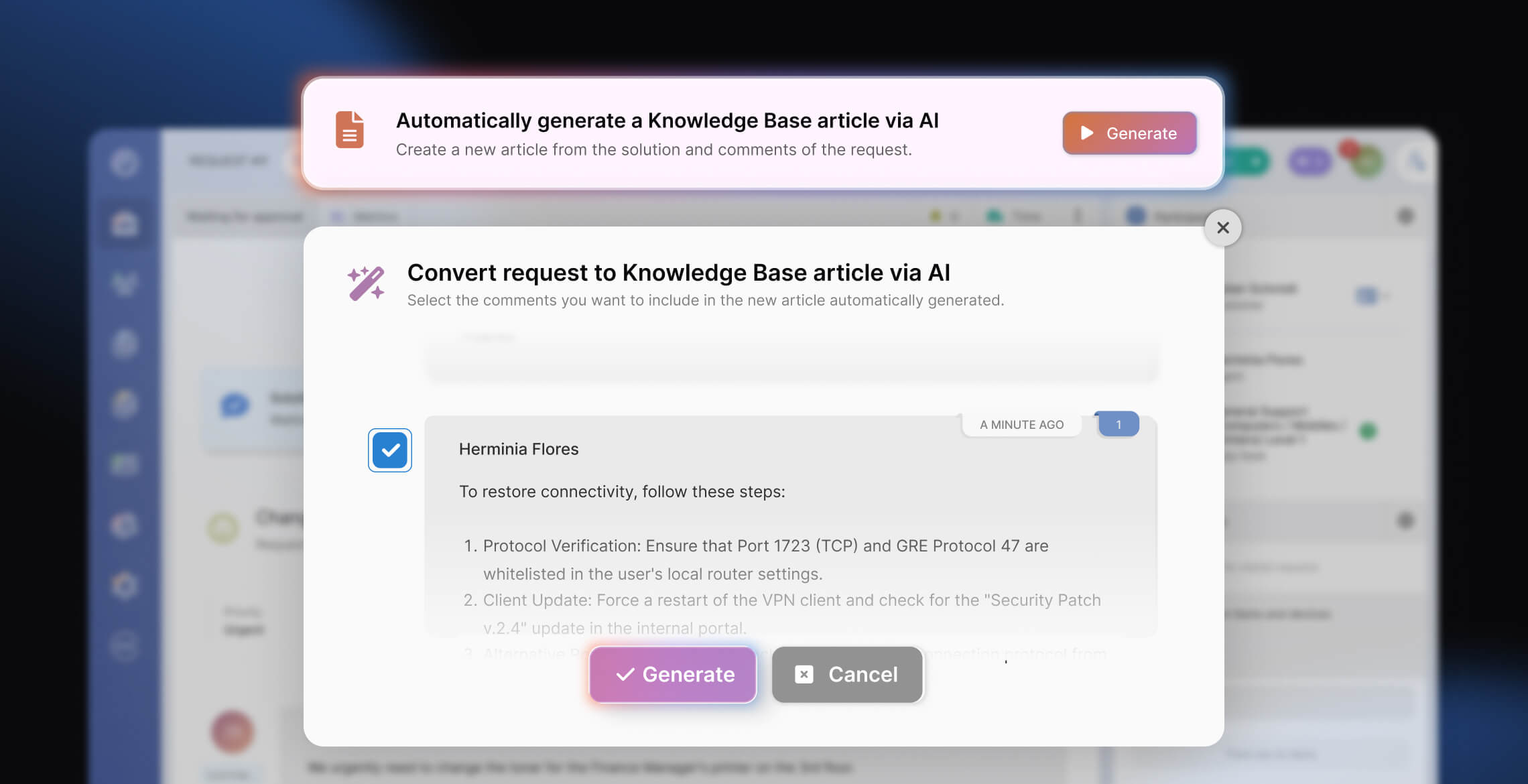
This is where most teams start, because it captures knowledge at the exact moment it is freshest: right after an issue is solved.
AI Knowledge Creation turns a resolved ticket into a first article draft in under 30 seconds*, so agents review and refine content instead of writing it from scratch. The flow looks like this:
Because the draft is created for you, the first step gets easier and articles actually get written. Every draft passes through human review before publishing, so people stay in control of what enters the knowledge base and, ultimately, what your AI features draw on.
Creating knowledge in InvGate Service Management is not limited to a single write-and-publish flow. You can also author articles from scratch in the editor when documenting a new process, service, or known issue, structuring content with clear sections and connecting it to your service catalog so the right article reaches the right requests.
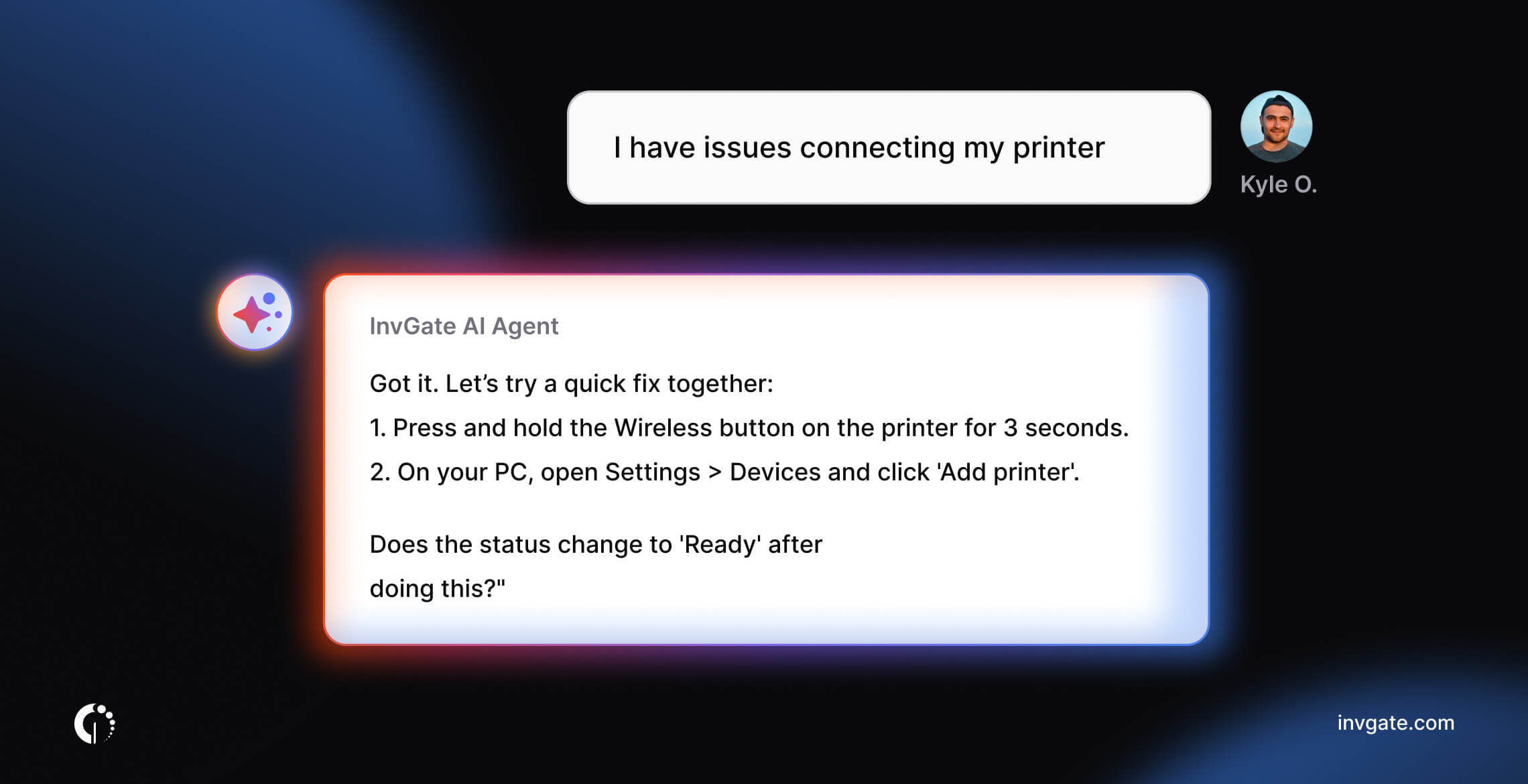
Creating knowledge is only half the job. It has to reach people at the moment they need it, in a format they will actually use.
The Virtual Service Agent (VSA) is the front door of your service desk. It lives in Microsoft Teams, WhatsApp, Slack, and your self-service portal, understands requests in natural language, and resolves common issues on the spot, so employees get help without opening a ticket.
Its answers draw on both your knowledge base and the knowledge InvGate Service Management mines from resolved tickets, so the guidance that closes real cases reaches end-users directly. When it can provide contextual knowledge article summaries, users get exactly what they need to solve the issue themselves, which lifts ticket deflection.
In internal testing, contextual summaries decreased tickets submitted through the chat by 15% and increased chatbot adoption by 40%*. When self-service is not enough, the VSA routes the request to an agent with full context, and users can create requests, check request details, comment on existing ones, accept or reject approvals, and more.
Agents get a conversational layer of their own. Solution Recommendation analyzes a ticket's content and context, then draws on knowledge articles, similar past tickets, and, if authorized, open knowledge from the internet to assemble a ready-to-use solution inside the ticket. That shortens first-response times and frees agents to focus on the complex cases.

A published knowledge base captures what someone had time to write down. Most of your organization's real expertise lives somewhere else: inside the tickets your team resolves every day. Knowledge Discovery is how InvGate Service Management reaches that expertise.
It analyzes the last three months of closed tickets and identifies recurring resolution patterns that are not already documented in your knowledge base. From those patterns it builds Snippets: short, reusable pieces of knowledge, each capturing how a specific type of issue was solved. Your ticket history becomes a usable knowledge source, with no one writing a single article from scratch.
Here is the part worth being precise about. Snippets form a knowledge corpus that sits alongside your knowledge base, not a replacement for it. Your formal articles stay exactly as they are. Knowledge Discovery adds a second, always-growing layer built from operational reality, and it even reveals where formal articles add value and where existing patterns already cover the need.
Governance is built in through a human-in-the-loop model. Nothing goes live on its own: administrators review, edit, accept, or reject each Snippet, and visibility works in levels.
Adopting a new platform does not mean leaving your existing documentation behind. If you already maintain a knowledge base in another tool, you can bring that content into InvGate Service Management.
You have two paths. The first is migrating your existing articles through the InvGate Service Management API, which moves the content you have already written into your new instance. The second is recreating articles directly in the editor, which is a good moment to review, consolidate, and refresh older material as you go. Many teams combine both: migrate the articles worth keeping, and rebuild the ones that were overdue for an update.
Before you import, configure your knowledge base by creating a few categories so incoming content lands in a clear structure and connects to the right services.
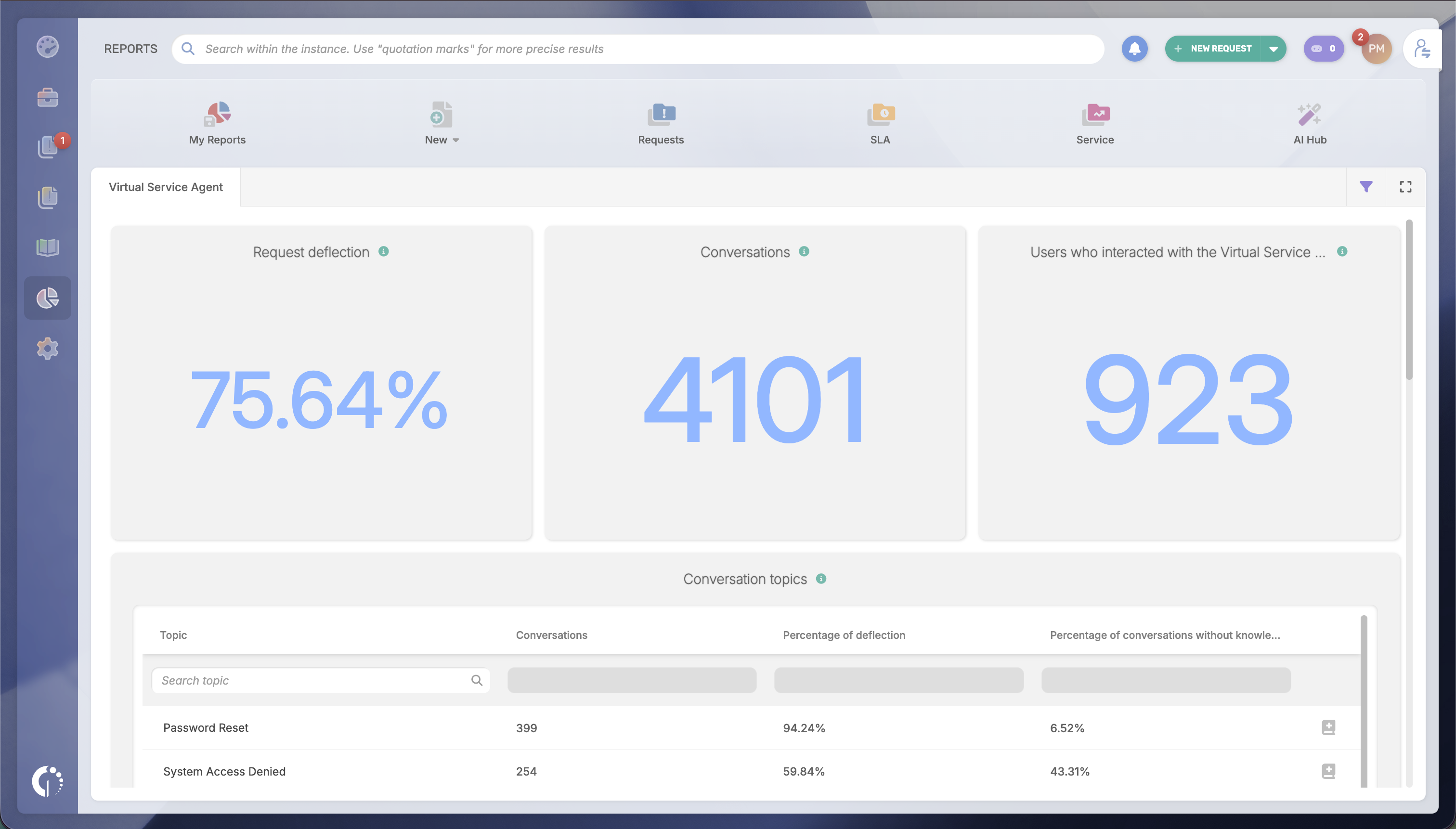
Knowledge Management is not a one-time cleanup. Services change, new questions appear, and content ages, so the final stage is measuring how your knowledge performs and feeding that back into creation.
AI Hub Reports brings those signals together. It analyzes your Virtual Service Agent's conversation history and surfaces unanswered questions, low-confidence responses, and escalation trends, organized by topic and category, so you can see where the VSA struggles without reviewing conversations one by one. It also tracks metrics like deflection rate and knowledge article usage over time.
Those insights are exactly how you find and fix knowledge gaps in your IT virtual agent: each cluster of unresolved questions points to a documentation gap, which becomes the next article to create or the next category to open up for Knowledge Discovery. Create, surface, deliver, measure, and back to create. That is the loop that keeps a knowledge base accurate as an organization grows.
AI turns Knowledge Management from a maintenance burden into a continuous system. In InvGate Service Management, that system spans the full lifecycle: AI Knowledge Creation drafts articles from resolved tickets, Knowledge Discovery surfaces reusable Snippets from your operational history, the Virtual Service Agent and Solution Recommendation deliver answers to end-users and agents, the API brings your existing content along, and AI Hub Reports measures what is working and what needs attention.
The pieces reinforce each other. Better creation feeds better delivery, delivery generates the data you measure, and measurement points back to what to create next. To turn it on, head to Settings > AI Hub in your instance.
Don't have InvGate Service Management yet? Grab a 30-day free trial and see the full Knowledge Management system in your own environment.


