Database governance is the set of practices that keeps every database an organization runs accounted for: which engines and versions are in use, who owns each instance, what depends on it, and whether it still meets security and compliance requirements. IT managers, Database Administrators (DBAs), and IT asset managers usually turn to it when a database version is about to lose vendor support, or when an auditor asks for a complete list of the instances in scope.
This article covers what database governance means in practice, why the 2026 support deadlines for SQL Server 2016 and PostgreSQL 14 make it urgent, and how Database Lifecycle Management and database discovery fit into the picture. It also lists what a database compliance audit expects a team to produce and how InvGate Asset Management supports each step.
What database governance means
Database governance covers the practices that keep a database estate under control: knowing which engines and versions are running, who owns each instance, what depends on it, and whether changes to it are documented. It sits inside the broader discipline of IT Asset Management (ITAM), and applied to databases it also goes by the name Database Asset Management: the same practice used for servers and laptops, extended to the engines that store an organization's data.
Many organizations already run IT Asset Management software to track laptops, servers, and network gear, while databases stay a topic for the DBA team alone. Database governance brings them into the same process, with the same owners, lifecycle tracking, and evidence as every other asset.
Database governance and data governance
Database governance is often confused with data governance, a related discipline with a different focus. Data governance deals with the content of the data itself: its quality, its classification, and the privacy rules around it.
Database governance deals with the infrastructure layer underneath: which database engines exist, what version each one runs, and who is responsible for them. The two complement each other, since every data governance policy assumes the team knows where the data actually lives.
Why database governance matters now
Unsupported database versions turn an inventory gap into a security and compliance problem. Once a version reaches End of Life (EOL), the vendor stops shipping security fixes for it, and every application that depends on that instance inherits the exposure.
In 2026, that deadline hits two widely used engines: SQL Server 2016 reached End of Support (EOS) in July, and PostgreSQL 14 reaches EOL in November. MySQL users went through the same milestone earlier, since MySQL 5.7 reached EOL in October 2023, when Oracle moved it to Sustaining Support, and MySQL 8.0 followed in April 2026, according to MySQL's EOL notices.
SQL Server 2016 reached End of Support in July 2026
Microsoft ended Extended Support for SQL Server 2016 on July 14, 2026, as its product lifecycle page shows. From that date on, the version receives security updates only through paid Extended Security Updates (ESUs), which Microsoft offers for up to three more years.
SQL Server 2016 instances often sit behind line-of-business applications that nobody wants to touch, which is how they outlive their support window. Finding every one of them, with its version and owner, is the first step to decide which to upgrade, which to cover with ESUs, and which to retire.
PostgreSQL 14 reaches End of Life in November 2026
The PostgreSQL Global Development Group supports each major version for five years, and PostgreSQL 14's final release is scheduled for November 12, 2026, according to the PostgreSQL versioning policy. After that date, the community stops publishing fixes for it, security fixes included.
Because PostgreSQL is free to deploy, it spreads easily across test environments, internal tools, and proofs of concept that later become permanent. A common pattern is an instance deployed for a project that wraps up, which keeps running in the background until a security review turns it up years later, with nobody left on the team who remembers setting it up.
Database Lifecycle Management and End-of-Life tracking
Every database goes through a lifecycle: it gets provisioned, runs in active use, goes through patches and version upgrades, and eventually gets retired or replaced. Most teams already practice Lifecycle Management for hardware, and Database Lifecycle Management applies the same logic to database engines and versions, tracking each instance on purpose from provisioning to retirement.
The hard part is scale. An organization running PostgreSQL, SQL Server, MySQL, MariaDB, and Oracle side by side has to track a separate End-of-Life and End-of-Support date for each engine and each version in use, and database EOL rarely lands on a convenient internal schedule. Cross-referencing vendor documentation instance by instance stops working past a handful of databases, so the dates that matter get missed until an audit or an incident forces the question.
Database discovery and inventory
Orphaned database instances tend to follow a predictable path. Someone spins one up to test a migration, a proof of concept turns into a dependency nobody planned for, or a developer copies production data into an environment that outlives the task it was created for.
Standard network scans built for laptops and servers often miss these instances, which can sit outside the segments those asset discovery tools typically cover. A database discovery tool looks at the environment from the host: it detects which engines run on each machine, identifies every instance, and surfaces the ones nobody remembers creating.
What a database inventory should record
A reliable database inventory captures more than a list of hostnames. At minimum, each record should include:
- Engine and version (PostgreSQL, SQL Server, MySQL, MariaDB, Oracle, and so on).
- Host server, IP address, and network location.
- Creation date and uptime.
- Technical and business owner.
- Dependencies, meaning which applications read from or write to the database.
Where the database inventory should live
Most organizations already track servers and network equipment through a Configuration Management Database (CMDB), often with dedicated CMDB tools, plus a general IT Inventory Management process for the rest of the estate. Databases belong in that same inventory.
Instances start to go unaccounted for when databases stay a separate, DBA-only exercise. Keeping them in the shared inventory means owners, lifecycle dates, and change records follow the same rules as every other asset.
Database compliance audits
A database compliance audit asks concrete questions: is this instance running a supported version, who owns it, and can the team show who approved each change. Answering from memory, spreadsheets, or a round of emails to the infrastructure team is slow, and it tends to miss exactly the instances nobody remembered.
Most of the evidence comes from regular software maintenance work, such as patching, version upgrades, and configuration changes, as long as it gets documented when it happens. For reviews such as SOC 2 (System and Organization Controls 2), HIPAA (Health Insurance Portability and Accountability Act), or ISO 27001, auditors typically expect a team to produce:
- The current engine and version of every database instance in scope.
- Confirmation that each version is still within its vendor's support window.
- A named owner for each instance, with a clear line to who can approve changes to it.
- Evidence for each change: who made it, when it took effect, and why.
- A record of which applications depend on each database, to support impact assessment before a change or migration.
How InvGate Asset Management supports database governance
InvGate Asset Management is an ITAM software that offers an enterprise experience without the complexity or the price of one, built around ease of use: an intuitive interface, a no-code approach, and fast deployment. It builds a single inventory from four sources (the Agent, network discovery, integrations, and manual or CSV import), and its database governance capabilities bring databases into that same record.
For database governance, those capabilities cover discovery, lifecycle status, connections, and change evidence, all on the asset record the team already uses for servers and endpoints. This is what each one does:
- Database discovery for PostgreSQL and SQL Server. The InvGate Asset Management Agent installed on each host detects PostgreSQL and SQL Server instances and registers each one as a Configuration Item (CI) in the Databases family, with its engine and version. Records update with the Agent's regular inventory cycle, so new instances and version changes reach the inventory without manual work. Discovery for MySQL, MariaDB, and Oracle is on the way.
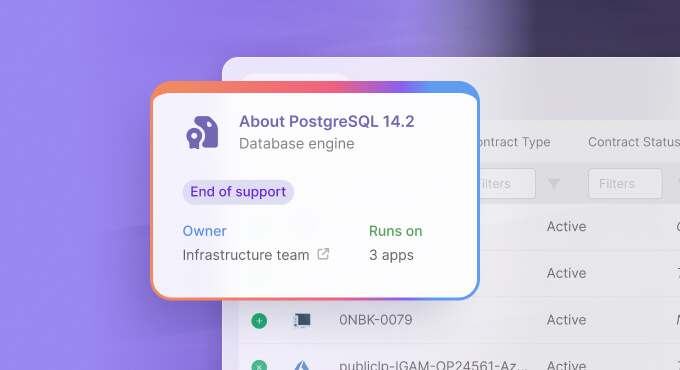
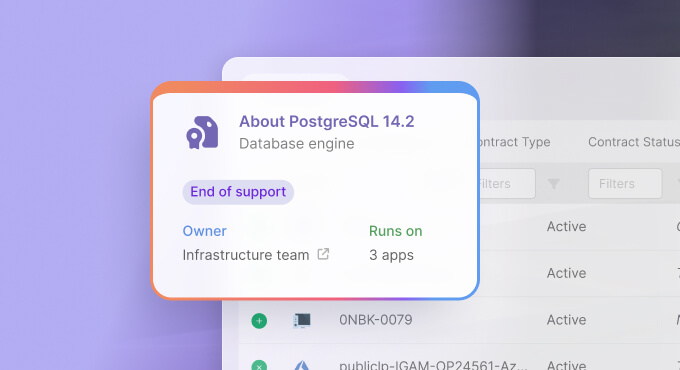
- EOL and EOS from Atlas. The Atlas AI Agent adds the End-of-Life and End-of-Support dates of each database version to the CI profile, taken from official vendor references, so an unsupported version shows up on the record itself. Coverage follows what each vendor publishes, and Atlas is available on cloud instances.
- CI connections. Each database can be linked to the server it is stored in, the applications that rely on it, and the people accountable for it, such as a Technical Owner or a Security Auditor. The Explorer can be filtered by connection, and automations can react when one changes, for example by notifying the new Technical Owner when a DBA leaves.
- Change Governance. When it is enabled, every change to a critical property of a database CI, such as its status or owner, asks for evidence before it saves: who actually made the change, when it took effect, and why. That evidence stays in the CI's history, ready for the next audit. It can be enabled from Settings > CIs > General.
- One inventory for the whole estate. Databases sit next to servers, endpoints, cloud resources, and software in the same platform, where they can be filtered and exported for an audit.
InvGate Asset Management can be deployed in the cloud or on-premises, including air-gapped environments, and database discovery works the same way in both models. The platform itself holds SOC 2 Type II and ISO 27001 certifications, which helps when an auditor also asks how the inventory is protected.
Conclusion
Database governance is what IT Asset Management looks like when it is applied to database infrastructure: knowing what is running, tracking its lifecycle and End-of-Life status, keeping an accurate inventory, and producing evidence of who changed what and why. With SQL Server 2016 already past End of Support and PostgreSQL 14 close behind, that practice decides whether a support deadline becomes a planned upgrade or an audit finding.
Treating databases this way turns compliance audits and lifecycle planning into routine checks. To get every database in your estate discovered, tracked, and accounted for, start a free trial of InvGate Asset Management or talk to Sales to see how it fits your environment.
Frequently Asked Questions
What is database governance?
Database governance is the set of practices that keep track of every database an organization runs, including its engine, version, owner, dependencies, and lifecycle status. It sits within the broader discipline of ITAM and focuses on the infrastructure layer, while data governance covers the content, quality, and privacy rules of the data itself.
Which database versions lose vendor support in 2026?
SQL Server 2016 reached End of Support on July 14, 2026, with paid Extended Security Updates available for up to three more years. MySQL 8.0 reached End of Life in April 2026, and PostgreSQL 14 reaches End of Life on November 12, 2026.
What does the MySQL 5.7 End of Life mean for organizations still running it?
MySQL 5.7 reached End of Life in October 2023, when Oracle moved it to Sustaining Support, so it no longer receives new fixes from the vendor. Organizations still running it operate without patches for newly discovered vulnerabilities, a security and compliance risk until each instance is upgraded to a supported release or decommissioned.
How do you inventory the databases across an organization?
An accurate database inventory records the engine and version, host and network location, creation date, owner, and dependencies of every instance. Building it usually requires a discovery process that detects database engines on each host, since database instances often sit outside the segments that standard network scans cover.