AI is moving into IT operations faster than most teams can govern it, and Gartner made that tension the center of its IT Symposium/Xpo 2026 keynote. Below, we go through the keynote's main recommendations and how each one maps to what we shipped at ENVISION'26 for InvGate Service Management and InvGate Asset Management.
Gartner's value-risk flywheel: AI risk is compounding faster than AI value
On October 19, Gartner opened IT Symposium/Xpo 2026 in Orlando with its keynote "Reaching Escape Velocity: Shaping an Effective Enterprise AI Economy" and a blunt diagnosis for CIOs: "Your need to build AI value is strong, but your ability to govern the risk is weak." Gartner says 86% of CIOs see risk growing faster than value. Only 21% have agentic AI governance today, yet 71% will deploy agentic AI within 12 months.
That risk compounds. Gartner's example was an AI customer service agent that bad actors tricked into issuing refunds. They showed other customers the trick, and the agent paid out $1.2 million over 340 transactions. Each risk built on the one before it.
Gartner's value-risk flywheel puts value and risk on two wheels spinning around each other. The goal is a flywheel where value compounds faster than risk, which makes where and how you apply AI the decision that matters most. Most of the keynote's advice matches the principles behind what we announced at ENVISION'26, our user conference in Buenos Aires last month.
Never strap a jet engine to a horse
Gartner said only 31% of executives redesign anything. Everyone else automates the process they already have: "It's the AI equivalent of putting a jet engine on a horse. It's still a horse." The keynote closed on the same warning: "Never strap a jet engine to your horse."
We call this the operational maturity prerequisite. AI multiplies what it finds, so fragmented data and undocumented processes come out the other side as the same chaos at larger scale. Ariel Gesto, InvGate's CEO, opened ENVISION'26 on that idea: "AI multiplies what it finds: order or chaos."
You can't redesign a process nobody understands, so we started by making the current one readable. The Workflow Assistant explains an existing workflow in plain language and shows six months of execution data, including the stage where most ticket time goes. The data AI runs on gets the same treatment. Physical audits check the asset record against the real world with phone or RFID scanning, and the Product Catalog ties each service request to a specific unit in stock, so the record updates when the order is fulfilled.
Use AI for autonomy, not automation
Gartner named using AI when you don't need it as the biggest drag on AI momentum: "AI agents are an expensive way to do a title search in a relational database." Its advice was to "use AI agents when you need autonomy, not just automation."
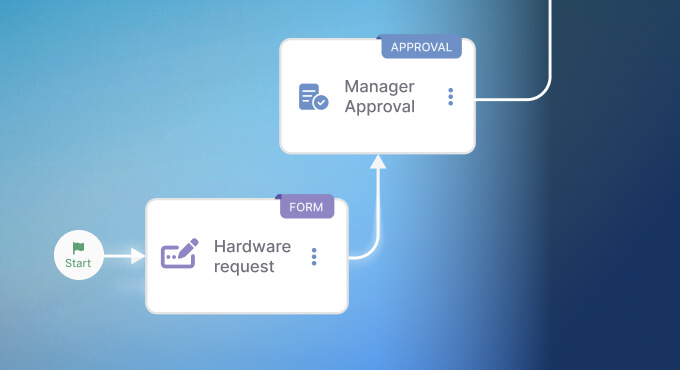
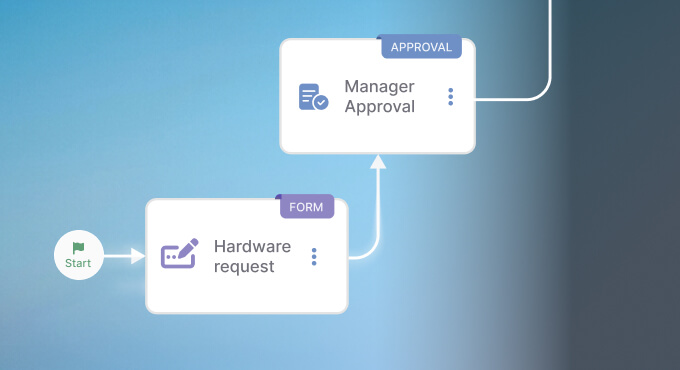
That is the line we drew for workflows. AI-powered workflow generation uses AI at design time: an administrator describes a process, answers clarifying questions, and reviews an editable plan before anything is built. What runs in production is a deterministic workflow that behaves the same way every time and can be audited step by step. AI deciding at runtime is reserved for work that needs judgment.
Autonomous agents and Agent Studio cover that second case: requests that need diagnosis instead of a fixed path. When an agent can't resolve a request, it hands the ticket to a person with its diagnostic work attached. Agent Studio is coming soon.
Govern what AI does, not only what it knows
"AI actions are more important than AI intelligence," Gartner said, warning that when "you give AI agents your access privileges," they "can do things you didn't intend to."
Agent Studio governs agents action by action. Every action an agent can take carries its own permission: execute automatically, ask for confirmation first, or never do it. Teams start conservative and widen autonomy one action at a time as confidence grows.
Atlas applies the same idea to asset data, one field at a time. It infers missing owner, location, and financial fields from signals already in your environment, shows its reasoning for each one, and records every confirmation on the asset. The InvGate Asset Management MCP server keeps AI assistants inside existing permissions: nine read-only tools, and each person's token inherits exactly the access they already have and can be revoked from their profile.
Nothing in IT runs without an owner
Gartner defined shadow AI as "AI used without explicit approval or security oversight." It isn't only a bad-actor problem: "good people can also use AI to unintentionally do bad things." Then came the question every IT leader will eventually get: "So who is responsible and accountable for AI in your organization?"
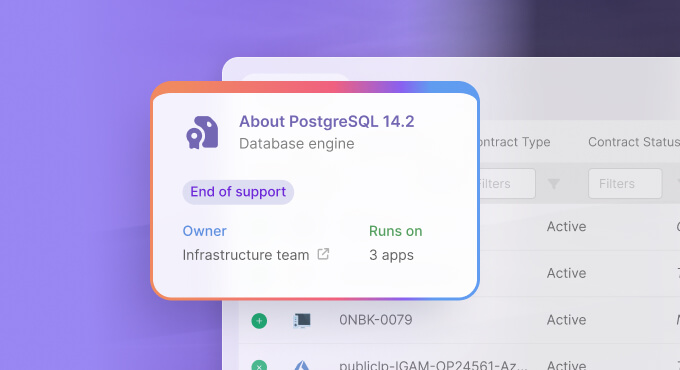
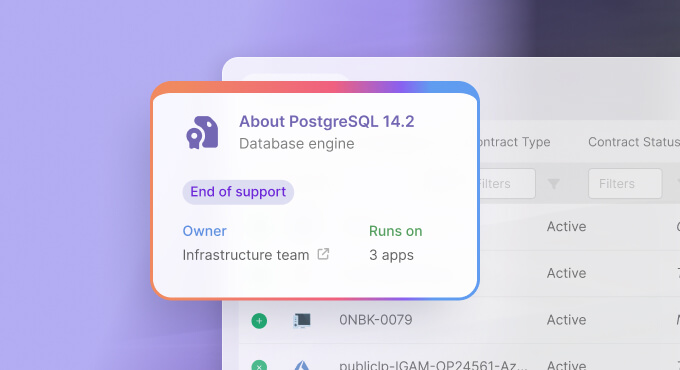
Our answer starts with a rule IT already follows: nothing runs without an owner. AI Assets turns agents, models, MCP servers, skills, plugins, and marketplaces into Configuration Items, each with an owner and a lifecycle status. They sit in the same CMDB as laptops and servers, so when someone asks what an agent is doing, a named person answers and the impact map is already there. Put an ERP into a change window and the business application diagram shows the agents that reach it through its MCP server. Digital Assets does the same for automation workflows and certificates. Registration is a manual step in this first release.
The right model for the right task
Gartner's advice for teams running more than one model was to invest in an AI gateway: "AI gateways route requests to the best model or platform for the task." It also called standardizing on a single model naive, since models differ in cost, speed, and accuracy.
The AI features inside InvGate already work this way. Our AI Service sits between the product and multiple model providers. We benchmark models on performance, speed, and cost, and a router sends each task to the model that handles it best. When a new model beats the current choice, we update the router. IT teams get that routing for InvGate's AI features without running it themselves.
Scale what works
Gartner's takeaway was to stop compounding volume and start compounding value. AI use cases grew more than 400% in a year, and most were treated as brand new. Its advice: "Instead of adding new use cases, scale the successful ones you already have."
Our releases follow that pattern. Start with deterministic workflows, add agents where autonomy pays off, and widen their permissions as each action proves itself. Measure the record AI depends on along the way: the new Data Completeness screen turns inventory quality into a number you can track (coming soon). The redesigned self-service portal puts instant AI answers in front of employees, each one traceable to the knowledge article it came from.
None of it requires an 18-month program. Both products deploy in weeks with the team you already have.
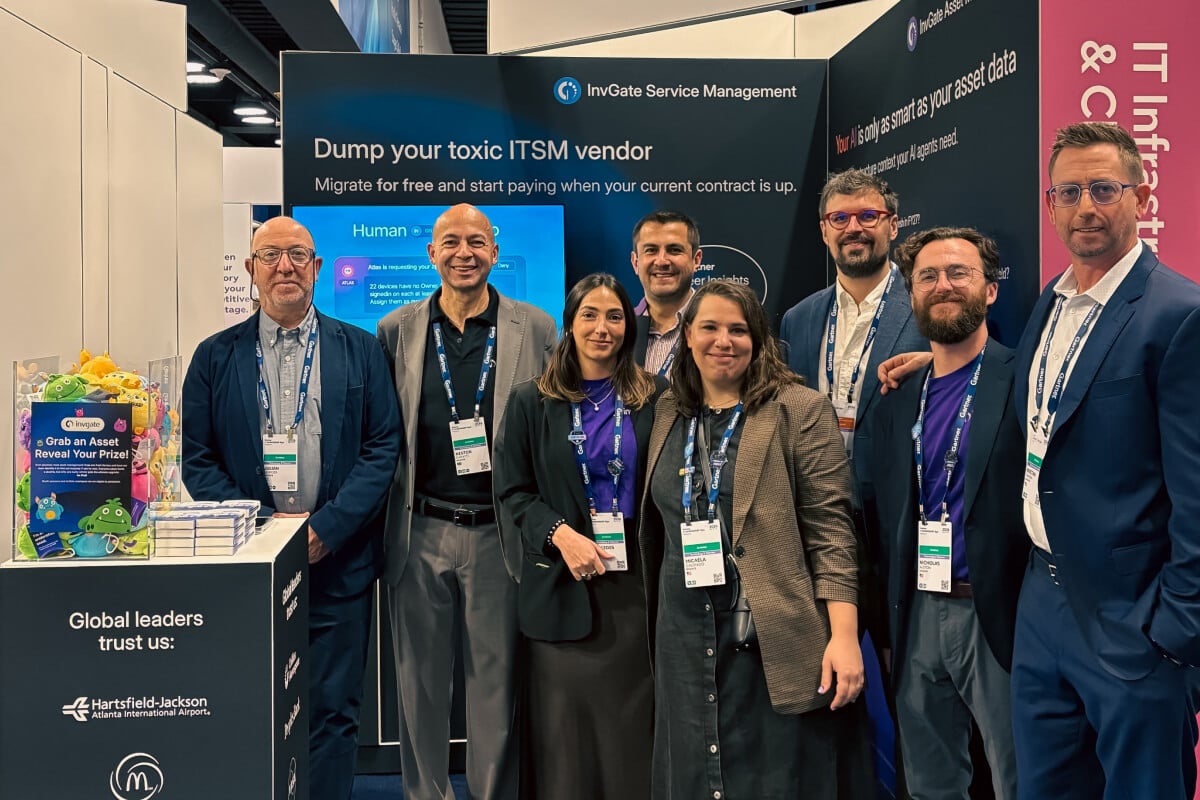
We're at Gartner IT Symposium/Xpo, booth #245. Stop by to see the platform live, or try both products free for 30 days.