










InvGate announced 11 new features at ENVISION'26, spread across InvGate Asset Management and InvGate Service Management. The list covers plenty of ground: an AI agent that completes asset data on its own, physical audits powered by QR and RFID scanning, and a redesigned self-service portal with instant AI answers. It also includes autonomous agents that resolve requests on their own within limits you set action by action, plus a product catalog to hand over a real device from stock, among several other announcements covered below.
This article gathers all of them in one place. Each announcement has a short description of what it does and who it is for, plus a link to the full article where one is available, so you can jump straight to the features that matter for your team.

The announcements below are grouped by product, with a final group for the one feature that spans both. Use the list to jump to any of them and come back for the rest.
InvGate Asset Management:
InvGate Service Management:
Across both products:
Most of what InvGate Asset Management gained at ENVISION'26 answers the same question from different angles: how complete and how trustworthy is the record of what the organization owns. Some announcements widen what the Asset Management Database (AMDB) covers, others verify it against the physical world, and others open it up so AI tools and finance teams can read it.
They are ordered here by how immediately they change day-to-day work, starting with the two that touch the asset record itself. Make sure you grab a 30-day free trial of InvGate Asset Management to try them against your own inventory.
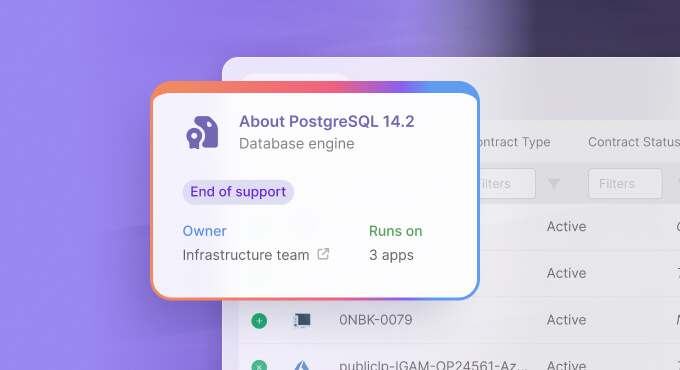
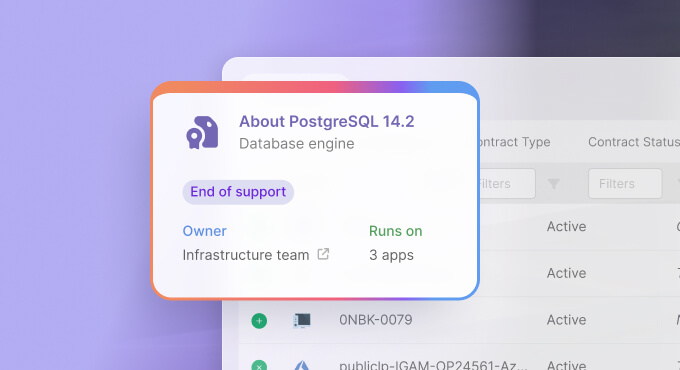
Atlas is the AI agent built into InvGate Asset Management, and it now goes from catalog lookups to inference. It already supplied End-of-Support (EOS) and End-of-Life (EOL) dates from official references. It reads signals that already exist in the environment to suggest values for owner, location, and financial fields.
Every suggestion shows the reasoning behind it and confirmations are recorded on the asset. A new Data Completeness screen turns inventory quality into a number teams can follow over time. Coming soon.
👉 Read how Atlas completes asset data in InvGate Asset Management.
A new "Physical audits" tab in the "Assets" module makes physical verification part of the asset record. You scope an audit to a location, walk it scanning with a phone camera or an RFID reader, and the platform reconciles what you scan against what it expects to find there.
Results arrive in three levels: Found, Pending/Missing, and Others. Closing the audit stamps every asset in scope with the date, location, and result, so the next count starts from evidence instead of a spreadsheet.
👉 Read how to run a physical audit with InvGate Asset Management.
A predefined dashboard with 16 components answers what Finance asks IT about hardware: book value of the fleet, depreciation, refresh spend, the split by cost center, and which devices to replace next. It reads fields teams already maintain, such as acquisition cost and date, current value, cost center, warranty, end of support, and battery health, so it is populated the moment it is switched on.
It ships with two platform-wide Smart Tags, "Flagged for decommission" and "Overdue retirement", plus a depreciated cost metric available for custom dashboards. Like any other dashboard, it respects the permissions each person already has.
InvGate Asset Management now runs as an MCP server. Model Context Protocol is an open standard that lets AI clients query external data sources without building a custom integration for each one, and the server exposes inventory data as nine read-only tools any compatible client can call in natural language.
Administrators enable it at Settings > AI Hub > MCP Server, and each person generates and revokes their own token from their profile. Paste-ready configuration ships for Claude Desktop, Claude CLI, Cursor, VS Code, Gemini CLI and Codex CLI, and every token inherits exactly the permissions its owner already has in the interface.
👉 Read how the MCP server works in InvGate Asset Management.
A new family of Configuration Items covers the pieces that keep the business running without ever having had a record of their own: automation workflows and certificates in this first release. Each one answers who owns it first, then what it is, what platform it runs on, which business application depends on it, and what changed on it.
They behave like every other asset family, with custom fields, tags, lifecycle status, automations, activities, permissions, business application membership and public API access. Loading them is manual: one at a time, in bulk, by CSV import, or through an existing API integration.
👉 Read about digital assets in InvGate Asset Management.
AI agents, models, MCP servers, skills, plugins, and marketplaces also become CIs. Teams register what AI is running in the organization, give each record an owner and a lifecycle status, and relate it to the devices, people and business applications it touches.
Because those records sit in the same Configuration Management Database (CMDB) as laptops and servers, impact analysis crosses from AI into the rest of the environment. Put an ERP into a change window and the business application diagram surfaces the agents that reach it through its MCP server.
The InvGate Service Management announcements concentrate on two audiences: the employee asking for help, and the administrator designing how that help gets delivered. For the first, the portal becomes conversational by default. For the second, AI explains, drafts and resolves, with a person confirming what happens.
All four share the same principle. The system computes and proposes, and every action that reaches a ticket carries an explicit permission behind it. Make sure you grab a 30-day free trial of InvGate Service Management to see how they work on your own service desk.
The self-service portal home page puts the Virtual Service Agent and AI-generated instant answers at the front, instead of behind a small chat icon. The page is organized into four zones: pending actions, open requests, catalog categories, and an Assistance Bar that stays visible at the foot of every home page.
The Assistance Bar surfaces topics based on what the person searches and shows instant answers underneath, built from the organization's own knowledge base articles and Knowledge Snippets, with each answer traceable to its source. The layout adapts to whoever is looking at it: someone with approvals and open tickets sees them at the top, and someone with nothing pending gets a clean page.
👉 Read about the new Self-Service Portal home in InvGate Service Management.
Agent Studio lets a team build one autonomous agent per department, for IT, Purchasing, HR, or any other area, each with its own name, knowledge scope, and channel coverage. Every action an agent can take carries its own permission: execute automatically, ask for confirmation first, or never do it.
When an agent cannot resolve a request, it hands it over to a person with the diagnostic work already done, leaving an internal comment with what it checked, what it found and what it could not determine, while staying visible on the original ticket. Teams can start conservative and widen an agent's autonomy action by action as confidence grows. Coming soon.
👉 Read about autonomous agents and Agent Studio in InvGate Service Management.
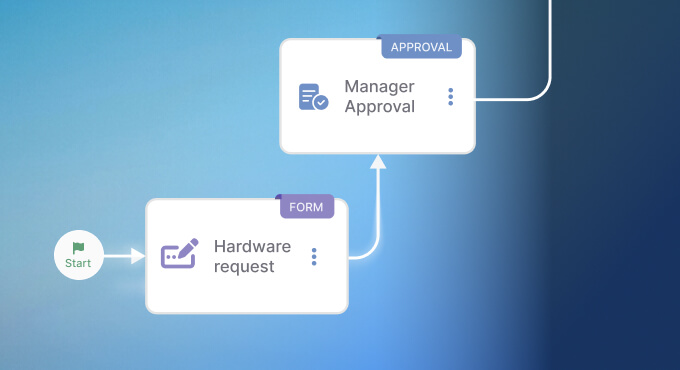
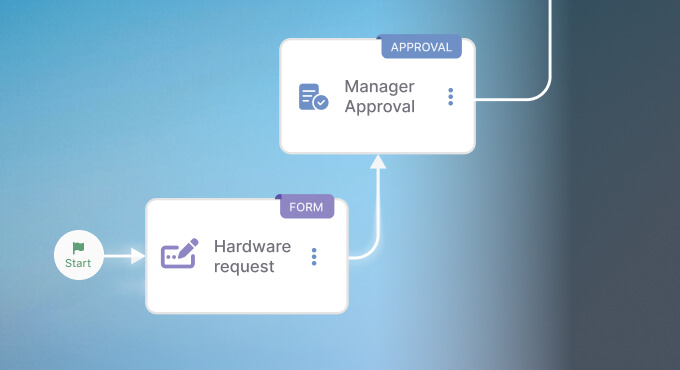
Administrators can start building a workflow by describing the process they want in plain language. A short round of clarifying questions follows in a chat, and the assistant returns an editable plan of the proposed stages for review before anything is created.
Once that plan is confirmed, it generates a starting workflow with the stages already connected, plus conditions and variables, which the administrator then finishes configuring in the Workflow Editor. It lowers the skill bar for teams extending Service Management into HR, Procurement, or Legal.
👉 Read about AI-powered workflow generation in InvGate Service Management.
Open a workflow in the canvas and InvGate Service Management generates a plain-language explanation of it: a narrated summary stage by stage, plus a detailed reference view, so someone who did not build it can follow it without reading every box. A chat sits on top of that explanation for follow-up questions, such as who approves a given stage or which integrations it calls.
For deployed workflows, it also surfaces execution data from the last six months: total runs, average ticket lifecycle time, and the single stage where most of that time is spent. The platform computes those numbers and the assistant narrates and interprets them.
One announcement lands on both platforms at once, because it needs the catalog on one side and the stock on the other. It is also the clearest illustration of what the two products do when they share the same record.
An organization publishes the hardware its people can request, and the agent hands over a specific unit from InvGate Asset Management stock inside that same request. Two new entities make it work: an Asset Management product, which is one record per asset type, manufacturer and model with live stock counts, and a Service Management catalog product, which is, within a “shopping cart” experience, the name, icon, and description the requester actually sees.
A published option such as “Standard Laptop” can point to several Asset Management Products at once, so it stays stable while the models behind it rotate. Total, available, and assigned units, along with a 12-month trend, sit on the Asset Management product profile, and the unit assignment happens the moment the agent fulfills the order.
👉 Read about the Product Catalog in InvGate Service Management and InvGate Asset Management.
Taken together, the ENVISION'26 announcements point in one direction across both platforms: a record of the environment complete enough, current enough, and structured enough for people and AI to act on it. InvGate Asset Management widens what gets recorded and verifies it against the physical world, and InvGate Service Management turns that record into requests resolved with less friction, with an audit trail behind every automated action.
Each feature has its own article with the setup steps and the detail this summary leaves out. The best place to start is whichever one maps to what your team is fighting with this quarter, on either side of the platform.
Want to see all of it in your own environment? Try both tools for free and see it for yourself. Or contact the Sales team to see how it can improve your daily operations.
ENVISION'26 is InvGate's global user conference, where the company presents the new capabilities coming to InvGate Asset Management and InvGate Service Management. This year's edition included 11 announcements across both platforms.
Eleven. Six belong to InvGate Asset Management, four to InvGate Service Management, and one, the Product Catalog, spans both because it connects the service catalog with hardware stock.
Digital assets cover automation workflows and certificates, the operational pieces that run the business without a record of their own. AI assets cover the AI layer specifically: agents, models, MCP servers, skills, plugins, and marketplaces. Both are new families of Configuration Items in the same CMDB, with an owner and a lifecycle status on every record.
It lets any MCP-compatible client query InvGate Asset Management data in natural language through nine read-only tools. Each person uses a personal token that carries exactly the permissions they already have in the interface, so the server changes how the data is reached without widening who can reach it.
Yes. With the Product Catalog, employees request a published option from the service catalog, and the agent assigns a specific unit from stock while fulfilling that request. The asset record is updated at that moment, without anyone going back to adjust it later.


