











AI is already part of many IT tools, but that doesn’t always mean it’s clear how it works or where it fits.
InvGate includes AI features for both products, InvGate Service Management and InvGate Asset Management in a way that supports everyday tasks without changing how teams already operate.
Still, adding AI into a platform raises questions for users. What does it actually do? Where does it help? How much control do teams have over it?
That’s what this article covers. We’ll go through the 10 most common questions about InvGate AI-Hub so you can understand how it works and how to use it in practice.
InvGate AI supports efficiency in two main ways.
First, through the AI-powered Virtual Service Agent, available in channels like Microsoft Teams, WhatsApp, and the self-service portal. It handles common questions and routine issues without agent involvement, so employees don’t need to spend time creating tickets or searching for answers. That frees up the service desk to focus on more complex requests.
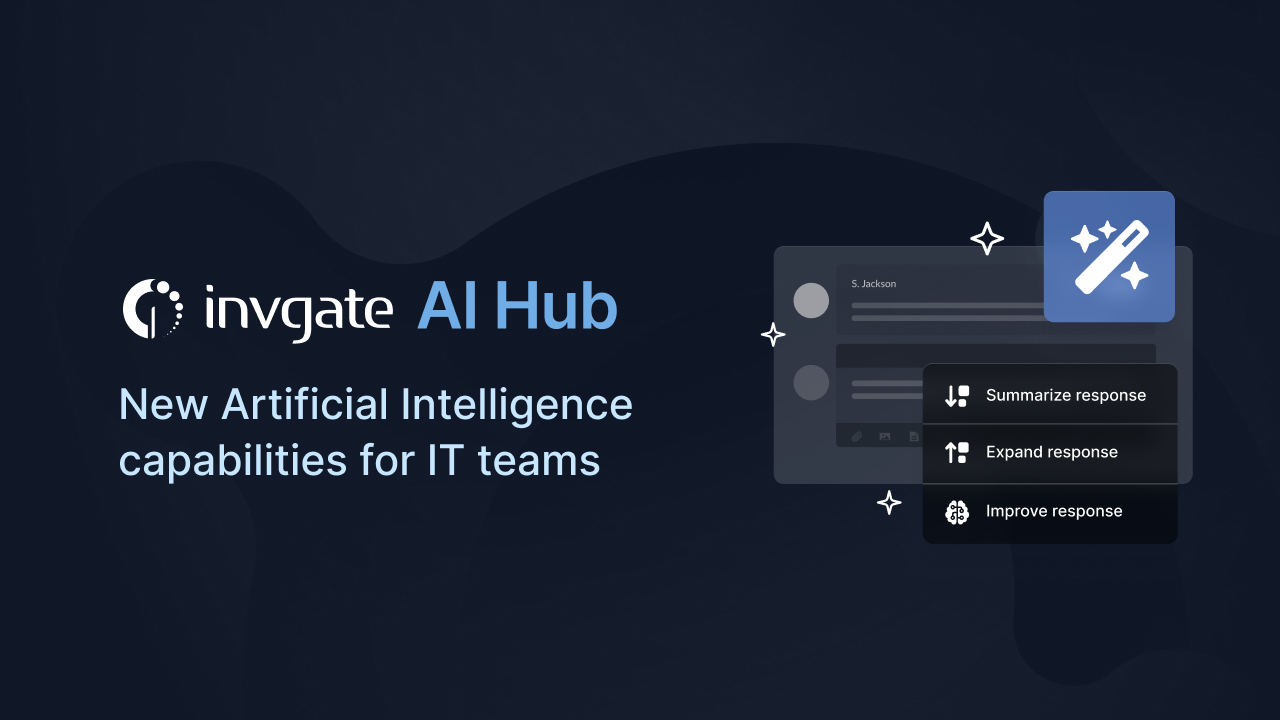
Second, through the features that live in what we call the AI-Hub, which is built to support agents while they work. It helps speed them up and reduce repetitive effort.
Some of the capabilities that our customers value most are:
Our vision is to allow all users to maximize their efficiency and become a power user in their own right.
No. We don’t use customer data to train AI models that are shared across customers. We understand that data privacy is a major concern for enterprise leaders, and we share this concern.
There have been several academic studies showing that parts of the training data can be extracted from generative models through what are known as “adversarial attacks”. To avoid such security risks, we distinguish between two types of AI models:
Our commitment to data privacy and security goes beyond AI models. We have stringent security measures in place to protect data both in transit and when stored in our systems.
All data, whether it's being used to train custom models or simply stored in our databases, is encrypted using strong encryption methods. This ensures that potentially sensitive information remains confidential and inaccessible to unauthorized parties.
In essence, while we strive to provide the best AI solutions for each customer, we never compromise on security and data privacy.
At InvGate, we aim to stay at the forefront of these advancements, ensuring our product always delivers state-of-the-art results. Agnostic AI allows us to be adaptable, selecting the most appropriate option for each use case. This strategy also helps us avoid vendor lock-in.
As we have seen over time, the quality and ability of the models by different vendors, including OpenAI, Anthropic, Google, and even open-source models, are still changing very rapidly. That's why we created a vendor-agnostic, proprietary AI service to maximize both efficacy and efficiency
However, when choosing providers, we only consider those that operate on a global scale and that uphold stringent security standards, such as SOC2. This is particularly important when it comes to adhering to compliance regulations, such as GDPR. For more information, you can check our trust center.
Absolutely not. We strive to ensure the AI features are integrated smoothly into our products, making them straightforward and intuitive to use. That said, we recognize that over time, becoming more familiar with these tools can contribute to a more enjoyable user experience and help to calibrate expectations.
If you're reading this, you've probably interacted with some AI tools like ChatGPT, and understand that they have limitations and can occasionally deliver unexpected responses. Typically, newcomers to this technology hold high expectations about what AI can accomplish. Yet, this mismatch is quickly resolved as users get to know the tools, enabling individuals from all backgrounds to harness the full potential of our AI-powered features efficiently.
The right implementation can significantly reduce the risks usually associated with AI. We've implemented several safety measures to ensure that AI operates within defined parameters. These include sanitization protocols applied to both the inputs and outputs of AI models, and the use of lightweight models to detect and manage ill-formatted or unsuitable content. These measures significantly reduce the likelihood of encountering adverse outcomes.
Regardless, we believe that the real value of AI comes from its ability to complement and collaborate with human insight and expertise. Every feature we develop includes a step of human validation, which ultimately ensures that the final result aligns with the intended expectations.
We are strong believers in governance and the ability for IT teams to have deterministic control over what actions AI can take, and we have designed our products with that philosophy.
All the capabilities available in the InvGate AI Hub are included in your licensing: Meaning that there is no cost pass-through or usage caps applicable to the usage of InvGate's AI capabilities.
Contrary to popular belief, AI itself is not necessarily more expensive than conventional software deployment. However, recently, LLMs have come under the spotlight, not only for their impressive results but also for the significant investment required to train them. Furthermore, the powerful hardware devices needed to operate these LLMs can also add to the operational costs.
Despite these elevated costs, the economies of scale of AI-providers and recent advancements in optimization techniques have been steadily decreasing the expenses. This has made it economically viable to leverage even the most powerful AI solutions.
We believe that our clients are best served by providing tools that work out of the box. Our clients have a lot of granularity to decide what capabilities to turn on and off, and they have multiple governance layers to implement AI capabilities across multiple help desk processes and workflows. However, we also acknowledge that not everyone might have the specialized knowledge needed to fine-tune token usage, context windows, and other technical capabilities that building a custom AI agent entails.
This is why we also offer our Enterprise clients the ability to use the InvGate MCP (currently in Research Preview) for them to use an agent builder of their choice if they decide to do so.
Yes. The InvGate AI Hub is also available for our on-premises deployments. However, it's important to note that this access still requires processing information using AI models hosted in the cloud.
Running these models requires specialized hardware, and since the AI Hub combines multiple models and techniques, it isn’t feasible to host and run it locally with typical on-premises infrastructure today.
We firmly believe that AI will replace some human work. In some cases, we're seeing as much as 77% of questions and requests solved by AI without human intervention. But replacing human work is different from replacing humans.
The true potential of AI is a topic of ongoing debate, with opinions ranging from dismissive skepticism to predictions of an impending dystopian future. Objectively, currently available AI technologies enable functionalities that were previously unattainable, such as outstanding natural language processing. This allows us to automate a great deal of repetitive tasks, and enhance with recommendations the more strategic ones.
While making predictions is challenging, it seems that AI can have an impact akin to that of Graphical User Interfaces (GUIs) in the last few decades. For most individuals today, the idea of interacting with computers without these interfaces is inconceivable. GUIs have enhanced most of our interactions with computers, allowing users to focus on the most relevant parts of their work and greatly increasing productivity. It’s likely that AI will eventually become just as integral to our interactions.
Definitely! Our 30-day trial gives access to the full product experience, including its AI features, so you can evaluate real use cases.
Plus, the AI Hub is included within the product licensing, so you don’t need a separate add-on to explore it. You can explore the available options and pricing directly on our pricing page.
AI is evolving at a breakneck speed, constantly presenting new opportunities and challenges. While it’s important to navigate the hype and misconceptions, the reality is that AI is increasingly becoming an essential tool.
AI does come with its own set of considerations, such as cost, hardware requirements, and data privacy. However, with the right implementation, these challenges can be managed effectively. As we continue to advance and refine our AI-Hub, we remain committed to delivering a product that is secure, accessible, and cost-effective.
In the end, AI is a tool, and like any tool, its value lies in how we use it. With a forward-thinking approach and a commitment to continuous learning, the possibilities for AI are vast and exciting. We look forward to exploring this future together!


