










IT environments are growing faster than most teams can manage manually. AI-enabled IT Asset Management (ITAM) has emerged as a practical response to this reality: a way to amplify what teams can do with the data they already have, with the discipline and the people behind it still at the center.
The promise is straightforward: less time chasing information across vendor documentation and spreadsheets, more time acting on insights that the system generates automatically. This post covers what AI-enabled ITAM actually means in practice, the use cases that deliver the most immediate value, the challenges to anticipate, and how InvGate Asset Management is implementing these capabilities today.
AI-enabled ITAM is the practice of applying artificial intelligence to automate, enrich, and improve decision-making across IT Asset Management processes. Where traditional IT Asset Management requires teams to manually collect, validate, and interpret asset data, AI-enabled ITAM does much of that work automatically, surfacing what matters without waiting to be asked.
The distinction is not about replacing the ITAM practice itself. Procurement, lifecycle governance, compliance, and retirement processes remain the same. What changes is how those processes are executed: with less manual effort, better data quality, and the ability to act on signals before they become problems. Good IT Asset Management software still needs a clear scope, governance policies, and human judgment behind every consequential decision. AI is what makes those decisions faster, more accurate, and based on a more complete picture.
A useful frame: traditional ITAM requires teams to chase information. AI-enabled ITAM is built so the information finds the team.
The core activities are the same in both models: discover assets, track them through their lifecycle, manage licenses, plan refreshes, and ensure compliance. The difference is in how each activity happens.
The difference is not in the tasks. It is in how those tasks are executed. Traditional ITAM produces a picture of what exists. AI-enabled ITAM produces a picture of what exists, what is at risk, and what to do next.
AI does not improve every part of ITAM equally. Its most immediate impact is in the activities that are most repetitive, most data-intensive, or most dependent on catching signals before they become problems.
AI improves the quality of discovery by helping platforms identify, classify, and normalize data from multiple sources simultaneously. Where traditional discovery might return five variations of the same device model from different systems, an AI layer reconciles those variations into a single, clean record. The same logic applies to duplicates and incomplete profiles: the system detects the inconsistency and resolves it, rather than flagging it for a human to investigate manually.
The practical outcome for the team is a cleaner inventory without the manual cleanup. That matters because data quality is the foundation everything else builds on. Reporting, compliance checks, and risk signals are only as reliable as the underlying records. Continuous IT asset discovery becomes something the platform sustains, not a project the team has to periodically re-execute.
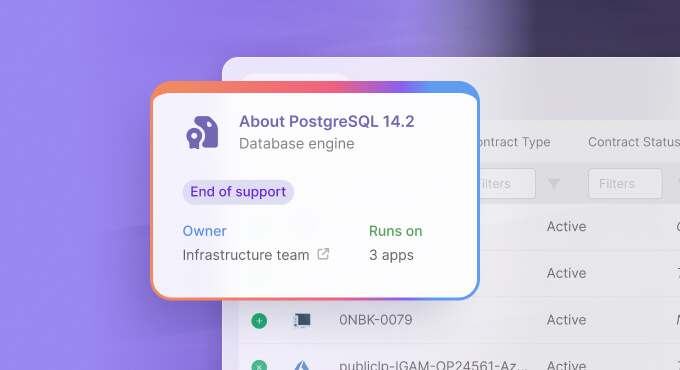
AI analyzes historical trends, usage patterns, and anomalies to surface signals that would be invisible in a static inventory. An asset approaching end-of-support without a replacement plan is one example. A device with declining health metrics and an open ticket history is another. A license pool where actual usage has drifted far from entitlement is a third.
In each case, AI detects the signal earlier than any periodic review would, and prioritizes it by potential impact. Teams stop reacting to problems that have already occurred and start acting on risks that are still manageable. This shifts the operating model from reactive to proactive without requiring teams to build the detection logic themselves.
Traditional ITAM reports describe the state of the inventory at a point in time. AI-enabled reporting goes further: it identifies what is changing, what is trending toward a threshold, and what options exist for responding. The output is not just a dashboard of asset counts and compliance rates. It is a set of insights about where action is needed and why.
This changes how IT Asset Management data gets used across the organization. The IT Asset Lifecycle Management stages that once required manual analysis at each step, from procurement planning to retirement decisions, can now be supported by systems that surface the relevant signals automatically. Finance and compliance stakeholders gain access to insights that were previously buried in raw exports, and IT teams spend less time building reports and more time responding to what those reports reveal.
AI capabilities are only as good as the data they operate on. Understanding what is needed, and what can block progress, helps teams plan a realistic adoption path.
Each of these challenges points toward the same mitigation: start with the inventory you have, clean it progressively, and choose AI capabilities that amplify existing data quality rather than requiring a rebuild from scratch before they can deliver value.

InvGate's approach to AI in Asset Management is built around one principle: amplify human capabilities, not replace them. The goal is to reduce friction, eliminate repetitive analysis, and convert raw asset data into actionable intelligence. That philosophy shapes how each of the following features is designed and where it fits in the day-to-day workflow.
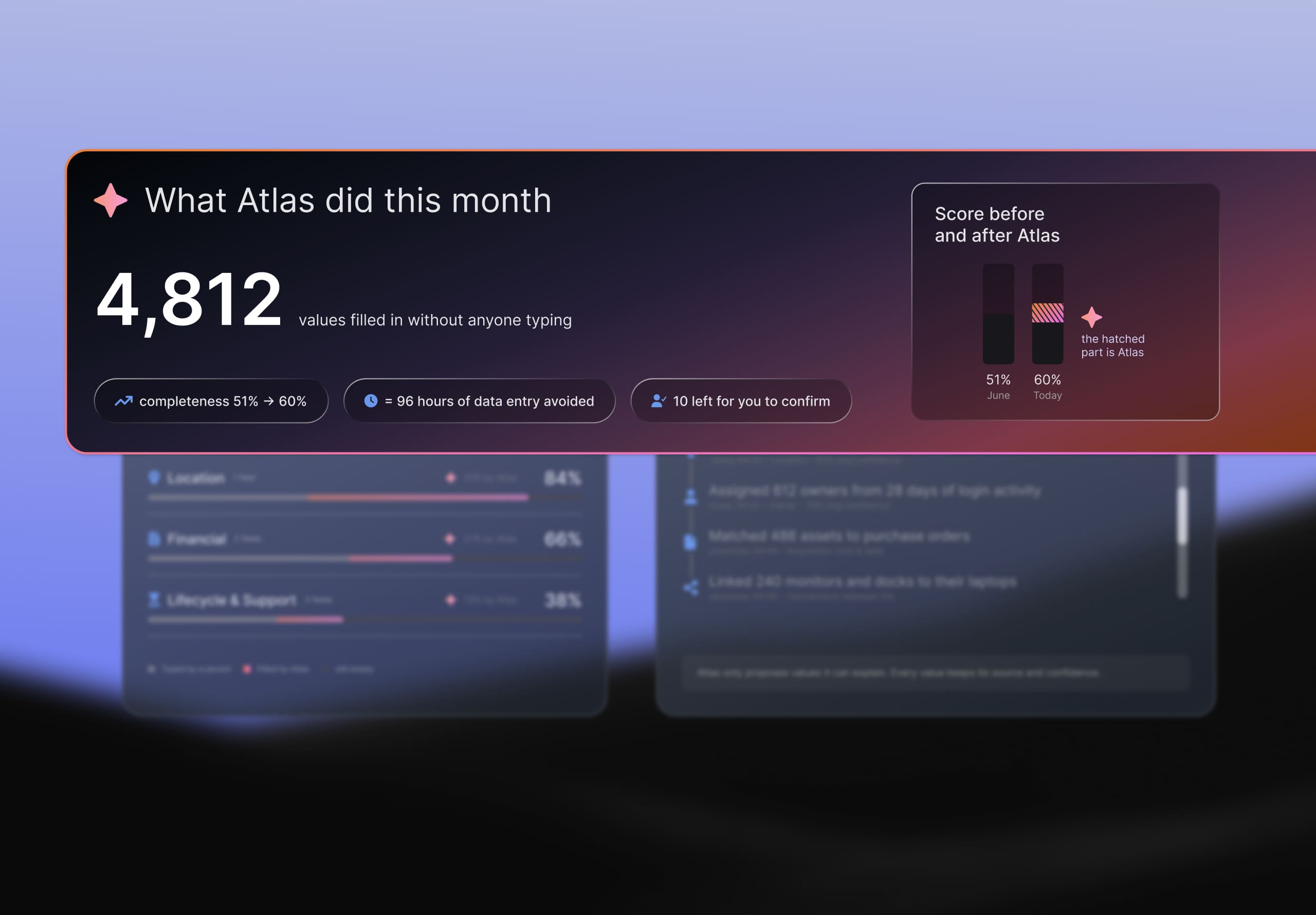
Atlas AI Agent is the first AI agent built exclusively for Asset Management. It enriches the assets in your IT ecosystem with context so teams can make better decisions. Next, it will automatically complete the core data every asset needs to be managed properly, such as owner, location, acquisition date, and cost, with a Data Completeness screen to review everything Atlas completes in one place. Teams will decide how it works: completing fields automatically, asking for review first, or leaving specific fields out of scope.
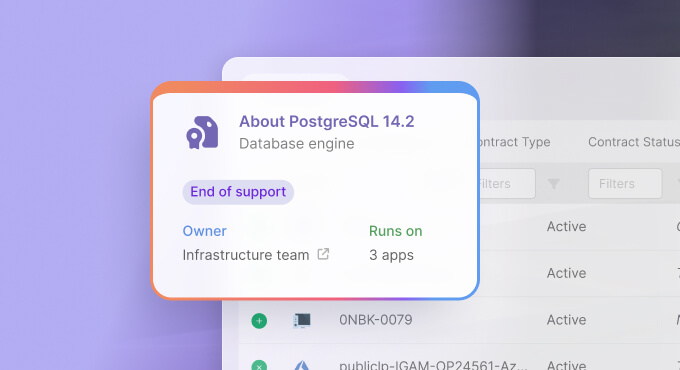
Today, Atlas already completes end-of-life and end-of-support dates for hardware and databases and adds a description to every Configuration Item profile explaining what the asset is and what it is used for.
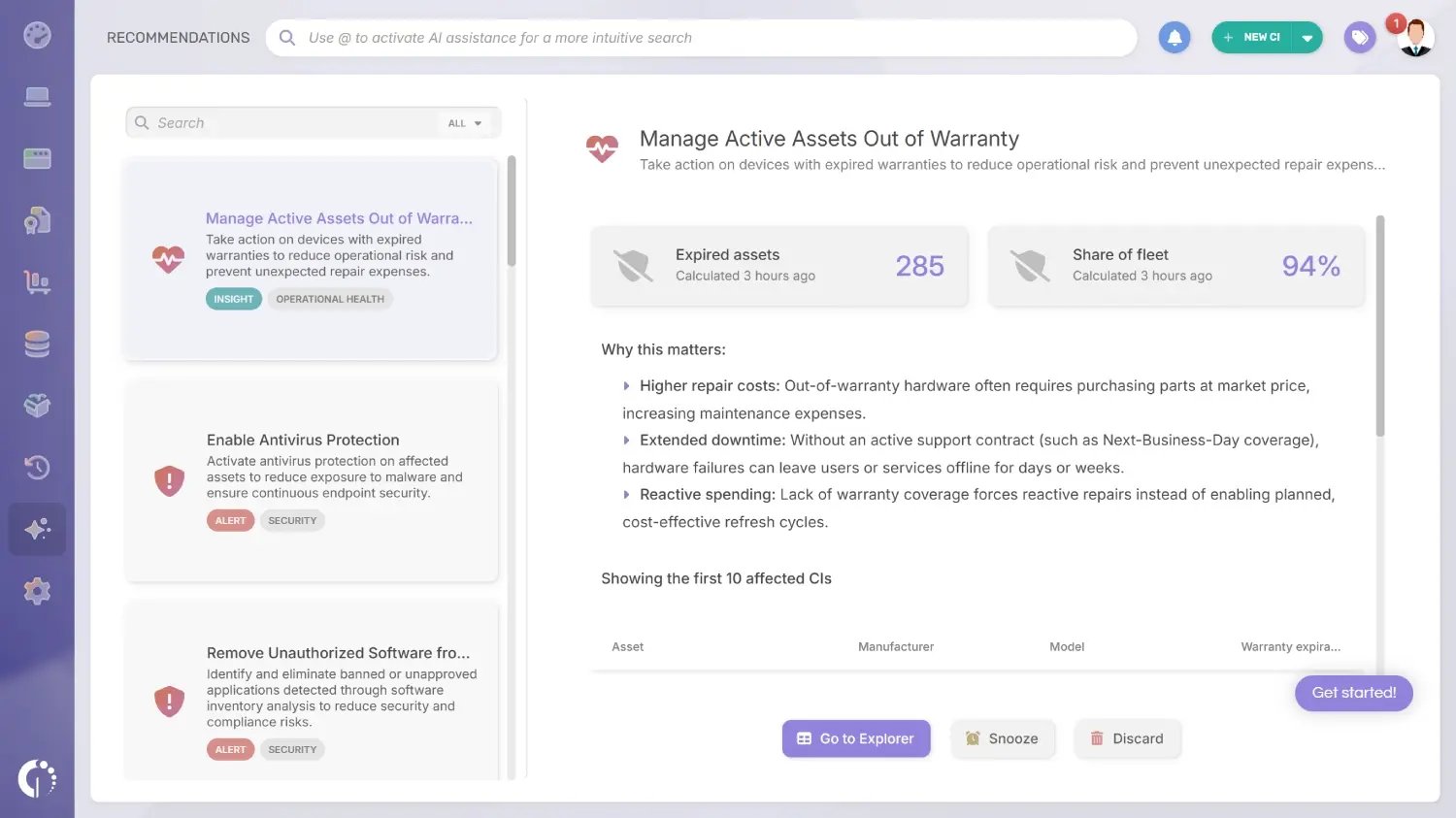
Smart Recommendations analyzes asset state, contracts, compliance, costs, and risk and turns the findings into prioritized recommendations, ranked by security risk, number of affected CIs, and business impact. They span seven categories (Cost Optimization, Data Quality, Monitoring, License Management, Operational Health, Risk & Compliance, and Security), from servers with no owner to devices with antivirus disabled.
Each recommendation links to its next step: teams can open the affected assets, set up an automation with pre-filled conditions, or create a Health Rule directly from a device health alert. Anything that is not a priority can be snoozed or discarded. Since it all runs on existing inventory data, Smart Recommendations turns asset data into prioritized actions without manual analysis.
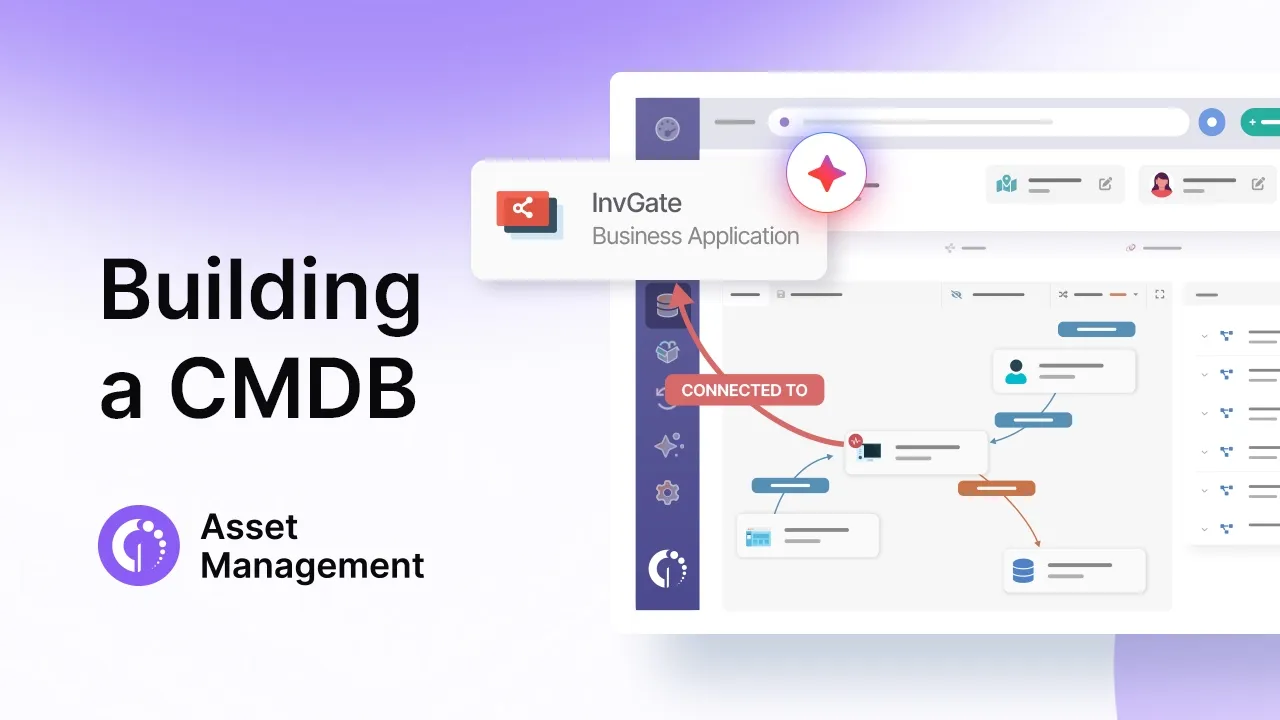
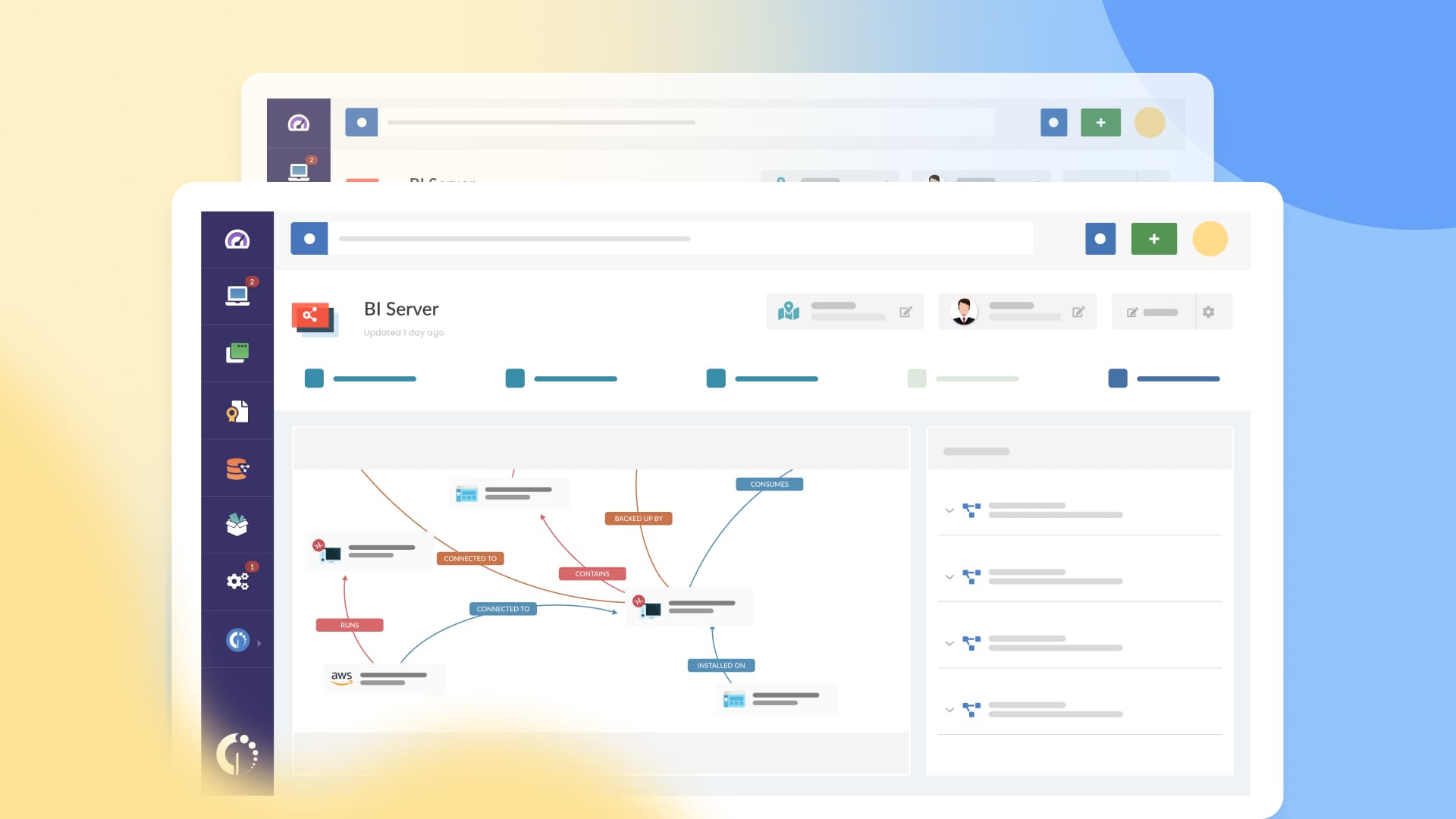
CMDB Auto-Mapping keeps the Configuration Management Database (CMDB) current by detecting relationships between assets, applications, and cloud resources, including AWS, Azure, and GCP. It proposes them in Business Application diagrams as connections users accept or reject with one click, so the team stays in control of what enters the CMDB.
The result is a more reliable CMDB and a step toward a System of Context model, where asset context is rich and trustworthy enough to support better decisions. With CMDB Auto-Mapping keeping relationships up to date, teams can assess change impact, handle incidents with more context, and resolve dependency questions faster.
AI Smart Search allows any team member to query the inventory in natural language, without building complex filters or memorizing technical syntax. To activate it, users type "@" in the search bar and write a query the way they would phrase it in conversation: "computers from remote workers with a missing critical update" or "devices with warranties about to expire." The platform translates that query into the correct structured parameters and returns precise results.
The impact extends beyond speed. How AI Smart Search eliminates complex query syntax from daily ITAM work means that the inventory becomes accessible to any team member, not just those who know the platform's filtering logic. Roles that rarely interact directly with ITAM data, including Finance, Legal, or HR, can extract actionable information without depending on an IT administrator to run the query for them. The result is that inventory data gets used more broadly, and more effectively, across the organization.
AI software and hardware normalization consolidates variations in asset names, models, and attributes from multiple discovery sources into a clean, consistent inventory. The problem it addresses is common: the same asset frequently appears under different names depending on the discovery method or originating system, producing duplicates, reporting inconsistencies, and unreliable data.
With AI-assisted normalization, that standardization process happens automatically rather than through periodic manual cleanup. The downstream effect is a stronger data foundation for every other capability: cleaner records mean more reliable reports, more accurate anomaly detection, and better lifecycle decisions. This feature also strengthens the data layer that Atlas, Smart Recommendations, and CMDB Auto-Mapping operate on.
Auto-healing executes corrective actions automatically when predefined conditions are met in the inventory. Retiring a failed asset, reassigning an idle one, or correcting an outdated record can all happen without requiring manual intervention at each instance. The team defines the rules; the platform acts when those conditions are triggered.
The long-term effect is inventory hygiene as a default state rather than the outcome of periodic audits. Teams stop reacting to problems that have already accumulated and instead operate on an inventory that maintains its own quality parameters continuously. Combined with Smart Recommendations and Atlas, auto-healing completes the operational intelligence cycle that InvGate is building into the platform.
Adopting AI-enabled ITAM does not require a perfect starting point, but it does require intention. The teams that get the most value from AI capabilities share a few common practices.
Staying current with key ITAM trends for 2026 helps teams identify which capabilities align most directly with their operational priorities at a given moment. And for teams evaluating how to match platform capabilities to their environment, how to evaluate IT Asset Management software provides a structured framework for narrowing the decision.
AI-enabled ITAM does not change what IT teams do. It changes how they do it. The same processes, the same governance frameworks, the same lifecycle discipline, all executed with less manual effort, better data, and earlier awareness of what matters. The endpoint is an inventory that enriches itself, generates recommendations the team can act on immediately, and reduces the operational overhead that has historically made ITAM feel like a discipline that is always behind.
If your team wants to explore InvGate Asset Management's AI capabilities hands-on, a 30-day free trial is available with no credit card required. If you would rather walk through how the platform fits your specific environment first, the InvGate team is available to work through that together.
The difference is not in the tasks themselves, but in how they are executed. Traditional ITAM depends on manual data collection, periodic audits, and rule-based alerts that teams have to configure in advance. AI-enabled ITAM automates the repetitive work of maintaining inventory accuracy, enriches records with external context, and detects anomalies before they require human investigation. The result is the same scope of asset management, but executed faster, with better data, and with the system doing more of the analytical work.
The use cases with the most immediate impact are automated discovery and data normalization, which reduce the manual effort of keeping inventory clean and consistent; AI-driven lifecycle enrichment, which surfaces end-of-life and end-of-support dates without manual research; proactive recommendations based on asset state, contracts, and compliance; and natural language search, which makes inventory data accessible to any team member without requiring technical query syntax. These four capabilities address the highest-friction points in most ITAM practices and can deliver value even before an organization has achieved full data maturity.
No. AI-enabled ITAM layers on top of the inventory and processes a team already has. The starting point is the structured asset data that already exists. AI capabilities, whether enrichment, recommendations, search, or automated mapping, are designed to improve what is already there, not to replace it. The pace of adoption is determined by data maturity: teams with a clean, structured inventory can move faster, but even a partial dataset is enough to start with capabilities like natural language search or anomaly detection.
The minimum requirement is a structured inventory with consistent attributes for hardware, software, and lifecycle data. From there, integrating historical data from ITSM, security, or financial systems expands the range of insights available. No environment needs to be complete before starting: high-value, low-friction capabilities like natural language search and automated lifecycle enrichment work with the data most organizations already have, and the system improves as data quality and breadth increase over time.

