










Clear workflows make everyday work easier, but only when people can build and use them without friction. A process shouldn’t depend on technical skills or one specific owner to exist or make sense.
InvGate Service Management’s no-code workflow builder focuses on accessibility from the start. Teams create workflows using a drag-and-drop editor, reusable building blocks, and no-code action connectors, which keep each step easy to follow and modify. Anyone can create a flow, and anyone with the necessary permissions can update it as needed. That same principle carries into AI assistance. You can generate a workflow from a plain-language description rather than building each step by hand.
The result is a straightforward way to design workflows that stay understandable, flexible, and easy to maintain across teams.
Curious about it? Keep reading to discover them!
A workflow builder is a tool that allows you to define a set of steps to perform any given process.
It usually follows an “If this, then that” logic, where you select the starting point of a flow and decide the action sequence until the process is finished. Once it’s set, the steps are triggered as the tasks are done.
Workflows are great for encouraging adherence to service desk SOPs or guiding cross-departmental processes, such as the onboarding of new hires.
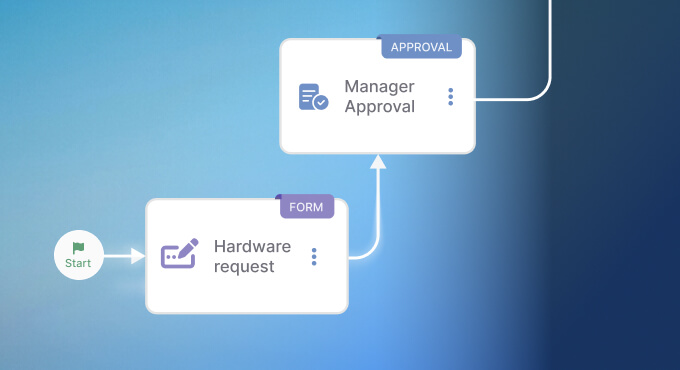
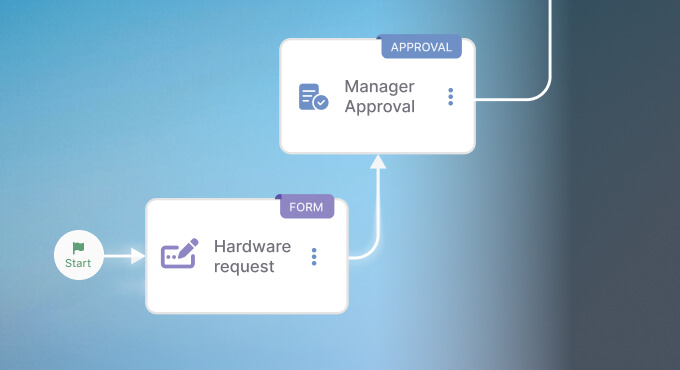
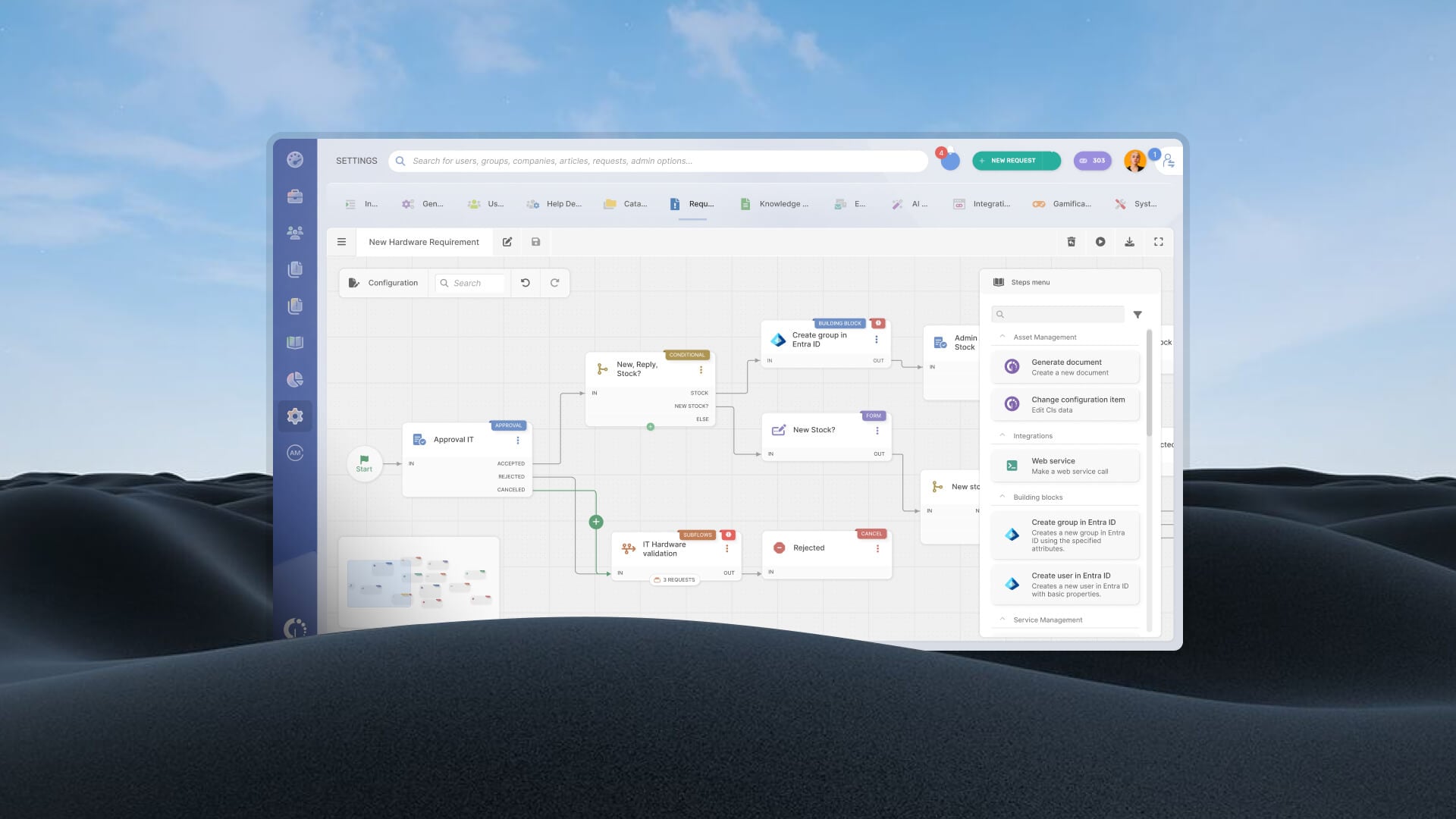
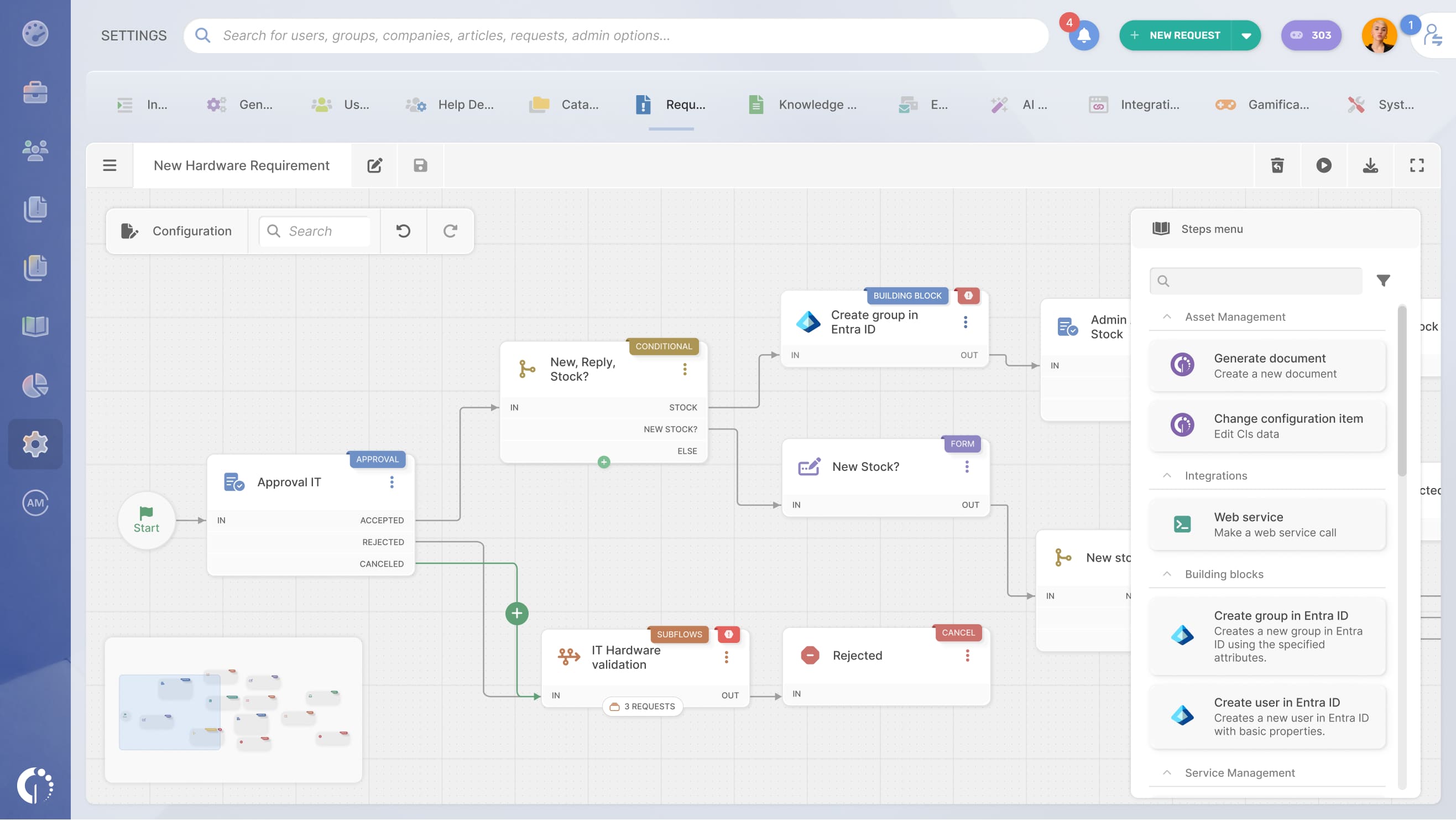
InvGate Service Management’s visual workflow builder allows users to drag and drop components into a process to define its multiple steps. And they can also build, modify, and optimize them in minutes without needing any technical knowledge.
Our workflow builder's design reduces the learning curve and technical knowledge required, making it easier than ever for users to understand and effectively build workflows quickly.
This focus on reducing entry barriers ensures that even users with limited technical expertise can get the most out of the tool, extending its use across multiple teams and, in consequence, improving multiple-department collaboration — making it perfect for speeding up your Enterprise Service Management (ESM) strategy!
InvGate's workflows module includes a set of features designed to support clear process design without adding unnecessary complexity. Instead of focusing on outcomes, the sections below describe what’s available in the builder and how each capability works.
The workflow builder includes several features that simplify how processes are configured and reviewed, even when flows include multiple paths or approvals:
The workflows module includes reusable building blocks that let teams apply the same configuration across multiple workflows. A building block is defined once and added wherever it's needed, so a common sequence does not have to be rebuilt each time.
A building block is a mini-workflow: a set of connected stages that behaves like a single stage within the workflow that uses it. Whoever inserts the block sees one stage with variables to configure, with no need to open or edit the internal logic. A building block can include approvals, actions, notifications, integrations, pauses, and cancellation stages. A building block cannot contain another building block.
Published building blocks appear in the Steps Menu in a dedicated "Building Blocks" category, separate from the workflow's native stages, ready to drag into any flow.
Built-in action connectors provide predefined actions for external tools. Users add them to a workflow through drag-and-drop and complete a small set of parameters, without creating custom web services.
A connector can read data from a connected tool for use later in the flow, and for several tools it can also perform actions, such as sending a message to a Slack channel, creating a Google Calendar event, or updating a user in an identity platform. The set of supported tools is broad and growing, covering Slack, Google Workspace, Microsoft Entra ID, Jira, Azure DevOps, HubSpot, Asana, ClickUp, Workday, and more.
A connector can also be wrapped inside a building block, so a common action travels together with the approvals and notifications around it.
The workflows module also includes preconfigured help desk workflow templates to simplify initial setup. These templates can be selected from the workflow list and customized as needed, so you don't have to start from an empty canvas.
Some of the available templates are:
The Formula step is a native step type that defines and evaluates expressions directly within a workflow, with no external service involved. It handles mathematical calculations, date comparisons, dynamic text, and decisions based on the result, all from the workflow configuration. A guided interface builds each expression, with autocomplete and real-time validation as you type.
The step is placed in the workflow diagram like any other step. When the workflow runs, it evaluates the expression, stores the result in a variable, and makes that variable available to the steps that follow, such as forms, conditionals, and notifications.
Typical uses include calculating purchase totals for an approval threshold, validating a requested change date against a cutoff, generating dynamic text for a notification or form field, and more.
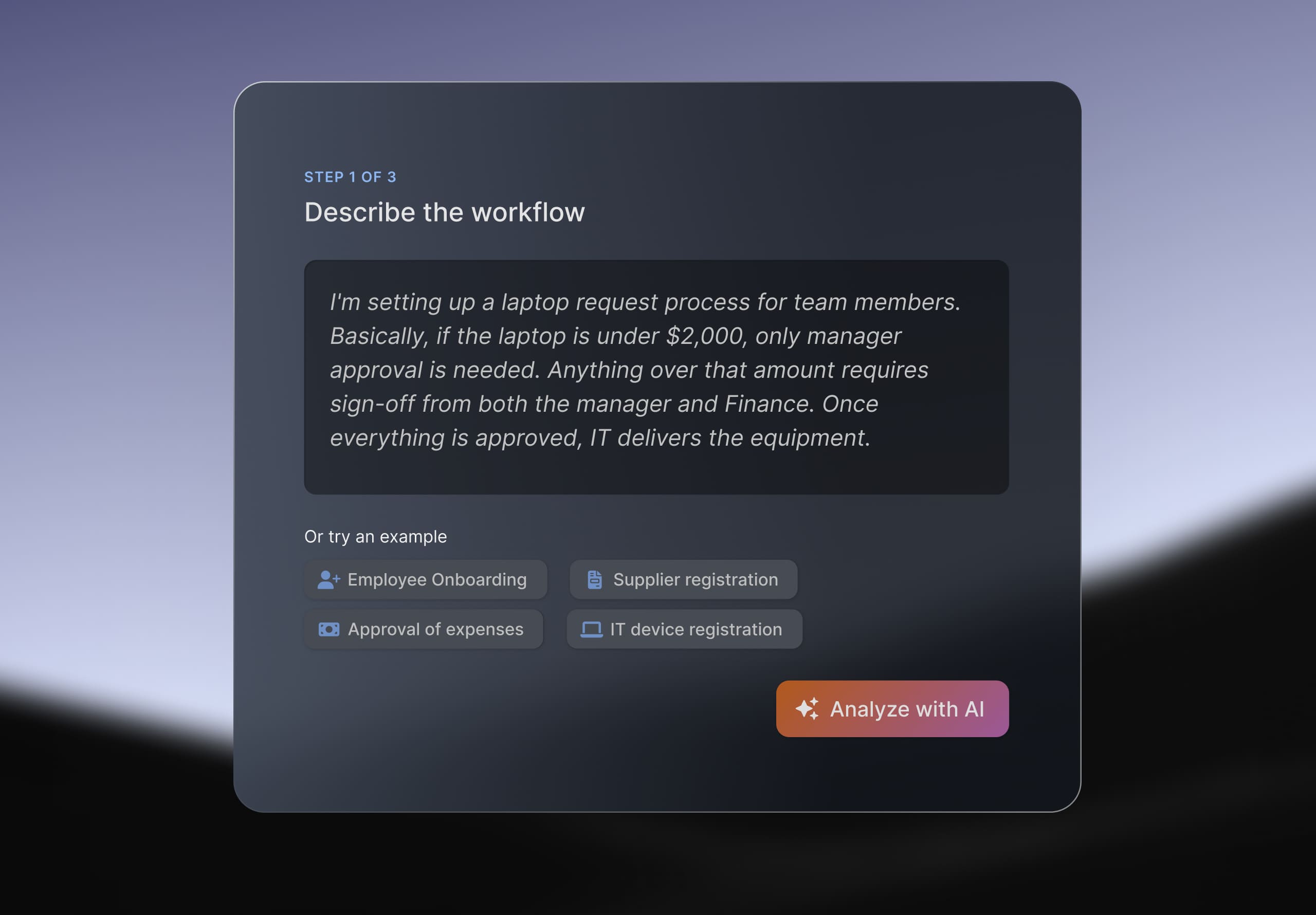
AI-Powered Workflow Generation is an additional entry point into the Workflow Editor. Rather than starting from a blank canvas or a template, users describe the process they need in plain language, and AI generates a workflow based on that description.
The process runs in a few steps. You describe what you need from the Workflows menu, explaining who's involved, what has to happen, and in what order. A short set of clarifying questions then fills in any gaps the description left open, such as a missing approver or condition. Before anything is created, the proposed stages, conditions, and variables appear as an editable plan you can adjust. Once you confirm it, InvGate Service Management generates a starting workflow, with stages, conditions, and variables already mapped, directly in the Workflow Editor.
From there, the workflow is completed like any other: assigning the approvers, adding the integrations, and finishing the configuration it needs to go to production.
The Workflow Assistant* helps trace and analyze the logic behind a workflow once it exists, whether it was built in-house or inherited.
Opening a workflow in the Canvas, users can generate an AI brief: a plain-language explanation narrated stage by stage, along with a more detailed reference view for pointing to a specific stage instead of skimming the whole flow. A chat sits alongside the explanation for direct follow-up questions, such as who approves a given stage, what an unlabeled web service call is doing, or what happens under a specific condition.
For the deployed version of a workflow, the Workflow Assistant can also surface execution data: how many times the process has run recently, how long its tickets typically take to close, and which single stage is accumulating the most time.
*The Workflow Assistant is coming soon.
Workflows are at the base of a successful Enterprise Service Management strategy. ESM is not only about providing your company with a shared service center; it’s also about making processes smoother for the whole organization.
And that’s where workflows become indispensable. They automate repetitive tasks within regular processes, such as the onboarding and offboarding of new employees, the knowledge article creation process, or the kick-off of a change process.
Unifying your organization under the same tool allows different departments to collaborate in cross-departmental processes. However, ESM projects often fail because the solution is too complex for non-technical users.
This is where the new workflow builder makes all the difference. Its no-code technology, intuitive interface, and advanced configurations encourage users to use it regardless of their tech skills. There’s no fear of breaking anything – a simple CTRL-Z will turn things back to where they were, as if nothing happened.
Workflows are essential for all technical and business teams to design, execute, and continuously improve their processes. In order for them to fulfill this purpose, software must be flexible enough to adapt to their needs and simple enough for anyone at the company to use without wasting too much time on their configuration and upkeep.
And InvGate Service Management’s no-code Workflow Builder achieves exactly that.
Designing your service desk processes is easier with InvGate. Go to the Workflows section on your instance to try them out – or request your 30-day free trial to see them in action!


