The return on a help desk investment comes from getting teams to use it, reducing manual work, improving response times, and creating processes that scale without adding headcount. The longer it takes to reach that point, the longer the organization waits to see value from the investment.
Many help desk platforms offer extensive functionality but require significant configuration, training, or implementation effort before those benefits become visible. Others focus on faster deployment, intuitive administration, and out-of-the-box capabilities that help teams improve service delivery within weeks rather than months.
In this article, we'll look at what immediate ROI actually means in the context of help desk software, the features and implementation factors that influence time-to-value, and several platforms that can help organizations start seeing results sooner.
Key takeaways
- The ROI of help desk software doesn't depend only on price: it depends on how fast the team adopts the tool and how much manual work it eliminates from day one.
- The key metrics to measure early ROI are cost per ticket, first contact resolution rate (FCR), and ticket deflection via self-service.
- No-code platforms that go live in days — like InvGate Service Management — shorten the time to first visible value.
- A solid business case for software procurement includes direct costs, hidden costs (implementation, training, integrations), and both tangible and intangible benefits.
- Knowing what to measure in the first 30, 60, and 90 days is as important as choosing the right tool.
Why most help desk implementations delay ROI
The pattern is consistent: a team evaluates help desk tools for weeks, selects a platform, signs the contract — and then spends the next several months trying to go live. By the time the tool is fully operational, the original business case has already aged past its assumptions.
However, the most common culprits aren't unique to any one platform.
Enterprise ITSM tools are typically built to be configured rather than deployed out of the box. A traditional implementation, for example, runs 8 to 12 weeks for basic modules, with complex multi-department rollouts routinely stretching to 6 to 12 months. Meanwhile, every week before go-live is a week the tool is generating cost without generating value.
Beyond raw setup time, there's a second delay that doesn't show up in vendor timelines: adoption. A tool can be technically live and still not be used effectively. If agents find the interface difficult to navigate, if end users bypass the portal and keep emailing directly, or if managers can't configure SLAs or workflows without opening a support ticket with the vendor, the ROI timeline extends further.
Then there's the implementation partner dependency. Many mid-market and enterprise platforms are designed with the assumption that a certified partner will handle configuration. That adds cost, timeline, and a loss of internal ownership. Teams that can't modify their own workflows six months after go-live are not in a position to realize compounding returns.
Common help desk migration mistakes — from underestimating data migration complexity to launching without adequate user training — compound all of the above, pushing the first visible win further out.
The takeaway: fast ROI isn't primarily about price. It's about time to adoption.
What "ROI" actually means for a help desk tool
Before building a business case or measuring anything, it helps to define the metric clearly. In the context of help desk software, ROI is the ratio between what the tool saves or generates and what it costs to run.
The base formula: ROI (%) = [(Benefits – Cost) / Cost] × 100
Applied to a real scenario: suppose a team of 10 agents handles 2,000 tickets per month. Their current cost per ticket is $25, driven by manual routing, untracked escalations, and no self-service layer. After implementing a structured help desk with automated routing and a self-service portal, cost per ticket drops to $18. Monthly savings: $14,000. Annual savings: $168,000. If the annual software cost is $40,000, the ROI calculation looks like this:
ROI (%) = [($168,000 – $40,000) / $40,000] × 100 = 320%
That's a simplified view, but it's the right starting structure. The more accurate the cost inputs, the more defensible the output.
For cost inputs, two categories matter:
-
Direct benefits are measurable and relatively easy to quantify. They include: hours of agent time recovered through automation (routing, categorization, escalation), reduction in cost per ticket through faster resolution and lower escalation rates, and lower onboarding costs driven by self-service and a documented knowledge base.
-
Indirect benefits are real but harder to put a number on. They include: fewer unmanaged incidents escalating into outages, less downtime per incident because structured processes route issues to the right person faster, reduced manual-error rate in service delivery, and better management visibility — which, in practice, means fewer reactive decisions and fewer fire drills.
Help desk software options to drive fast ROI
Not all help desk platforms reach value at the same pace. The tools with the fastest time-to-ROI tend to share a few structural characteristics: no-code configuration that doesn't require developer involvement, built-in self-service that reduces inbound ticket volume from day one, analytics that surface the metrics management needs, and all-inclusive pricing that doesn't add hidden cost as adoption grows. Below are five platforms worth evaluating on those criteria.
Methodology note: InvGate builds and offers IT Service Management and IT Asset Management solutions, making us an active player in this software market. Some vendors in this article are our competitors. Even so, we aim to deliver accurate, honest, and practical information that helps you make the best decision.
Our evaluations draw from publicly available sources — vendor websites, product documentation, user reviews on platforms like Gartner Peer Insights, G2, and Capterra, and analyst reports. We assess each solution based on functionality, integrations, and user experience. We'll review this content regularly to stay current with product updates and market developments.
1. InvGate Service Management
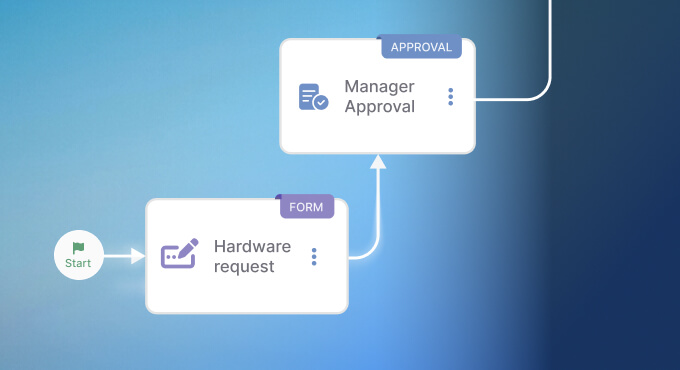
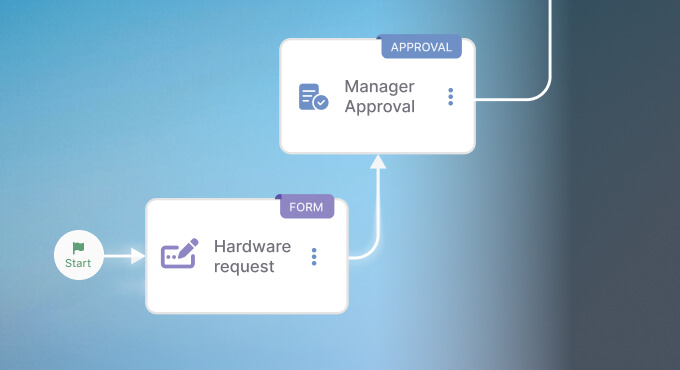
InvGate Service Management is an ITSM and ESM platform designed to go live without an implementation partner. The no-code workflow builder lets IT teams configure routing, approvals, and automation using a visual drag-and-drop interface — no scripting required. Pre-built templates for common processes like onboarding, Access Management, and incident response reduce initial setup time significantly.
The self-service portal integrates directly with the knowledge base and service catalog. The AI Virtual Service Agent connects to existing knowledge and closed ticket history to deflect requests before they reach an agent — with no manual training required. Agents can turn resolved tickets into searchable knowledge articles using AI-assisted drafting, which means the knowledge base improves automatically as the team resolves tickets.
For measuring ROI, InvGate Service Management includes over 150 built-in metrics, configurable dashboards, and OLAP-based reporting — all included in the core platform without add-ons. SLA Management, analytics, and reporting are native capabilities, not separate products. Pricing is per agent, all-inclusive, with no AI surcharges for core features.
InvGate Service Management is available both as a cloud service and as an on-premise deployment, making it a strong fit for organizations that must meet strict data residency, security, or regulatory requirements.
Best for: Mid-market and enterprise IT teams that need ITSM depth without long implementation cycles or ongoing partner dependency.
2. Freshservice
Freshservice (Freshworks) is a purpose-built ITSM platform known for rapid deployment. It deploys in days to two weeks with self-service setup and is frequently recommended for teams with no prior ITSM experience. The interface is clean, the onboarding is guided, and the automation logic is accessible without technical configuration.
Change and Problem Management are included in the Pro tier and above. AI features (Freddy AI Copilot) require an add-on on top of the Pro plan, which affects TCO projections for teams planning to leverage AI-assisted ticket handling.
Best for: Teams that want fast time-to-value and a straightforward ITSM configuration without extensive process maturity requirements.
3. Jira Service Management
Jira Service Management (Atlassian) is a strong option for organizations already running Jira Software or Confluence. The native integration between development and service desk tickets — linking incidents directly to dev backlogs — is a differentiated capability not easily replicated elsewhere.
Standard setup runs one to two months for teams new to the Atlassian ecosystem. Interface complexity is a frequently cited adoption barrier: the tool is built for users who think in queues and sprints, and less technically fluent agents face a steeper learning curve. Change and problem management require the Premium tier.
Best for: IT teams with strong Atlassian investment and a developer-adjacent service desk model.
4. Zendesk (for IT)
Zendesk is primarily designed for customer-facing support but is used by IT teams that want an omnichannel-capable platform with fast initial setup. It integrates with over 1,200 apps via its marketplace and is known for quick agent onboarding. The depth of ITIL-aligned process support is more limited than dedicated ITSM platforms.
Total cost of ownership can escalate quickly: AI features, advanced analytics, and enterprise security controls are often gated behind higher tiers.
Best for: IT teams that prioritize end-user experience and already use Zendesk for external support.
5. ManageEngine ServiceDesk Plus
ManageEngine ServiceDesk Plus is a full ITSM suite available as both cloud and on-premise deployments. It covers the complete ITIL process stack — Incident, Problem, Change, Asset Management — and offers deep configuration flexibility. The trade-off is implementation complexity: the platform rewards teams with dedicated ITSM administrators who can manage ongoing configuration.
For teams that need on-premise hosting or strict data residency requirements, it's one of the few viable options at the mid-market price point.
Best for: IT departments with on-premise requirements and an internal administrator available to manage configuration and ongoing customization.
Disclaimer: All product names, logos, and brands are property of their respective owners. All company, product, and service names used on this site are for identification purposes only. Use of these names, trademarks, and brands does not imply endorsement. Comparisons are based on publicly available information as of April 2026 and are provided for informational purposes only.
Building the internal business case
Most help desk purchases require internal sign-off beyond the IT team — finance, operations leadership, or a CFO. The failure mode isn't usually a weak tool selection. It's a weak internal presentation: a decision-maker hears "we need better ticketing software" and responds with "how much does it cost?" The answer to that question, absent context, rarely moves a decision forward.
A business case reframes the conversation. It's not "here's what the software costs" — it's "here's what we lose every month without it, here's what the software costs to fix that, and here's when we expect to be ahead."
What to Include
Direct costs. License fee per agent per month (or per year, if annual pricing applies). Implementation costs — internal hours, any vendor professional services engaged, and setup or onboarding fees. Training time for agents and administrators.
Hidden costs — and how to surface them honestly. This is where internal presentations often fail: underestimating total cost of ownership by omitting the costs that appear after contract signature. Common ones: mandatory implementation partner fees (some platforms require certified partners to go live), premium support tiers that are standard in practice even if optional in the contract, integration development for non-native connections, and add-on fees for AI features or advanced analytics that were shown in the demo but live behind a higher tier.
Quantifiable benefits. Use the 90-day measurement framework above to project annual benefit. Ground your numbers in real baseline data, not vendor case studies. A conservative projection built on your own numbers is more credible than an optimistic one built on someone else's.
Intangible benefits — framed credibly. These belong in the business case, but should be presented with honesty about their measurement challenge. Better team adoption because the interface is intuitive. Fewer manual errors because workflows enforce process steps. Management visibility through dashboards that don't require a BI analyst to interpret. Reduced risk of an unmanaged incident escalating into an outage. Each of these has real financial consequence — they're just harder to put in a cell of a spreadsheet.
Common objections and how to address them
"We don't have budget for new software right now." The response isn't to push back on the budget constraint — it's to quantify the cost of not acting. If cost per ticket is $25 and the industry median for a comparable operation is $15, the gap is $10 per ticket multiplied by the monthly volume. That's the ongoing cost of the status quo, expressed in terms that finance understands.
"The current tool is good enough." This objection usually means the current tool is familiar, not that it's effective. Pull the baseline metrics — FCR, time to resolution, escalation rate, cost per ticket — and compare against benchmarks. If the numbers are below average, "good enough" becomes a harder position to hold.
"Implementation will disrupt operations." This is a legitimate risk and should be addressed directly. Platforms with no-code configuration and guided go-live paths — like help desk software that doesn't require a partner — reduce this risk materially. The question to ask vendors during evaluation: can your team go live without a mandatory partner engagement, and what does the Customer Success support model look like during implementation?
"We'll revisit this next quarter." Delay has a cost. Quantify it as monthly savings foregone. If the ROI model projects $14,000/month in savings starting at month two, a three-month delay costs approximately $42,000 in unrealized benefit — not counting the fixed costs that continue in the interim.
Frequently Asked Questions
How do you calculate ROI for help desk software?
Use the formula ROI (%) = [(Benefits – Cost) / Cost] × 100. Benefits include direct savings — recovered agent hours, reduced cost per ticket, lower escalation rates — and indirect savings from fewer outages and lower manual-error rates. Cost includes license fees, implementation, training, and integrations. For the calculation to be credible, benefits must be grounded in baseline data from your own operation, not vendor-supplied benchmarks.
How long does it take to see ROI from a help desk tool?
It depends on implementation speed and adoption rate. Platforms that go live in days and include self-service from day one can show measurable impact on cost per ticket and FCR within the first 30 days. The financial breakeven point — where cumulative savings exceed cumulative costs — typically falls between 3 and 12 months for mid-market IT teams, depending on team size, ticket volume, and the starting cost structure. Tools with mandatory implementation partners or long onboarding cycles push this timeline further out.
What is a good cost per ticket for an IT help desk?
According to HDI benchmarking data, cost per ticket for IT help desks in North America ranges broadly from $6 to $40 or more, depending on channel, escalation rates, and ticket complexity. MetricNet benchmarks place Tier 1 resolutions at approximately $22 per ticket and Tier 3 escalations at $104 or more. The most useful benchmark is your own historical baseline compared against your post-implementation cost — not an industry average applied out of context.
What features of help desk software drive the fastest ROI?
The features most consistently correlated with fast ROI are: automated ticket routing (reduces manual triage time from the first day), self-service portals with integrated knowledge bases (deflect tickets before they reach agents), no-code workflow configuration (enables internal ownership without developer dependency), and built-in analytics (surface FCR, time to resolution, and cost per ticket without a separate reporting layer). Platforms that include all of these in the base product — rather than gating them behind higher tiers — produce lower TCO and faster payback.