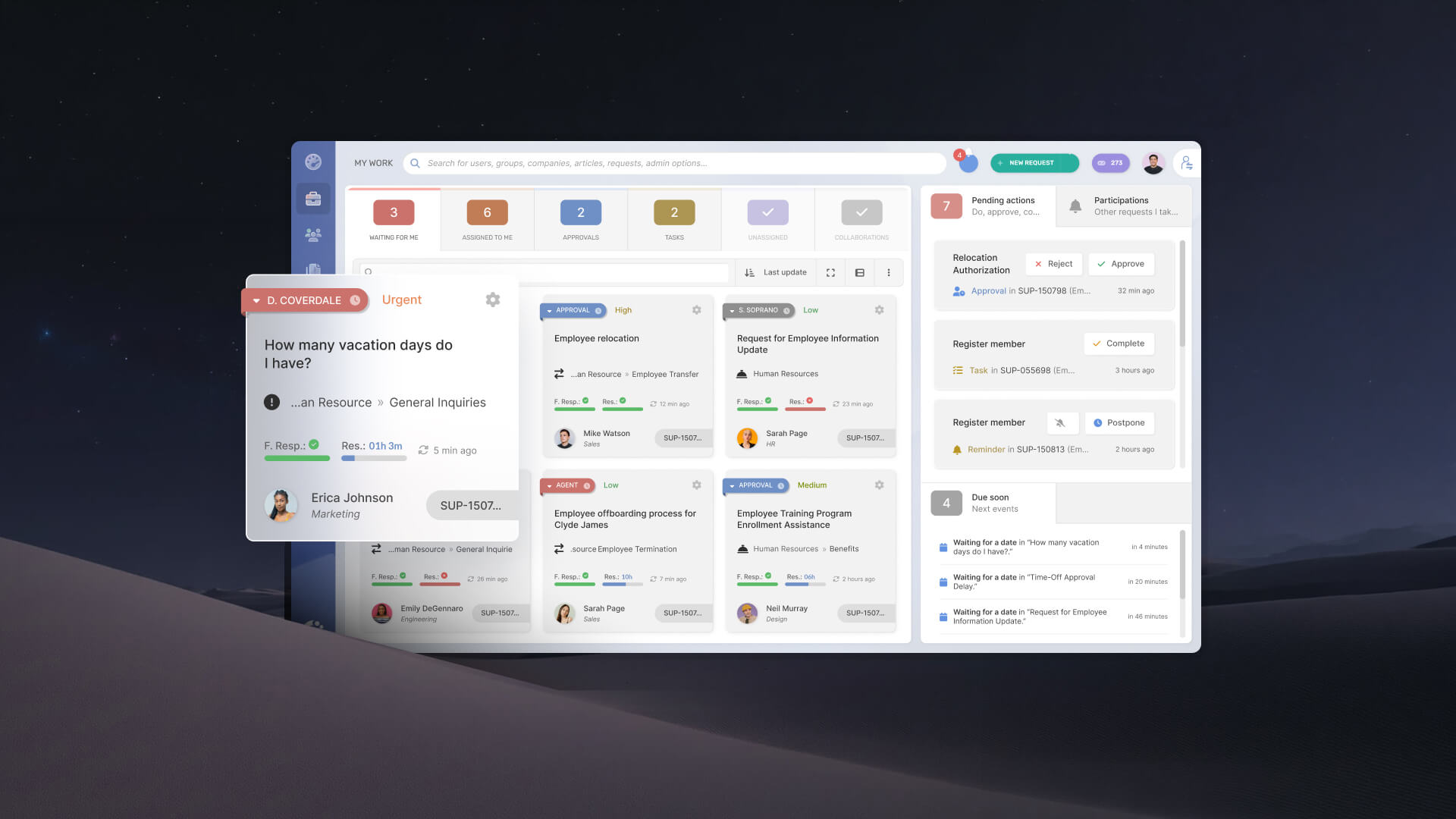
Real estate operations don't stop. Agents work from field offices, shared spaces, and client sites. IT requests come in through WhatsApp, email, and phone calls — with no central record and no SLA in sight. If your team is still triaging support through group chats, this list is for you.
This guide focuses on internal IT and operational support — not customer-facing portals or property inquiry tools. The platforms below help real estate IT teams manage tickets, automate workflows, and cover HR and facilities from a single system.
Key takeaways
- Real estate IT teams face a specific challenge: distributed agents, field-based staff, and multiple office locations that need structured internal support — not just a customer inbox.
- The right help desk centralizes requests, automates routing, and enforces SLAs across IT, HR, and facilities from a single platform.
- No-code configuration matters: real estate IT teams are lean and can't afford lengthy implementations or vendor-managed changes.
- InvGate Service Management covers IT, HR, and facilities Request Management in one platform — configurable without code and deployable in days.
- Pricing, deployment model, and ESM readiness vary significantly across vendors — evaluate based on your team structure, not just features.
Why real estate companies need a dedicated help desk
Real estate firms run on distributed infrastructure. A mid-sized brokerage might have a central IT team supporting dozens of branch offices, field agents without a fixed desk, and facilities staff managing properties across multiple cities. That setup creates support problems that a shared inbox or a Slack channel can't solve.
The typical failure points:
-
Lack of traceability. Requests arrive by WhatsApp, email, or phone. There's no ticket, no owner, no SLA, and no record of resolution. When the same issue recurs two weeks later, the team starts from scratch.
-
Decentralized support. Branch offices don't have local IT staff. When a printer breaks or a VPN fails, the field agent has no structured channel to escalate — and IT has no visibility into the backlog across locations.
-
Mixed request types. IT tickets, HR onboarding requests, and facilities maintenance reports land in the same inbox. Without a proper ticketing system, nothing gets routed, prioritized, or measured.
-
Frequent employee turnover. Real estate has high agent turnover. Provisioning and deprovisioning access across systems is a recurring workload that manual processes handle poorly.
A purpose-built help desk doesn't fix the complexity of real estate operations — but it gives IT the structure to manage it. Centralized ticket intake, automated routing, SLA enforcement, and multi-department coverage are table stakes, not differentiators.
Scope note: This guide does not cover customer-facing support tools for property inquiries or buyer/tenant portals. The focus is on internal IT and operational support for real estate firms.
What to look for in help desk software for real estate
These are the criteria used to evaluate the platforms in this list. Use them as a selection framework for your own evaluation.
-
Multi-location support. The platform should handle request intake and assignment across branches without requiring manual coordination. Agents in different offices should get consistent support regardless of location.
-
ESM capabilities. Real estate IT teams rarely support only IT. HR onboarding, facilities maintenance, and contract-related requests often land on the same team. Look for enterprise service management capabilities — multiple departments, separate catalogs, unified visibility.
-
No-code configuration. Lean IT teams can't wait on vendors to update workflows or add categories. The platform should let an IT admin configure routing rules, service catalogs, and approval flows without writing code.
-
SLA management and automatic escalation. Distributed teams need enforceable SLAs. If a field agent's VPN is down, that ticket should escalate automatically after a defined threshold — not sit in a queue until someone checks manually.
-
Self-service portal. A help desk software with self-service portal lets agents resolve common issues without opening a ticket. That reduces volume for IT and cuts resolution time for the agent.
-
Integration with existing channels. If your agents already use Microsoft Teams or WhatsApp for internal communication, the help desk should meet them there — not ask them to adopt a new channel.
-
Deployment time and adoption curve. Real estate IT teams don't have months for implementation. Prioritize platforms that can be configured and deployed in days, not quarters.
Best help desk software for real estate
Methodology note: InvGate develops ITSM and ITAM software and is one of the vendors evaluated in this list. The analysis below is based on public documentation, official demos, and user reviews on Gartner Peer Insights, G2, and Capterra. All vendors receive the same structural treatment.
1. InvGate Service Management
InvGate Service Management is a no-code ITSM/ESM platform with an integrated AI Hub. It covers IT, HR, and facilities from a single instance — without requiring a partner for initial configuration.
Key features for real estate IT teams:
- Service catalog configurable by department. IT, HR, and Facilities can each have their own catalog without separate instances.
- Multi-channel self-service portal — accessible via web portal, Microsoft Teams, WhatsApp, and email. Field agents can submit and track requests from whatever channel they already use.
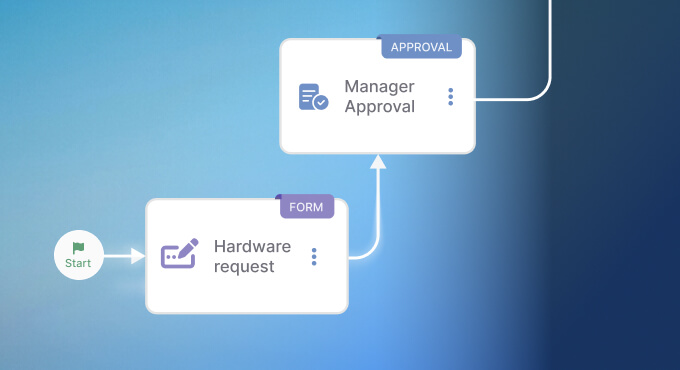
- Drag-and-drop workflow builder. Routing rules, approval chains, and escalation logic are configured visually — no code, no vendor dependency.
- SLA management with automatic escalation and breach alerts.
- AI Virtual Agent for ticket deflection on high-volume, low-complexity requests.
- Customizable dashboards for IT managers tracking volume, SLA compliance, and team performance across locations.
Deployment: Available as cloud and on-premise, with feature parity across both models.
Pricing: InvGate Service Management has flexible pricing plans that scale to meet the unique needs of your organization.
-
Starter: 24.98/agent/month billed annually and 5 agents minimum - $1499/year.
-
Pro: $500/agent/year. 5-50 agents.
-
Enterprise: Custom pricing for larger organizations.
2. Freshservice
Freshservice is a cloud-based ITSM platform from Freshworks with strong AI capabilities through its Freddy AI layer. It's a mature product with broad market adoption across mid-market and enterprise IT teams.
Freshservice is a capable platform for teams already in the Freshworks ecosystem. Configuration flexibility is solid, though more advanced workflow logic may require Freshworks Professional Services involvement. Strong choice for firms that prioritize a polished out-of-the-box experience.
Key features for real estate IT teams:
- Multi-department ESM support with separate service portals per team.
- Freddy AI for automated ticket categorization, suggested responses, and agent assistance.
- Asset management module included natively.
- Pre-built integrations with Microsoft 365, Slack, and Jira.
Pricing: Starts at $19/agent/month (Growth plan). Enterprise plans with full AI features are priced higher. - Checked on June 2026 (US) official website.
3. Zendesk
Zendesk is widely known as a customer support platform, but its Employee Service suite (Zendesk for Employee Service) addresses internal IT and HR use cases. It's a strong option for real estate firms that need both customer-facing and internal support under a single vendor.
Key features for real estate IT teams:
- Unified agent workspace with omnichannel intake (email, chat, Teams, WhatsApp).
- Workforce management and advanced reporting for IT managers.
- AI-powered ticket routing and summarization.
- Flexible views and SLA tracking per department.
Pricing: Employee service suite prices (with annual billing).
- Suite Team: $29 per agent/month.
- Suite Growth: – $59 per agent/month.
- Suite Professional: $98 per agent/month.
- Suite Enterprise: price available upon request.
- Checked on: June 2026 (US), official website.
4. Jira Service Management
Jira Service Management (JSM) is Atlassian's ITSM platform. It's tightly integrated with the Jira and Confluence ecosystem, which makes it a natural fit for real estate IT teams that already run their project tracking or documentation in Atlassian tools. For teams already on Atlassian, it's one of the most integrated options available.
Key features for real estate IT teams:
- Native integration with Jira Software for cross-team visibility.
- ITIL-aligned workflows for incident, problem, and change management.
- Asset and configuration management via Assets (formerly Insight).
- Forms-based intake configurable per team.
Pricing: The following rates apply to a 50-agent deployment:
- Standard: Starting at $20.63 per agent / per month.
- Premium: Starting at $52.16 per agent / per month.
Checked on: June 2026 (US), official web.
5. HappyFox
HappyFox is a help desk platform with both customer support and internal IT use cases. It appears frequently in real estate-specific searches — though its core design leans toward customer-facing support, it has added internal ticketing capabilities over time.
Key features for real estate IT teams:
- Omnichannel ticket intake (email, phone, chat, social).
- Internal help desk module separate from customer-facing queues.
- SLA management and automation rules.
- Reporting and analytics dashboards.
Pricing: Agent-based plans (billed annually):
- Basic: $24 per agent/month (up to 5 agents).
- Team: $49 per agent/month.
- Pro: $99 per agent/month.
- Checked on: June 2026 (US), official website.
For a broader comparison across categories and use cases, see the best help desk software options reviewed in depth.
Disclaimer: All product names, logos, and brands are property of their respective owners. All company, product, and service names used on this site are for identification purposes only. Use of these names, trademarks, and brands does not imply endorsement. Comparisons are based on publicly available information as of April 2026 and are provided for informational purposes only.
How to choose the right help desk software for your real estate team
The vendor comparison above is a starting point. The decision comes down to your team's actual structure and priorities. Four questions that cut through the noise:
-
¿Is the focus internal IT support, external customer support, or both? Most platforms optimize for one. If your primary need is internal — IT tickets, HR requests, facilities issues — prioritize ITSM-native platforms like InvGate Service Management, Freshservice, or JSM. If customer-facing support is equally important, Zendesk or HappyFox may offer better coverage across both use cases.
-
How many offices or locations need support? A single-office team can manage with simpler tooling. A firm with 10+ branch offices needs structured routing, location-aware assignment, and SLA visibility per site. Confirm that the platform supports multi-location ticket management natively before committing.
-
Can the IT team configure and maintain the tool without vendor involvement? This is a practical constraint, not a feature check. If every workflow change requires a support ticket to the vendor, your team will end up working around the tool instead of with it. No-code configuration isn't a nice-to-have for lean IT teams — it's a requirement.
-
Does the platform need to cover HR and Facilities in addition to IT? If the answer is yes, the shortlist narrows. Not all platforms on this list support multi-department ESM at the same level. Confirm ESM scope — separate service catalogs, per-department SLAs, independent agent queues — before the evaluation ends.
A service catalog is one of the fastest ways to structure intake across departments. If the platform can't build one without code, it will create more work for IT, not less.
For teams managing physical assets across locations, a maintenance ticketing system for facilities teams is worth evaluating as a complementary layer.
FAQs
What features should a real estate help desk have? A real estate help desk needs multi-location ticket routing, SLA enforcement, a self-service portal for field agents, and ESM capabilities to handle IT, HR, and facilities requests in one system. No-code configuration is critical for lean IT teams that can't rely on vendor support for every change.
Do real estate firms need ITSM software or just a ticketing system? A basic ticketing system handles intake and tracking. ITSM software adds SLA management, workflow automation, service catalog, and multi-department support — which real estate firms with distributed teams and mixed request types typically need. A ticketing system is the floor; ITSM is the ceiling.
How is help desk software for real estate different from property management software? Property management software (such as Buildium or AppFolio) manages leases, rent collection, maintenance requests from tenants, and property financials. Help desk software for real estate manages internal IT and operational support for the firm's own staff — agents, HR, facilities teams. They solve different problems and serve different users.
Can one platform handle IT, HR, and facilities requests for a real estate company? Yes — platforms with ESM capabilities can manage multiple departments from a single instance, with separate service catalogs, SLAs, and agent queues per team. InvGate Service Management, Freshservice, and Jira Service Management all support this model. Confirm ESM scope with each vendor before selecting.