











The best asset tracking software for retail gives IT teams a continuously updated inventory of every device across every store (POS terminals, barcode scanners, receipt printers, laptops, and network equipment) along with the chain of custody records, audit dashboards, and vendor visibility that multi-location retail IT operations require. For retail chains, IT Asset Management (ITAM) isn't a back-office function: a POS terminal that goes offline during peak hours is a revenue problem, and knowing what's deployed where is what prevents it from becoming a recurring one.
A clarification on terminology: searches for "asset tracking software for retail" return three different categories. GPS and RFID platforms (Samsara, AirFinder) track the physical location of assets in motion: delivery vehicles, containers, and field equipment. Retail inventory and ERP systems track merchandise stock: what's on shelves, what's in the warehouse, and what needs to be ordered. This article covers the third category: IT asset tracking platforms that manage the technology the IT department deploys across store locations.
Retail IT environments have a scale and operational complexity that most standard ITAM tools weren't designed for. The differences that matter are specific.
A regional retail chain with 200 stores manages thousands of devices distributed across locations that each have their own network, their own vendor relationships, and their own local IT footprint. Corporate IT can't physically visit every store, so asset tracking must work remotely and automatically. Location hierarchy (store, region, country) needs to be built into the data model, not approximated with spreadsheet filters.
Without centralized visibility, answering basic questions becomes a project. Which stores have equipment approaching end-of-life? What's the warranty status of the POS terminals installed last quarter? What does the asset forecast look like for next quarter's new store openings? With the right platform, those answers are a report away.
Retail IT involves a moving parts problem that office IT doesn't: technicians carry replacement equipment between a central depot and store locations, and critical devices move constantly. Without traceability at each handoff, the inventory drifts. A device shows as "in depot" when it's actually in a technician's van. A store shows as fully equipped when a POS terminal was swapped out and never logged.
Mobile-based asset updates, where technicians scan and update device status, location, and assignment from the field, close that gap. When every handoff is recorded, the inventory reflects what's actually deployed, not what was last manually entered.
Retail has the highest annual employee turnover rate of any industry, and most retail IT teams are simultaneously managing ongoing departures, new hires, and new store openings. Each of those events involves device assignments that need to be tracked, updated, and in some cases reclaimed. When a departing employee's device isn't logged back into the system, it becomes a ghost asset: present somewhere, counted as available, but functionally lost.
New store openings add another layer: coordinating laptop provisioning, POS setup, network equipment, and vendor scheduling across dozens of stakeholders. When that coordination runs on email and spreadsheets, equipment arrives late and openings get delayed.
Retail IT audits are complex because the asset estate is distributed across hundreds of locations, managed by different teams, and supported by multiple vendors. Compiling audit evidence manually (exporting data from different systems, reconciling spreadsheets, tracking down warranty records) can take weeks. The result is usually a snapshot of what the data shows, not what's actually true.
An asset tracking platform that maintains a continuously updated, location-aware inventory produces audit evidence on demand rather than through manual reconstruction. That's the difference between an audit that takes a day and one that takes three weeks.
The following platforms are evaluated as IT asset tracking solutions for retail IT departments. Pricing reflects each vendor's publicly available information as of July 2026.

InvGate Asset Management is a no-code, scalable ITAM platform that manages hardware, software, cloud, and non-IT assets from a single interface. It supports cloud and on-premises deployment and is designed to deliver professional visibility over the IT estate without the implementation complexity of enterprise platforms. Multi-location retail is one of its most established verticals, with deployments spanning chains of hundreds and thousands of stores.
The Día Argentina case study shows what this looks like in practice. The supermarket chain (1,000 stores, 3,200 employees, seven provinces) used InvGate Asset Management to build full visibility over 28,000+ assets across its entire operation, combining discovery agents, VMware and SNMP integrations, and a mobile app for store technicians to log asset changes in the field. Audit preparation dropped from 20 days to a single day. Employee onboarding went from 11 days to 1. Franchise agreement processing dropped from 90 days to 15.
"With InvGate Asset Management, we gained control over our teams and improved estimates, reports, and timelines. When an audit is scheduled, the information is available within a day."
Sebastián Laporte, IT Services Manager at Día Argentina
The following capabilities make InvGate Asset Management a strong option for retail IT teams managing distributed, high-volume asset estates.

Start a 30-day free trial or talk to Sales to find the right plan. Both options give access to the full platform from day one.
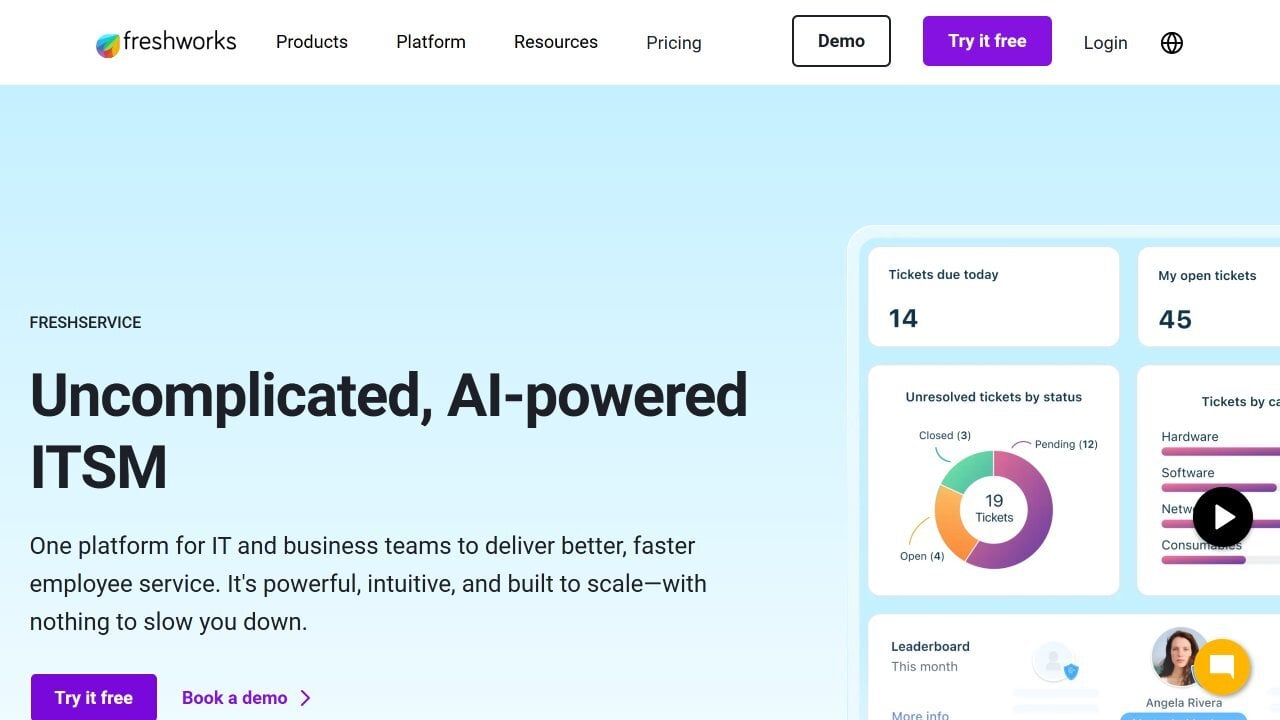
Freshservice is a cloud-native ITSM and ITAM platform that combines IT service desk capabilities with hardware and software asset tracking. Its Asset Management module covers lifecycle tracking, Contract Management, and software license reconciliation, integrated directly with its ticketing and Change Management workflows. For retail IT teams managing both the device estate and the service desk that keeps stores operational, Freshservice's unified approach reduces the gap between knowing what's deployed and managing what goes wrong. It is widely used in retail and hospitality organizations and offers integrations with the SaaS tools those teams already use.
Freshservice publishes its pricing by plan tier. For current plan details or to start a free trial, visit their official site.
ManageEngine AssetExplorer is an IT Asset Management solution available in cloud and on-premises editions, combining agent-based and agentless discovery with lifecycle tracking, software license management, and a built-in CMDB. Its financial tracking covers hardware from procurement through disposal, with depreciation calculation, Contract and Warranty Management, and purchase order workflows. For mid-size retail chains that need structured ITAM with financial data per asset and multi-location reporting, AssetExplorer provides that depth at a mid-market price point.
ManageEngine AssetExplorer's pricing starts at $955/year for on-premises or $1,245/year for cloud (250 assets). A free edition for up to 25 assets and a 30-day free trial are available.
Lansweeper is an agentless network discovery platform that scans using WMI, SNMP, and SSH protocols to build complete hardware and software inventories without installing agents on endpoints. Its coverage extends to IT, OT (Operational Technology), and IoT devices, making it relevant in retail environments where POS terminals, payment card readers, digital signage, and connected store equipment share the same network infrastructure as standard IT assets. Discovered data integrates with ITSM platforms for broader lifecycle and Service Management workflows.
Lansweeper offers a permanent free plan for up to 100 assets. Paid plans scale based on asset volume. A 14-day trial is available; for plan details, visit their official site.
ServiceNow ITAM is the IT Asset Management module within the Now platform, combining Hardware Asset Management and Software Asset Management in a unified environment built on the same CMDB that drives the platform's IT Service Management, Change Management, and security operations modules. For large retail conglomerates and multi-brand chains already standardized on the ServiceNow ecosystem, the depth of native integration (asset records feeding directly into change workflows, vendor management, and compliance reporting) is a significant operational advantage.
ServiceNow ITAM pricing is not publicly listed and is structured as part of broader Now platform licensing. Implementation typically requires certified ServiceNow partners and extended timelines. For pricing or to begin an evaluation, contact ServiceNow through their official site.
Retail IT teams face an asset tracking problem at a scale and velocity that most platforms weren't originally designed for: thousands of devices distributed across hundreds of locations, constant equipment movement between stores and depots, high employee turnover creating continuous provisioning and reclamation cycles, and audit requirements that can't wait weeks for manual data compilation. The platforms that serve them best are those built for multi-location visibility, field-ready mobile traceability, and automated lifecycle workflows that keep pace with retail operations.
InvGate Asset Management covers that scope with a deployment model retail IT teams can operate without specialist support. InvGate Service Management connects the asset estate directly to incident management and vendor coordination workflows, so the full cycle (from tracking what's deployed to resolving what breaks) runs from a single platform.
Disclaimer: All product names, logos, and brands are property of their respective owners. All company, product, and service names used on this site are for identification purposes only. Use of these names, trademarks, and brands does not imply endorsement. Comparisons are based on publicly available information as of July 2026 and are provided for informational purposes only.
ServiceNow is a registered trademark of ServiceNow, Inc. InvGate is not affiliated with, sponsored by, or endorsed by ServiceNow.


