If you're running IT with two to ten people, you've probably looked at ITSM platforms and immediately thought: this is built for someone three times our size. Small IT teams face a different set of ITSM challenges than large enterprises. With limited staff, every hour spent configuring workflows, maintaining the platform, or managing complex processes is time taken away from supporting users and improving services.
Many ITSM tools were designed with larger organizations in mind, often requiring significant administrative effort, lengthy implementations, or specialized expertise to operate effectively. For teams of just a few IT professionals, that level of overhead can outweigh the benefits the platform is meant to provide.
In this article, we'll look at what makes an ITSM platform a good fit for small teams, including the features, deployment considerations, and management requirements that have the greatest impact on day-to-day operations. We'll also review five ITSM solutions that balance functionality with ease of administration, making them practical options for lean IT organizations.
Key takeaways
- Small IT teams need ITSM software they can configure, maintain, and evolve without external consultants or dedicated admins.
- The biggest overhead drivers in ITSM are implementation complexity, workflow configuration, and ongoing platform maintenance — not ticket volume.
- No-code workflow builders, self-service portals with knowledge bases, and AI-assisted deflection are the features that multiply capacity for lean teams.
- The right ITSM platform for a small team grows with the organization — starting with ticketing and expanding to ESM without a platform change.
Why small IT teams struggle to run most ITSM platforms
A three-person IT team at a growing company gets to a point where email threads and Slack messages stop working. Someone proposes a proper ITSM platform. They run a few demos, pick a tool — and six months later, half the team is still running support out of a shared inbox because the platform was never fully configured.
This pattern shows up constantly in Spiceworks threads, where IT pros at small shops describe the same friction: "we bought the tool, but it's running us." The problem isn't technical incompetence. It's that most ITSM platforms weren't designed for autonomous operation by a lean team.
The specific pain points tend to cluster around four areas:
-
Implementation that requires external partners. Many enterprise-grade platforms build their revenue model around professional services. Configuring them properly requires someone with platform certification, a project plan, and a timeline measured in months — not hours.
-
Workflow changes locked behind development cycles. When a routing rule needs to change or a new approval step is required, the team has to open a ticket to the vendor, wait for a developer, or learn a proprietary scripting language. In a small team, no one has that time or those skills.
-
Platform administration as a second job. In larger organizations, there's usually a dedicated ITSM admin. In a team of five, the person maintaining the platform is the same person resolving P1 incidents. When maintenance takes meaningful time each week, it becomes a tax on the entire operation.
-
Enterprise modules no one will ever use. Platforms sized for thousand-seat organizations come with feature sets that require specialized knowledge to configure and ongoing attention to maintain. A small IT team working without dedicated resources ends up paying for complexity — in licensing, in maintenance overhead, and in cognitive load — that delivers no return.
The symptoms usually appear before the diagnosis: teams stuck in email because the portal never got finished, SLAs missed because routing was never set up correctly, or a backlog that grows every Monday because tickets aren't being categorized automatically.
What "manageable" actually means for a small IT support team
Before evaluating any platform, it's worth making the definition concrete. "Easy to use" and "easy to manage" aren't the same thing. A platform can have a clean interface and still require a full-time admin to keep it running.
For a small IT team, manageable means four specific things:
-
Implementation without a partner. The team can go from sign-up to live tickets without engaging a reseller, consultant, or professional services firm. Check: can you complete a basic setup — categories, portal, routing rules — in a single day? For a reference point, see what help desk software you can implement without a partner looks like in practice.
-
Workflow configuration without code. Any team member with admin access can modify routing logic, add an approval step, or create a new category without writing a script or raising a change request with the vendor. The real question: can your team reconfigure a workflow without opening a support ticket to the vendor?
-
Ongoing maintenance by the team itself, without specialized knowledge. Updates don't break configurations. Reporting is built in. Adding a new service category doesn't require understanding a data model. The platform stays functional without recurring technical intervention.
-
Scalability without a platform change. When the team grows from five to fifteen people, or when HR asks to join the service desk, the platform can accommodate that without a migration project. Starting with ticketing and expanding to ESM should be a configuration change, not a new purchase.
5 ITSM Platforms Small IT Teams Can Actually Manage
The tools below were evaluated specifically on manageability: implementation time, configuration without code, and ongoing admin overhead. Pricing figures reflect publicly available information and should be confirmed directly with vendors.
1. InvGate Service Management
Overview. InvGate Service Management is built around the idea that IT teams shouldn't need developers or consultants to configure their own service desk. It's an ITSM and ESM platform that emphasizes no-code configuration and internal ownership — the workflows, portal, and categories are all managed by the team itself, without requiring professional services to unlock core functionality.
Relevant features for small teams:
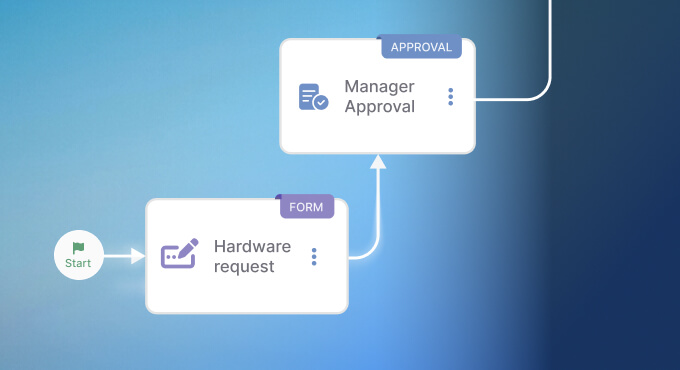
- No-code workflow builder with drag-and-drop canvas: triggers, conditions, approvals, assignments, and escalations assembled visually — no scripting.
- Self-service portal with integrated knowledge base and service catalog, configurable without code.
- AI Hub with virtual service agent deployable in Microsoft Teams and WhatsApp — connects to the knowledge base automatically, with no manual training required.
- Knowledge Discovery: analyzes closed tickets and generates knowledge snippets automatically, growing the knowledge base even when no one is actively writing articles.
- SLA management out of the box, including automatic escalation before breach.
- Pre-built workflow templates for onboarding, offboarding, change requests, and access management.
- Integration with InvGate Asset Management.
On setup time. Users report going from zero to a working help desk in under 20 hours of consultancy for basic setups. Standard cloud implementations typically run in a few weeks for more complex environments. No mandatory professional services engagement is required to go live.
Pricing.
- Starter: 24.98/agent/month billed annually and 5 agents minimum - $1499/year.
- Pro: $500/agent/year. 5 - 50 agents
- Enterprise: Custom pricing for larger organizations.
2. Freshservice
Overview. Freshservice is a cloud-based ITSM platform from Freshworks designed for ease of use. Its Starter plan targets small IT teams moving away from shared inboxes, and the platform offers a no-code workflow automator alongside a self-service portal and knowledge base.
Relevant features for small teams:
- No-code drag-and-drop workflow automator on all paid plans
- Self-service portal with knowledge base integration — contextual article suggestions during ticket submission
- Freddy AI for response drafting and knowledge article creation (available as add-on or on higher tiers)
- SLA management with automation for escalations
- Mobile app included
Pricing. Starter plan from $19/agent/month (billed annually). Note: Asset Management and Change Management require higher tiers, and AI capabilities are add-ons on most plans rather than included. - Checked on June 2026 (US) official website.
3. Jira Service Management
Overview. Jira Service Management (JSM) is Atlassian's ITSM platform, built on top of the Jira platform. It's a strong fit for teams already in the Atlassian ecosystem.
Relevant features for small teams:
- Pre-built ITSM templates for fast project creation
- Automation rules for triage, categorization, and routing
- Embedded knowledge base (powered by Confluence on higher plans)
- Portal for end-user request submission
Pricing. JSM has four pricing tiers (Free, Standard at ~$20/agent/month, Premium at ~$53/agent/month, Enterprise). The Free plan is capped at 3 agents and 500 automation runs per month — workable for proof of concept, constraining in practice. Teams that need Asset Management or advanced change workflows will require Premium. - Checked on: June 2026 (US), official web.
4. ManageEngine ServiceDesk Plus
Overview. ManageEngine ServiceDesk Plus is a well-established ITSM platform used by a wide range of organizations, from small businesses to large enterprises. Its Standard edition offers a free tier for up to five technicians, which is useful for very small teams getting started.
Relevant features for small teams:
- Incident management, knowledge base, and self-service portal in Standard tier
- Professional tier adds IT asset management
- Enterprise tier includes full ITIL suite (change, release, service catalog)
- Free tier for up to 5 technicians with basic functionality
Pricing. Pricing starts at $13/technician/month for Standard (cloud). Add-ons and tier upgrades can raise total costs over time. - Checked on: June 2026 (US), official website.
5. HaloITSM
Overview. HaloITSM is a fully ITIL-aligned platform that takes a different pricing approach: one license covers all modules — ticketing, asset management, change control, knowledge base — with no feature gating by tier. This matters for small teams that want ITIL depth without having to upgrade to access change management or asset tracking.
Relevant features for small teams:
- Full ITIL module access on a single license (no separate charges per module)
- Ticketing, asset management, self-service portal, and knowledge base included
- Automation for incident routing and management
- Integrates with Microsoft Teams, Azure AD, and other common tools
Pricing. HaloITSM doesn't publish pricing on its website — you'll need to contact them for a quote.
ITSM software features that reduce admin overhead
Once the definition is clear, feature evaluation becomes more focused. The question isn't "does this platform have automation?" — it's "can my team use this automation without writing code or hiring someone?"
1. No-code workflow builder. This is the single highest-leverage feature for a small team. Any admin should be able to modify routing rules, escalation paths, and approval chains using a visual interface — no scripting required. When a workflow change takes fifteen minutes instead of a day, the team can iterate on their processes instead of living with outdated ones. Good ITSM automation doesn't require a developer to implement.
2. Automatic ticket routing and categorization. Manual triage at low ticket volumes is manageable. At fifty or more tickets per week, it becomes a time sink that pulls the team away from actual resolution work. Automatic routing based on category, keywords, or request type eliminates that triage burden entirely — tickets arrive at the right queue, assigned to the right person, without anyone touching them first.
3. SLA management out of the box. Small teams don't have time to build SLA configurations from scratch. A platform that ships with sensible defaults — response targets, escalation rules, breach notifications — lets the team activate SLA tracking from day one, without a configuration project.
4. AI-assisted deflection. For lean teams, an AI layer that can handle common requests (password resets, VPN access questions, software installations) allows for fewer repetitive tickets to reach them from the start. The key is that this capability should be available without significant setup or a separate tool to configure.
These five features, together, are what allow a small IT team to operate a proper ITSM platform without full-time admin overhead. For a broader look, see a comparison of help desk software with no-code workflow automation.
FAQs
What is the easiest ITSM software to implement for a small team?
The easiest ITSM tools to implement are those that don't require professional services, external consultants, or scripting to go live. The key criteria: cloud-native deployment (no infrastructure setup), no-code configuration for workflows and categories, and pre-built templates that let you start from a working structure rather than a blank canvas.
Can a small IT team run an ITSM platform without a dedicated admin?
Yes — if the platform is designed for it. The difference is in the architecture: platforms that require scripting, regular vendor intervention for changes, or specialized technical knowledge to maintain create an ongoing admin burden. Platforms built on no-code configuration, with visual workflow editors and self-managed portals, allow any IT team member with admin access to make changes without involving anyone outside the team.
What features does a small IT team actually need in an ITSM tool?
The baseline for a lean team is: structured ticketing with categories and priorities, automated routing so tickets reach the right person without manual triage, a self-service portal connected to a knowledge base to deflect repetitive requests, basic SLA tracking with escalation, and a no-code way to change workflows as processes evolve.
How long does it take to implement ITSM software for a small team?
It depends heavily on the platform and the scope. With a no-code ITSM tool designed for fast deployment, a small team can have a working service desk — categories, portal, routing rules, and basic SLAs — in hours. A more complete configuration (knowledge base populated, workflows tuned, integrations connected) typically takes a few days to a few weeks.