











An enterprise service desk is a service desk built to run at organizational scale: high ticket volume, many departments, strict governance, and AI that operates inside controlled processes. What makes it "enterprise" is not a bigger version of the same tool. It is a different set of requirements around routing, control, auditability, and the data foundation that automation and AI depend on.
This guide covers what actually changes at scale and how to evaluate a platform against it, with InvGate Service Management as a running example of each requirement.


A standard service desk is usually built around a defined support function, often IT, with a relatively contained set of processes and integrations. An enterprise service desk operates as a service management platform across departments, systems, and workflows. It has to connect the people requesting services with the teams, data, and platforms responsible for delivering them.
Three shifts define the difference:
The result is a different evaluation criteria. The question is not simply whether a service desk can process a high volume of tickets. It is whether the platform can connect services, teams, systems, and data while maintaining the governance needed to operate at enterprise scale. The rest of this guide looks at the capabilities that make that possible.
This is where enterprise ITSM diverges from a help desk that has simply grown. The evaluation question shifts from "can it handle our tickets?" to "can it handle our tickets across departments, under governance, on a foundation automation can build on?" The rest of this guide answers that second question.
An IT service desk primarily focuses on IT-related issues such as software troubleshooting, hardware failures, and access requests. Its main users are internal employees who require technical assistance. An enterprise service desk, however, extends beyond IT to cover a range of business functions. It supports HR, finance, procurement, legal, and other departments, allowing employees and external users such as suppliers or partners to submit service requests through a single system.
Another key difference is scalability. While an IT service desk is often structured around technical support, an enterprise service desk is built to handle the needs of an entire organization. It integrates different departments, enabling automation and data sharing across multiple business units. This allows companies to provide faster service, reduce manual work, and improve coordination between teams.
These are the capabilities that separate an enterprise-grade platform from a tool that happens to have a lot of users. For each, here is what changes at scale and how InvGate Service Management addresses it.
At enterprise scale, employees should never have to guess whether a request goes to IT, HR, or Facilities. Scattered inboxes and forms produce misrouted tickets, duplicated work, and slow resolution.
InvGate Service Management uses a unified service catalog, so every request type has a defined home, owner, and form. Forms carry custom fields per type, so the right information is captured at intake and the ticket lands with the team that can act on it. AI creates keywords for request categories to keep the catalog navigable as it grows, and surfaces each user's most frequent requests first in the self-service portal.
Enterprise processes are multi-step, multi-team, and change often. Waiting on paid professional services hours for every edit does not hold up when you maintain dozens of processes.
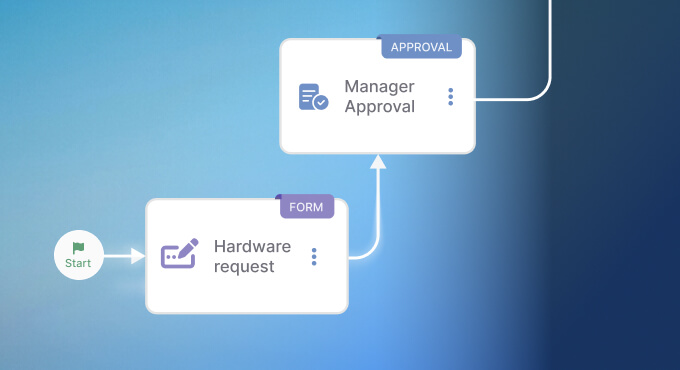
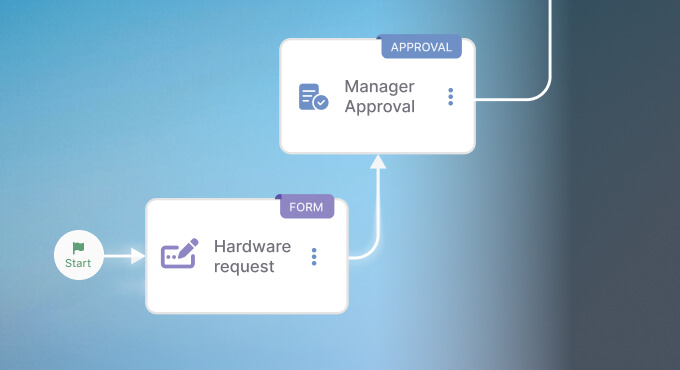
The drag-and-drop Workflow Builder lets teams create and edit workflows, automations, and custom fields with no code and no paid services hours. Automated process guardrails keep those workflows consistent as volume grows, so a process behaves the same way on ticket one and ticket ten thousand.
Scale brings scrutiny. Audits, compliance requirements, and internal controls all assume you can show who did what, when, and under whose approval.
InvGate Service Management keeps an audit trail on tickets and builds approvals into the workflow itself. Approvers do not require a paid license, which keeps governance from becoming a per-seat cost as reviewers are added across departments. Role-based access scopes sensitive processes to the right people, alongside the access controls and security posture enterprise IT expects.
AI multiplies what it is given. Pointed at undocumented, disconnected processes, it multiplies the mess. The enterprise requirement is not "does it have AI" but "does the AI work inside governed processes with traceability."
InvGate Service Management applies AI with that principle in mind. The Virtual Service Agent tries to resolve first, deflecting tickets by answering from your knowledge before anything is created; when a request does need a human, it hands off with context already attached.
Knowledge Discovery surfaces relevant answers to agents and help keep the knowledge base current. Smart Ticket Assignment routes work to the right agent, and Expert Collaborator Suggestion pulls in the right people for complex cases. The complet AI Hub features owrks alongside AI Hub Reports to keep a view of where AI is acting and what it produces, so automation stays observable rather than becoming a black box.
AI and automation are only as good as the context they run on. An agent resolving an incident needs to know what the affected service depends on, who owns it, and what changed recently.
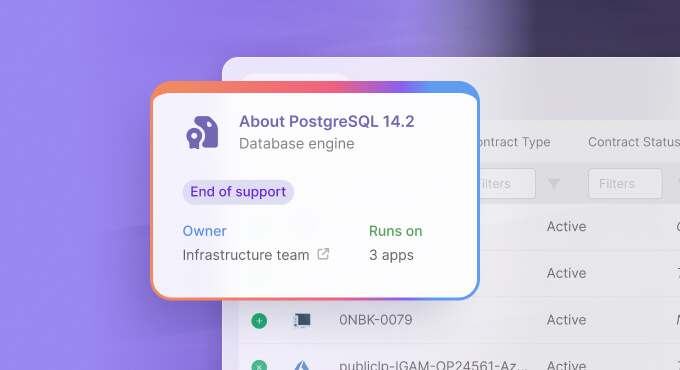
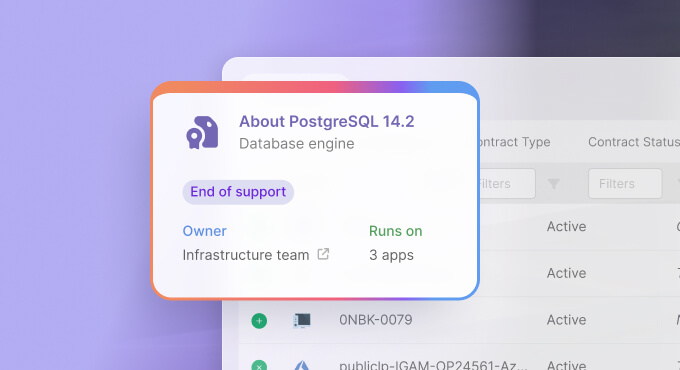
This is where InvGate Service Management pairs with InvGate Asset Management. Asset Management provides the CMDB, the inventory, ownership, and dependency map across your infrastructure, and Service Management draws on it so incidents, changes, and requests carry that context. Together they give automation and AI the federated view they need to act safely.
When service delivery crosses departments, leadership needs to see performance across all of them, not one team at a time.
InvGate Service Management provides integrated dashboards and analytics, plus AI Hub Reports for AI activity. Custom fields feed reporting, so you can measure what matters to each department: ITIL-aligned metrics, custom SLAs, and more.
Enterprise operations are rarely single-site or single-language, and they never run on one tool. InvGate Service Management offers multi-language support, rules-based SLAs, a mobile experience, and integrations with tools like Jira Software, Azure DevOps, Active Directory, and more, so the service desk fits the environment you already run.
The clearest sign a service desk has reached enterprise scale is that other departments want in. Enterprise service management (ESM) is the practice of giving those teams the same structure IT relies on, catalogs, workflows, SLAs, and self-service, without standing up a separate tool for each one.
An ESM platform makes that possible on a single foundation. Because InvGate Service Management is no-code, HR, Facilities, Finance, and other teams become service providers in their own right: each defines its own request types and workflows and keeps its own governance, and employees get one place to ask for anything.
Self-service travels with them. The Virtual Service Agent works in the portal and in the collaboration tools employees already use, including Microsoft Teams, Slack, and WhatsApp, so deflection reaches people wherever they work, across every department that has been onboarded. The foundation that lets IT scale is what lets service management spread across the business.
An enterprise service desk helps organizations manage service requests across multiple departments, improving efficiency and collaboration. By centralizing service management, automating workflows, and integrating with other business systems, companies can enhance their service delivery while reducing operational overhead.
InvGate Service Management provides a robust solution for businesses looking to implement an enterprise service desk. With its scalable architecture, automation features, and multi-department support, it enables organizations to improve service efficiency and user satisfaction. Find out why businesses choose InvGate – Start your 30-day free trial!
What is the difference between an enterprise service desk and a help desk? A help desk resolves individual issues, usually for IT, and tends to be reactive and ticket-focused. An enterprise service desk manages services across the organization with defined catalogs, governed workflows, approvals, and analytics. Help desk work is a subset of what an enterprise service desk does, which is why teams shopping for enterprise help desk software are usually looking for that broader capability set rather than faster ticket handling alone.
What is the difference between enterprise ITSM and ESM? Enterprise ITSM applies IT service management practices, incident, request, change, and problem management, at scale within IT. ESM extends those same practices and tooling to non-IT departments such as HR, Facilities, and Finance. Enterprise ITSM is the foundation; ESM is the expansion onto the same platform.
How many agents or tickets make a service desk "enterprise"? There is no fixed threshold. What defines enterprise is the requirement set, multi-department support, governance and auditability, automation, and a data foundation for AI, rather than a specific headcount or ticket count. Some smaller organizations have enterprise-grade needs, and some large ones do not.
Do we need ITIL to run an enterprise service desk? No. ITIL is a widely used framework for structuring service management practices, and ITIL-aligned tooling helps at scale. Choosing a framework and choosing a platform are separate decisions, and you can implement as much or as little of ITIL as fits your organization.


