










Change Management in IT is always high-stakes — but in manufacturing, the stakes reach a different level entirely. A misconfigured network switch in a corporate office causes a help desk ticket. The same change in a plant environment can halt a production line, delay a shipment, or trigger a safety event. That asymmetry defines everything about how IT change management should work in manufacturing.
The right tool helps teams assess risk, coordinate stakeholders, document decisions, and maintain control throughout the change lifecycle. In this article, we'll examine the key requirements of IT Change Management in manufacturing environments, discuss what capabilities to look for, and introduce tools that support ITIL-aligned change processes.
Key takeaways
Understanding the risks isn't enough. IT and service desk leads in manufacturing face structural challenges that make those risks hard to manage without a formal process.
Unplanned downtime risk from IT/OT dependencies. When a corporate IT change affects a connected OT system — a network segment shared with industrial controllers, a DNS change that disrupts MES connectivity, an authentication update that locks out a SCADA workstation — the result is operational downtime, not just a service disruption. Most IT change processes aren't designed to surface these dependencies at the assessment stage.
Maintenance windows that don't belong to IT. In a standard ITSM environment, the IT team schedules changes during low-impact periods. In manufacturing, those windows are determined by production. A change might need to wait for a planned plant shutdown, a weekend non-production shift, or a coordinated pause in the line. If IT doesn't have a formal mechanism to negotiate and reserve those windows, changes either get delayed indefinitely or get pushed through without proper coordination.
Inconsistent processes across plants. When multiple facilities operate under the same IT organization, the temptation is to standardize everything. But plants often have different ERP versions, different network topologies, and different OT vendors. A change that's routine at one site may carry significant risk at another. The change process has to accommodate that variability without creating so much overhead that it becomes unworkable.
Unauthorized changes that accumulate as technical debt. In the absence of a formal change process, plant technicians and IT staff make quick fixes. A configuration change here, a firewall exception there. None of them go through documentation. None of them go through assessment. Over time, those undocumented changes become invisible risk — the kind that surfaces only when something breaks and no one knows what was changed or when.
When evaluating any of these tools for a manufacturing context, look specifically at how each handles configurable change types, CAB routing, maintenance window scheduling, and audit trail depth. Those are the capabilities that matter most when IT changes carry operational consequences.
Below are four tools that support ITIL-aligned Change Management with workflow automation and formal approval processes.
Methodology note: Before we get started, a quick note: InvGate builds and offers IT Service Management and IT Asset Management solutions, making us an active player in this software market. Some vendors in this article are our competitors. Even so, we aim to deliver accurate, honest, and practical information that helps you make the best decision.
Our evaluations draw from publicly available sources — vendor websites, product documentation, user reviews on platforms like Gartner Peer Insights, G2, and Capterra, analyst reports, and hands-on testing or demos when available.
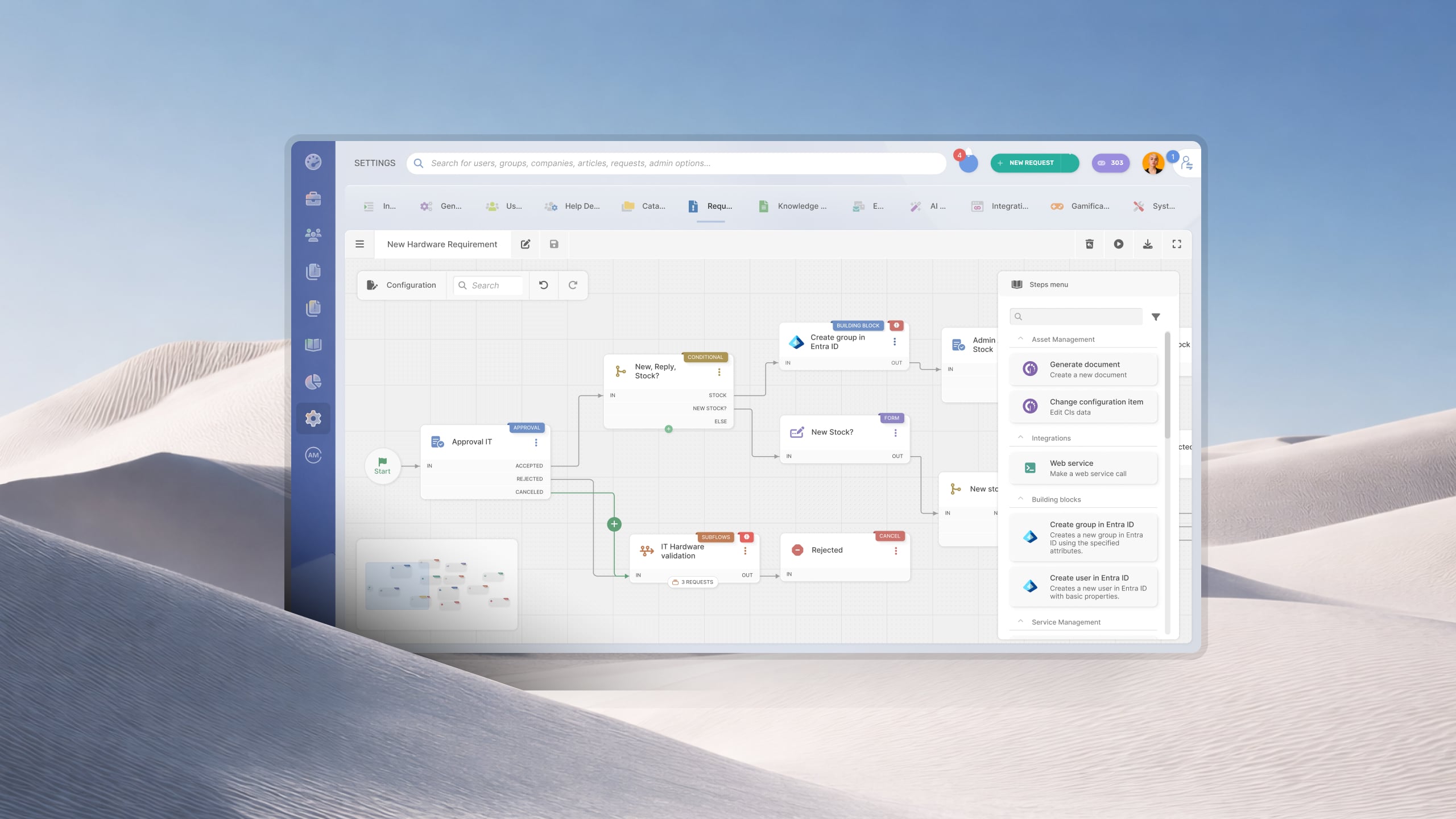
InvGate Service Management is an ITIL-certified ITSM platform with a no-code workflow builder designed for real-world change scenarios. It supports standard, normal, and emergency change types with configurable approval flows, CAB routing, risk assessment fields, and AI-powered impact analysis. Approvers — including operations and OT stakeholders — participate in the approval flow without requiring a licensed agent seat, which matters when you need plant-side sign-off without adding licensing overhead. The platform carries PeopleCert's ITIL 4 accreditation across 15 practices, including Change Enablement.
ServiceNow ITSM is an enterprise-grade platform with mature Change Management capabilities and a strong presence in large manufacturing organizations. It includes configurable approval workflows, change calendars, CMDB-based impact analysis, dependency mapping, and AI-driven risk scoring. Its flexibility allows manufacturers to build detailed governance processes around production-impacting changes, although implementation and administration often require significant internal resources or consulting support.
BMC Helix ITSM is widely used in large enterprises that require formal change governance across complex environments. Its Change Management capabilities include risk assessment, automated approvals, change calendars, dependency mapping, and CMDB integration. Organizations can define separate workflows for standard, normal, and emergency changes while maintaining detailed audit trails and compliance documentation. The platform is particularly well suited to manufacturers with mature ITSM practices and large-scale infrastructure.
ManageEngine ServiceDesk Plus provides ITIL-aligned Change Management with change templates, approval workflows, CAB support, risk categorization, and change scheduling capabilities. Its integration with asset and configuration management functions helps IT teams evaluate the potential impact of planned changes before implementation. The platform is commonly adopted by mid-sized and large manufacturing organizations looking to formalize change processes without the complexity associated with larger enterprise suites.
Disclaimer: All product names, logos, and brands are property of their respective owners. All company, product, and service names used on this site are for identification purposes only. Use of these names, trademarks, and brands does not imply endorsement. Comparisons are based on publicly available information as of April 2026 and are provided for informational purposes only. ServiceNow is a registered trademark of ServiceNow, Inc. InvGate is not affiliated with, sponsored by, or endorsed by ServiceNow.
A process that works on paper needs to be operationally viable in a plant environment. These practices close the gap.
Document IT/OT dependencies before assessing any change. The single most common failure mode in manufacturing IT change management is a change that moves through the standard assessment process without anyone surfacing a downstream OT dependency. Before any normal or emergency change is assessed, the team should have a current map of which IT systems connect to which OT systems — and that map needs to live somewhere that everyone on the approval chain can access. If that dependency documentation doesn't exist yet, building it is the first step. Using IT change management software that integrates with your CMDB or configuration items makes this significantly more tractable.
Define "standard change" in production terms, not just technical ones. A change qualifies as standard not just because it's routine from a technical standpoint, but because it has been validated as safe for the production environment. That validation should be explicit and documented. If a change type has never been tested with OT systems in the loop, it doesn't belong in the standard change catalog yet — regardless of how routine it looks from a pure IT perspective.
Establish maintenance windows with operations, not just IT. Maintenance windows for IT changes in manufacturing are not IT's to define unilaterally. Scheduling should be a shared process between IT and operations, anchored to production calendars, planned shutdowns, and shift structures. Formalizing this as part of the change process — not as an informal email thread — ensures that windows are honored and that conflicts surface before implementation, not during it.
Build rollback plans with time estimates for every normal and emergency change. In a plant, the time a rollback takes is operational time, not just IT time. Every normal change and every emergency change should have an explicit rollback plan that includes an estimated time to complete. That estimate needs to be visible during the approval stage so that the CAB and operations stakeholders can evaluate it against the available maintenance window before signing off.
Use change metrics to reduce emergency change volume over time. The change process generates data that most teams underutilize. Failed change rate, emergency change volume, average time to approval, and repeat emergency changes for the same system are all indicators of where the process is breaking down — and where investments in standardization and documentation will have the most impact. Reviewing these metrics quarterly creates a feedback loop that gradually shifts the distribution from reactive emergency changes toward planned normal changes.
Treat undocumented changes as risk, not minor deviations. The most dangerous change in a manufacturing environment is the one that didn't go through any process. Quick fixes, informal workarounds, and undocumented configuration changes accumulate into an invisible layer of technical risk. A simple logging requirement — even for changes that happen under time pressure — creates the paper trail that makes those risks manageable. If the process is too burdensome for technicians to use under pressure, that's a signal to simplify the process, not to accept informal workarounds.
What is IT Change Management in manufacturing?
IT Change Management in manufacturing is the process of planning, assessing, approving, and implementing changes to IT systems in a way that accounts for the operational risks specific to industrial environments. Unlike standard enterprise IT, manufacturing environments include OT systems — industrial controllers, SCADA platforms, MES, and ERP integrations — that can be directly affected by IT changes. A structured IT Change Management process ensures that changes are evaluated for production impact, coordinated with operations stakeholders, and implemented within appropriate maintenance windows.
What should a CAB include in a manufacturing environment?
A manufacturing CAB should include the IT manager or service desk lead, an operations or production representative, an OT systems lead (where that role exists), an information security representative, and a change manager. The operations representative is the most critical addition that standard IT CABs often lack — they're the ones who can evaluate whether a proposed maintenance window is compatible with the production schedule and whether the rollback plan is realistic given plant constraints.
What's the difference between change management and change control in manufacturing IT?
Change Management is the broader process: it covers governance, assessment, CAB, approval, implementation, and review. Change control is a subset focused specifically on authorization — the mechanism that determines who can approve a change and under what conditions. In manufacturing, change control is often where the process breaks down: without a formal gate, technicians make unauthorized changes under time pressure, and those changes accumulate as undocumented risk. A mature Change Management process includes robust change control, but change control alone — without the broader assessment and review components — isn't sufficient to manage the risks of an IT/OT environment.


