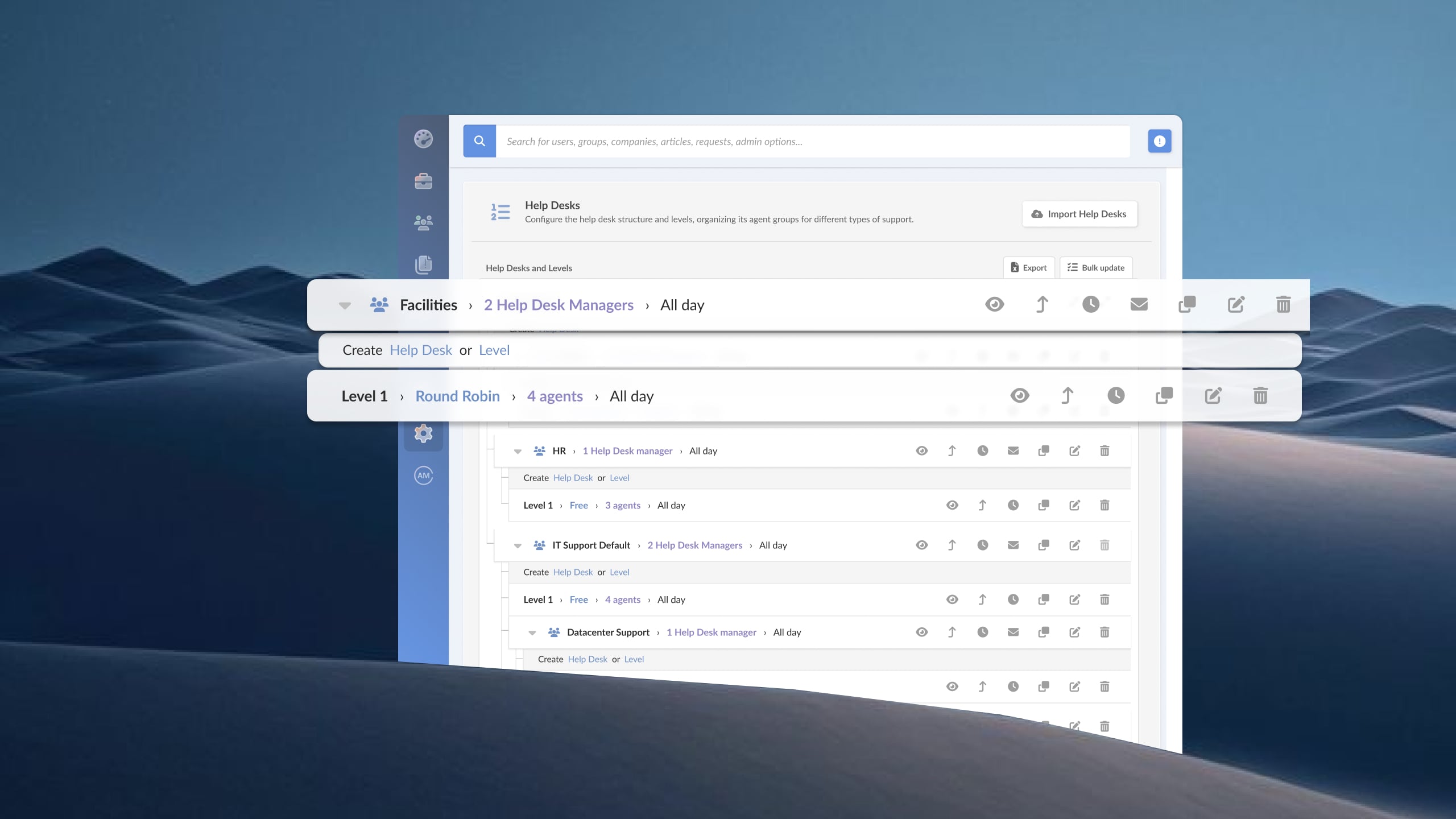
Manufacturing organizations should evaluate ITSM software based on how well it supports service delivery across facilities, teams, and operational systems. Key considerations include incident and change management, asset visibility, workflow automation, reporting, and integration with existing tools.
The five platforms below offer different approaches to ITSM and help desk management. The comparison table outlines their main capabilities and pricing, followed by a closer look at each tool and the use cases it supports.
Key takeaways
- In manufacturing, an IT failure is not just a ticket: it can stop a production line.
- Structured ITSM reduces response times, centralizes workload, and gives IT teams visibility over SLAs across multi-site environments.
- No-code workflow automation allows lean IT teams to handle high ticket volumes without scaling headcount.
- Extending ITSM to Facilities, Maintenance, and HR (Enterprise Service Management) multiplies value without adding complexity.
ITSM and help desk software for manufacturing: comparison table
Five platforms manufacturing teams commonly shortlist, at a glance:
What ITSM can cover for manufacturing operations
ITSM is the operating system for IT service delivery. It is not a monitoring tool, not a production control system, and not a replacement for OT-specific platforms. Its scope is the IT services that support manufacturing operations: the infrastructure, applications, and support processes that keep systems running and users productive.
In a manufacturing context, the core ITSM processes that matter most are:
-
Service Request Management. Structured intake for all IT requests — hardware, access, software, connectivity — with routing logic, approval flows, and fulfillment tracking. Replaces the informal mix of emails, phone calls, and WhatsApp messages that most plant-floor users currently rely on.
-
Incident Management. Rapid detection, categorization, prioritization, and resolution of IT failures. In manufacturing, this includes defining which incidents affect production-critical systems and ensuring those tickets are escalated and resolved on a timeline that reflects operational urgency.
-
Problem Management. Root cause analysis for recurring failures. If the same network issue takes down a workstation three times in a month, problem management is the process that identifies the underlying cause and resolves it — rather than closing the same ticket repeatedly.
-
Change Management. Governed, documented, risk-assessed approval process for any planned change to IT systems. In manufacturing, changes that affect production-critical infrastructure carry elevated risk and require traceability for compliance purposes.
-
SLA Management. Service level agreements that reflect operational reality — with different response and resolution targets for production-critical systems versus back-office applications.
ITSM platforms worth considering for manufacturing
Methodology note: InvGate builds and offers IT Service Management and IT Asset Management solutions, making us an active player in this software market. Some vendors in this article are our competitors. Even so, we aim to deliver accurate, honest, and practical information that helps you make the best decision.
Our evaluations draw from publicly available sources — vendor websites, product documentation, user reviews on platforms like Gartner Peer Insights, G2, and Capterra, analyst reports, and hands-on testing or demos when available. We assess each solution based on functionality, pricing (where made public), and integrations. We'll review this content regularly to stay current with product updates and market developments.
The market for ITSM software includes platforms at different levels of complexity, implementation overhead, and pricing. Five options to consider:
1. InvGate Service Management
InvGate Service Management is an ITSM platform designed to help organizations standardize service delivery while keeping implementation and administration manageable For manufacturers, its combination of IT Service Management, workflow automation, and integration with IT Asset Management makes it particularly useful in environments where uptime, asset visibility, and operational efficiency are priorities. Available as cloud (SaaS) or on-premises with feature parity.
Best fit for mid-to-large manufacturing organizations that need to move quickly without developer dependency. InvGate has experience supporting manufacturing environments, with customers including TROGroup, Mastellone, and Ternium.
Key features relevant for manufacturing:
- Incident, Problem, Change, and Service Request Management aligned with ITIL practices.
- No-code workflow builder for automating service processes and approvals.
- Native integration with InvGate Asset Management for hardware lifecycle visibility.
- Self-service portal and Knowledge Base to reduce service desk workload.
- Cloud and on-premise deployment options.
Pricing:
- Starter: 24.98/agent/month billed annually and 5 agents minimum - $1499/year.
- Pro: $500/agent/year. 5-50 agents.
- Enterprise: Custom pricing for larger organizations.
If you're considering InvGate for manufacturing, you can request a free trial, so you can try the platform before committing to a plan.
2. ServiceNow
ServiceNow is one of the most widely adopted enterprise service management platforms and is commonly used by large manufacturers operating across multiple sites and business units. Its extensive workflow capabilities allow organizations to connect IT processes with broader operational and business services.
Key features relevant for manufacturing:
- Enterprise-scale Incident, Problem, Change, and Asset Management.
- CMDB and service mapping for visibility into infrastructure dependencies.
- Workflow automation across IT, operations, and business functions.
- AI-powered virtual agents and predictive analytics.
- Large ecosystem of integrations and industry solutions.
Pricing: Not publicly disclosed. Custom pricing based on products, users, and deployment scope.
3. ManageEngine ServiceDesk Plus
ManageEngine ServiceDesk Plus is an ITSM platform that manufacturers often use to keep the IT infrastructure their production depends on running. Its manufacturing positioning centers on the systems behind the line — handling incidents, managing changes such as ERP patches and updates to SCADA servers, and processing requests for components and access. It’s available in both cloud and on-premise deployments.
Key features relevant for manufacturing:
- Incident, Problem, Change, and Service Request Management.
- Built-in IT asset management with ticket-to-asset association.
- Multi-level, time-based escalation and operational-hours configuration.
- Integration across the broader ManageEngine suite, including endpoint and monitoring tools.
- Self-service portal and knowledge base.
Pricing: Pricing is available in both cloud subscription and on-premises. Plans vary based on the number of agents and modules.
Cloud pricing tiers:
- Standard: Starts from $13 / technician / month
- Professional: Starts from $27 / technician / month
- Enterprise: Starts from $67 / technician / month
Note: For Professional and enterprise tiers, price changes also according to the amount of assets. There are also available add-ons. - Checked on: October 2026 (US), official website.
4. BMC Helix ITSM
BMC Helix ITSM is an enterprise-grade platform designed for organizations managing complex, distributed IT environments. Manufacturing companies with multiple facilities, hybrid infrastructure, and mature service management requirements often consider it for its automation capabilities and ITIL-aligned processes.
Key features relevant for manufacturing:
- AI-driven incident categorization, prioritization, and predictive analytics.
- Advanced Change and Release Management capabilities.
- CMDB integration for visibility into infrastructure and service dependencies.
- Cloud-native architecture with on-premise and hybrid deployment options.
- Workflow automation for incidents, requests, and operational processes.
Pricing: Not publicly disclosed. Custom pricing based on deployment model, modules selected, and organizational requirements.
5. Ivanti Neurons for ITSM
Ivanti Neurons for ITSM combines service management with endpoint and asset management capabilities, making it a strong option for manufacturers managing large fleets of devices across offices, warehouses, and production facilities. Its automation features help reduce manual work while improving visibility into assets and service operations.
Key features relevant for manufacturing:
- Incident, Change, Problem, and Service Request Management.
- Discovery and asset visibility across distributed environments.
- Workflow automation and low-code service management tools.
- Integration with endpoint management and security solutions.
- AI-powered service desk capabilities and self-service options.
Pricing: Not publicly disclosed. Custom pricing based on users, modules, and deployment requirements.
Disclaimer: All product names, logos, and brands are property of their respective owners. All company, product, and service names used on this site are for identification purposes only. Use of these names, trademarks, and brands does not imply endorsement. Comparisons are based on publicly available information as of October 2026 and are provided for informational purposes only. ServiceNow is a registered trademark of ServiceNow, Inc. InvGate is not affiliated with, sponsored by, or endorsed by ServiceNow.
Why manufacturing puts unusual pressure on IT teams
Manufacturing is not a typical enterprise environment. The specific pressures that separate manufacturing IT from standard enterprise IT include:
- 24/7 operations with no maintenance window. Plants do not stop at 5 PM. A system failure at 2 AM on a Sunday has the same operational weight as one during business hours.
- IT/OT convergence complexity. Manufacturing environments run a hybrid of corporate IT systems and operational technology — PLCs, SCADA systems, industrial controllers, and edge devices that were never designed to be managed alongside traditional enterprise infrastructure.
- Multi-site coordination. A single IT team may support plants in different cities or countries, each with its own working hours, SLA requirements, and local escalation paths.
- Compliance and audit obligations. Compliance pressure is constant. ISO 9001, ISO 27001, and sector-specific standards require documentation that most informal processes do not produce automatically.
- Lean IT staffing model. Manufacturing organizations rarely maintain large IT departments relative to their operational footprint. The ratio of IT staff to supported users and systems is often unfavorable.
In most industries, a service disruption means frustrated users. In manufacturing, it means something measurably worse. When an ERP system goes offline or a network segment in the plant goes dark, the downstream effect is physical: lines stop, output drops, and delivery commitments are at risk. Handling those production-impacting failures through a structured incident process built for the plant floor is what keeps a single outage from cascading.
This reframes what SLA means in a manufacturing context. A four-hour resolution window that would be acceptable in a corporate environment can represent unacceptable production loss on the factory floor. IT teams need tooling that reflects this urgency — with SLA tiers that map to operational criticality, not just ticket categories.
Help desk software for manufacturing: supporting the plant floor
The help desk is the first line of support for the plant — the layer that receives, triages, and resolves the day-to-day requests coming off the production floor before they turn into bigger problems. In a manufacturing setting, that layer has to account for how plants actually run.
Support runs around the clock, so tickets need to carry their context across shift changes: a request opened on the night shift should reach whoever is on duty next without losing history or restarting the clock. Teams that run this way get more out of a help desk built for shift-based coverage, where assignment and escalation follow the hours people actually work.
Intake also has to meet operators where they are: a self-service portal, a request from a phone, or a QR code posted on the line, so someone can log an issue without leaving the floor. Beyond that, tickets should link to the specific equipment that failed, jump in priority when a line stops, and run against SLAs defined per plant rather than a single global target.
Next steps: how to evaluate ITSM software for manufacturing
Manufacturing environments often have unique needs related to production continuity, Asset Management, facility support, and change control. A structured evaluation process can help narrow the field and identify the best fit.
- Define the scope of your ITSM initiative. Determine which processes you want the platform to support, such as Incident Management, Service Request Management, Change Management, Asset Management, Knowledge Management, or service catalog delivery.
- Document manufacturing-specific requirements. Consider factors such as multiple plants or facilities, shared services teams, operational technology (OT) support, asset lifecycle tracking, compliance requirements, and integrations with existing business systems.
- Identify your key stakeholders. Include representatives from IT, operations, facilities, security, compliance, and any other teams that will use or depend on the platform.
- Review your current processes. Document how requests, incidents, changes, and asset-related activities are managed today. Look for manual work, reporting gaps, duplicated effort, and process inconsistencies.
- Create a list of evaluation criteria. Beyond core ITSM capabilities, assess workflow automation, asset visibility, reporting, self-service functionality, deployment options, integration capabilities, scalability, and ease of administration.
- Test real-world manufacturing scenarios. Ask vendors to demonstrate common workflows such as responding to a production-impacting outage, processing equipment requests, managing plant-wide changes, or supporting users across multiple facilities.
- Assess implementation requirements. Evaluate the time, resources, training, and expertise required to configure, deploy, and maintain the platform over time.
- Calculate total cost of ownership. Consider licensing, implementation services, integrations, training, administration, and future expansion costs rather than focusing solely on subscription pricing.
- Conduct a proof of concept. Before making a final decision, test the platform with a small group of users and a limited set of processes to validate usability, performance, and operational fit.
A successful ITSM implementation in manufacturing depends on how well the platform supports your organization's workflows, operational requirements, and long-term service management objectives—not simply the number of features included.
Frequently Asked Questions
What is ITSM in manufacturing?
ITSM (IT Service Management) in manufacturing refers to the structured set of processes and tools used to manage IT services that support manufacturing operations. It covers how IT incidents are logged and resolved, how service requests are handled, how changes to IT systems are approved and documented, and how service levels are defined and tracked. In a manufacturing context, ITSM is particularly important because IT failures can directly impact production continuity — making structured escalation, prioritization, and audit trails more operationally critical than in standard office environments.
What should manufacturing IT teams look for in an ITSM platform?
The most relevant evaluation criteria for manufacturing environments include: multi-site support with per-location SLA and working hour configuration, no-code workflow automation that does not require developer involvement to maintain, change management with built-in audit trails for compliance, SLA tiers that can be differentiated by system criticality, and ESM capabilities that allow non-IT departments to operate on the same platform. Deployment flexibility — cloud or on-premises — is also relevant for manufacturing organizations with network segmentation requirements or data residency considerations.