Professional services firms depend on people, processes, and technology working together efficiently. Yet many internal service teams still rely on disconnected tools for IT requests, employee onboarding, facilities management, and other operational processes. As organizations grow, those silos can create delays, inconsistent service experiences, and additional administrative work.
Modern ITSM platforms help address those challenges by providing a central place to manage requests, automate workflows, and support service delivery across multiple departments. Many have evolved into Enterprise Service Management (ESM) platforms, extending capabilities beyond IT to HR, Finance, Facilities, Legal, and other business functions.
In this article, we'll look at the best ITSM software for professional services firms, comparing their strengths, implementation considerations, and suitability for organizations that need multi-department service management, employee lifecycle workflows, auditability, and room to scale.
Key takeaways
- In professional services firms, IT downtime is not just a technical problem — it is billable time lost.
- The rotation of consultants and attorneys demands onboarding and offboarding flows that generic ITSM does not automate well without dedicated configuration.
- Enterprise service management (ESM) allows you to extend the service desk to Legal, HR, and Facilities without deploying separate tools for each department.
- Differentiated SLAs by department are essential when the business impact of a ticket varies radically depending on the area that submits it.
- InvGate Service Management is configured in no-code mode: no paid implementation projects, no scripting required to adapt workflows to your sector.
The IT pressure that's unique to professional services firms
If you manage IT for a consulting firm, a law firm, or an accounting practice, you already know that the stakes of an IT incident are different from those in most industries. The pressure is not just operational — it is commercial.
-
Billable time at risk. In professional services, time is the product. A partner who cannot access a case management system, a consultant locked out of a client portal, or a tax advisor waiting on a frozen workstation is not simply inconvenienced — they are losing revenue that cannot be recovered. A ticket sitting open without a defined SLA is not a minor process gap; it is a direct hit to utilization. Firms with high billing rates feel this acutely: even short resolution delays compound quickly across a team of ten or twenty fee earners.
-
Staff churn and project-based assignments. Professional services firms operate with fluid workforces. Consultants rotate across client engagements. Attorneys join and leave matters. Seasonal hiring in accounting firms means large cohorts of staff arriving and departing within compressed timeframes. Each move generates an IT event: access to be provisioned, devices to be assigned, credentials to be revoked. In most firms, this process is manual, fragmented across email threads and spreadsheets, and dependent on individuals remembering to follow up. The result is either delayed access that slows project ramp-up, or orphaned access that creates compliance risk.
-
Multi-department support without structure. IT is rarely the only team generating service requests, but it is often the one expected to absorb everything. HR sends onboarding checklists over email. Facilities submits room booking conflicts via Slack. The Legal team's internal contract review requests end up as direct messages to whoever answers the phone. Without a formal channel, all of this lands on IT or disappears. The cost is invisible until something urgent gets missed.
-
Client data compliance. Law firms, accounting practices, and consulting firms handle confidential client information that is subject to contractual, regulatory, or professional standards obligations. The traceability of who accessed what system, who approved a change, and when a credential was revoked is not an audit nicety — it is often a contractual requirement with enterprise clients, and increasingly a regulatory one. Generic ITSM tools often treat the audit trail as a report to generate after the fact, rather than a process control built into every workflow.
These four pressures define the ITSM problem for professional services. Addressing them well requires more than a ticketing system. It requires a platform built around structured service delivery, automated workflows, and departmental flexibility — which is exactly what InvGate Service Management is designed to provide.
What ITSM needs to solve for professional services firms
Before evaluating any platform, it helps to define the capabilities that actually matter in this context. Professional services firms have a narrower set of critical requirements than large enterprises, but those requirements are non-negotiable.
-
Fast, no-code configuration. The IT team of a 300-person consulting firm is not running a dedicated ITSM implementation project. There is no ServiceNow administrator on staff. The platform needs to be configurable by the IT team itself, without scripting, without vendor professional services hours, and without a months-long rollout before the first ticket is processed. Configuration agility is not a nice-to-have — it is a prerequisite for adoption.
-
Automated onboarding and offboarding workflows. The platform must support chained workflows that link access provisioning, device assignment, system credentials, and approval gates across IT and HR without manual intervention at each step. This is especially important in firms where project-based staff moves are frequent. A workflow that requires someone to manually trigger the next step after every phase is not automation — it is a reminder system.
-
Multi-department SLA control. A critical access request for a client matter system and a supply order from Facilities cannot carry the same response time. The platform must support distinct SLAs by department, by request type, and by priority — and it must make those SLAs visible to requesters, not just to agents. SLA visibility is itself a trust signal: it tells partners and senior staff that their request is governed, not arbitrary.
-
Audit trail and access traceability. Every change to access, every approval step, and every ticket resolution must be logged in a format that is exportable and readable for internal or client-facing audits. This is not about building a separate reporting layer — it should be native to the platform's workflow engine.
ITSM for professional services: tools
Professional services firms evaluating ITSM platforms will find a market shaped primarily by tools designed for large enterprise IT operations. The options below represent the platforms most commonly considered, evaluated on functionality, deployment model, workflow flexibility, and fit for the specific demands of consulting, legal, and accounting environments.
InvGate builds and offers IT Service Management and IT Asset Management solutions, which makes us an active participant in this market. Some of the vendors listed here are our direct competitors. Even so, our goal is to deliver accurate, honest, and practical information to help you make the best decision for your team.
Our evaluations draw from publicly available sources — vendor websites, product documentation, user reviews on platforms like Gartner Peer Insights, G2, and Capterra — as well as analyst reports and hands-on testing. We assess each solution based on functionality, pricing (where publicly available), integrations, user experience, and support quality. We revisit this content regularly as products evolve.
1. InvGate Service Management
InvGate Service Management is a no-code ITSM and ESM platform built for mid-market and enterprise organizations that need structured service delivery without a dedicated implementation team or ongoing vendor dependency.
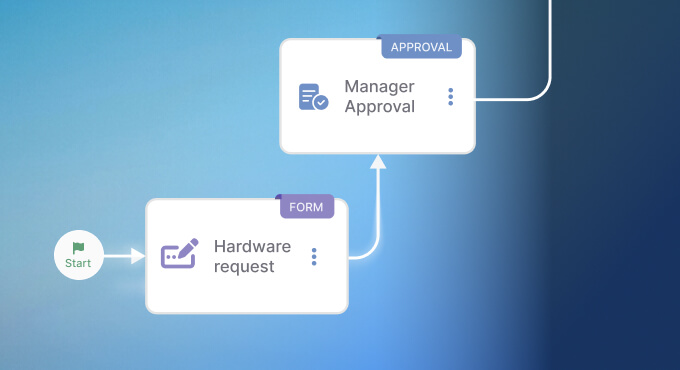
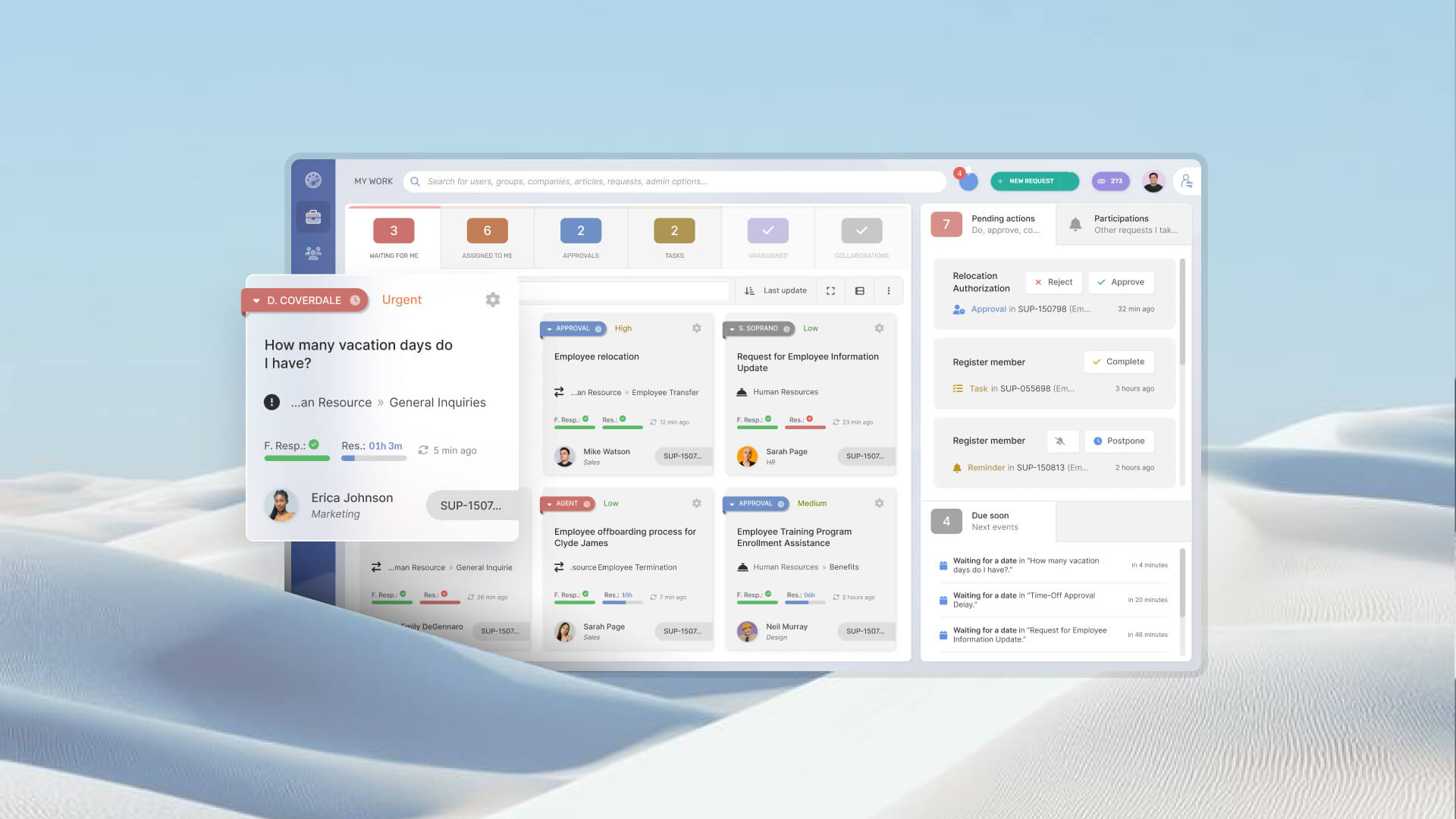
For professional services firms, the key differentiator is the combination of no-code workflow configuration, native ESM extension, and granular SLA management — all accessible without scripting or paid consulting hours. The drag-and-drop workflow builder supports full onboarding and offboarding automation, including cross-departmental steps that involve HR, IT, and Facilities as coordinated stages within a single triggered process. Built-in action connectors allow workflows to take actions in external systems — creating accounts in identity providers like Entra ID or Okta, scheduling meetings, or notifying teams — without custom API integrations.
Departments outside IT can operate their own help desks within the same platform, each with its own service catalog, SLA definitions, and agent assignments, while all data remains under unified reporting and governance. The analytics module delivers SLA compliance rates, resolution times by department, and workload visibility without requiring a separate BI tool. Approvers do not require a full license, which keeps costs manageable as the platform expands beyond IT.
Pricing:
InvGate offers flexible pricing plans that scale to meet the unique needs of your organization.
- Starter: 24.98/agent/month billed annually and 5 agents minimum - $1499/year.
- Pro: $500/agent/year. 5-50 agents.
- Enterprise: Custom pricing for larger organizations.
You can also request a free trial, so you can try the platform before committing to a plan.
2. ServiceNow ITSM
ServiceNow® offers a centralized platform for managing internal services across multiple departments while maintaining governance and visibility. Organizations can use it to automate onboarding and offboarding processes, coordinate approvals across teams, maintain detailed audit trails, and standardize service delivery practices. Its extensive integration ecosystem make it suitable for firms with complex operational requirements and a long-term ESM strategy.
For professional services firms, ServiceNow's primary challenge is implementation weight. While the platform can support nearly any service management or workflow use case, organizations often require significant configuration, process design, and ongoing administration to realize its full value.
Pricing: Not publicly available.
3. Freshservice
Freshservice® is a cloud-native ITSM platform from Freshworks, recognized for fast time to value and a clean interface that reduces the learning curve for IT teams. It covers the core ITIL modules — incident, problem, change, and service catalog — and supports automation and integrations with tools like Microsoft Teams and Slack.
For professional services firms, Freshservice is a credible option for teams that prioritize fast deployment and ease of use. It is designed as a SaaS product and typically goes live quickly. The platform's AI capabilities, branded as Freddy AI, are available as a paid add-on on lower tiers. ESM capabilities exist but may require additional plan tiers depending on the scope of departmental expansion needed.
Pricing:
- Starter: $19 per agent, per month.
- Growth: $49 per agent, per month.
- Pro: $99 per agent, per month.
The fourth tier, Enterprise, requires a quote. - Checked on June 2026 (US) official website.
4. ManageEngine ServiceDesk Plus
ManageEngine® ServiceDesk Plus is a full-stack ITIL-aligned Service Management platform with broad feature coverage across Incident, Problem, Change, and Asset Management. It is available as both cloud and on-premises, and supports multi-channel ticket intake including email, phone, self-service portal, and chat.
For professional services firms, ServiceDesk Plus offers a practical mid-market option with transparent pricing and strong asset management integration. The platform supports ESM through separate departmental help desks and includes audit trail and access control capabilities relevant to compliance-oriented environments.
Pricing:
Cloud implementation tiers:
- Standard: Starts from $13 / technician / month
- Professional: Starts from $27 / technician / month
- Enterprise: Starts from $67 / technician / month
- Checked on: June 2026 (US), official website.
5. TeamDynamix
TeamDynamix® is an IT Service Management and Enterprise Service Management platform that combines ITSM, workflow automation, service catalogs, knowledge management, and project portfolio management in a single solution. The platform is designed to support service delivery across multiple departments, including IT, HR, Finance, Facilities, and other shared services teams.
For professional services firms, TeamDynamix stands out for its ability to connect operational service requests with project work, resource planning, and business initiatives. The platform supports employee onboarding and offboarding workflows, configurable approval processes, self-service portals, and detailed audit trails.
Pricing: Custom pricing based on products, modules, and organization size. Contact vendor for a quote.
Disclaimer: All product names, logos, and brands are property of their respective owners. All company, product, and service names used on this site are for identification purposes only. Use of these names, trademarks, and brands does not imply endorsement. Comparisons are based on publicly available information as of April 2026 and are provided for informational purposes only. ServiceNow is a registered trademark of ServiceNow, Inc. InvGate is not affiliated with, sponsored by, or endorsed by ServiceNow.
Frequently Asked Questions
What is ITSM for professional services?
ITSM for professional services refers to the application of IT Service Management practices and tools to the internal IT operations of consulting, legal, accounting, and staffing firms. The focus is on structuring how the firm's IT team receives, prioritizes, and resolves requests from internal staff — not on providing IT services to external clients.
How does ITSM help consulting firms manage IT support?
ITSM gives consulting firms a structured intake channel that replaces ad-hoc email and direct messaging as the primary route for IT requests. Tickets are categorized, prioritized, and routed automatically. SLAs define how quickly each request type must be resolved, making commitments visible to both IT and the requesters. Over time, structured ticketing generates the data needed to identify recurring issues, optimize staffing, and make the business case for IT investment.
Can ITSM tools handle onboarding and offboarding for project-based staff?
Yes, but the effectiveness depends on the platform's workflow engine. Modern ITSM platforms support automated onboarding and offboarding workflows that chain tasks across IT, HR, and other departments into a single triggered process. In InvGate Service Management, these workflows are built using a no-code drag-and-drop builder and can include approval gates, automatic task assignment, and built-in connectors that take actions in external systems — such as creating user accounts in Entra ID or revoking access in Okta — without manual intervention at each step. For consulting and legal firms where staff movement is frequent, this automation significantly reduces the cycle time and compliance risk of each transition.
What's the difference between ITSM and PSA software for professional services firms?
PSA — Professional Services Automation — is software designed to manage the delivery of client-facing services: project management, time tracking, billing, resource utilization, and contract management for the services the firm sells to its clients. ITSM — IT Service Management — manages the internal IT operations of the firm itself: how IT support is structured, how requests are handled, how incidents are resolved, and how changes are controlled. A consulting firm may use a PSA tool to manage billable projects and an ITSM platform to manage its own internal IT service desk. The two are complementary, not interchangeable.
How do law firms use ITSM to meet compliance requirements?
Law firms handle confidential client information subject to professional responsibility obligations and, in many jurisdictions, sector-specific data security requirements. ITSM supports compliance in several ways: access requests and changes are routed through approval workflows with a documented audit trail; offboarding processes ensure that access is revoked in a governed, traceable sequence when staff depart or change roles; and change management workflows require documentation of who requested, who approved, and what was implemented before any system change is finalized.