Every employee lifecycle event is two events at once. A new hire is an identity in Okta and a stack of tickets in the service desk: provision a laptop, grant app access, add them to the right groups. A departure is a deactivation in Okta and, ideally, a clean revocation of everything that was ever granted. When the identity system and the service desk don't talk to each other, IT spends its day copying data between the two, and the gaps — an account that never got deprovisioned, an access request that sat for a week — turn into security risk.
Connecting your service desk to Okta is how those two halves become one process. In this guide, we look at five service desk platforms with Okta integrations, and how deeply each one reaches into identity: from single sign-on, to automated provisioning, to acting on Okta data inside your own workflows.
Key takeaways
- Every hire, role change, and departure is both an identity event in Okta and a workflow in the service desk. Connecting them turns two manual processes into one automated one.
- Single sign-on is the floor, not the ceiling. The integrations that save real time handle provisioning and full user lifecycle, not just login.
- The highest-leverage capability is a service desk that can both read Okta data (users, groups, app assignments) and act on it (create and update users, manage group membership) from inside an approval workflow.
- Identity touches security, so native, vendor-supported integrations are the safer foundation than brittle third-party connectors.
Why connect your service desk to Okta
Okta is the source of truth for who someone is and what they can access. The service desk is where the work of onboarding, offboarding, and access management actually happens: the approvals, the hardware, the account setup, the record of who asked for what and who signed off. Connecting the two is where IT support automation gets genuinely useful, because the identity data and the workflow that acts on it finally live in the same place.
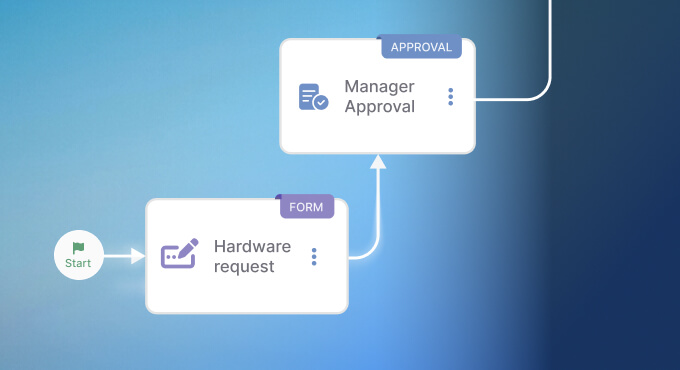
Start with what automation removes. When a new hire lands, a connected service desk can read their Okta profile and group memberships, provision the right access, and open the tasks for hardware and accounts — with no agent looking up which groups a "marketing analyst" belongs to and doing it by hand. When someone leaves, an offboarding workflow can revoke access and close out the identity in one governed sequence, so nothing gets forgotten. Access requests become a form and an approval instead of a Slack message and a manual change. The repetitive identity toil that surrounds every lifecycle event becomes a workflow that runs itself.
AI is the second layer, and it changes what the service desk does with each request. AI can triage and categorize incoming access requests, surface the standard access profile for a given role, draft responses, and flag requests that fall outside the norm for a closer look. AI-powered self-service handles the routine, well-understood asks — a password reset, a standard app request — before they ever reach an agent. Automation handles the mechanical provisioning steps and AI handles the judgment and knowledge work, and the result is faster onboarding processes, cleaner offboarding, and an access process that documents itself.
What to look for
The tools below were evaluated against the following criteria, with equal weight given to each vendor.
1. Depth beyond SSO. Single sign-on is table stakes. The integrations that pay off support provisioning and lifecycle management, so identity changes in Okta flow into the service desk and back without manual reconciliation.
2. Read and act on identity. The most useful integrations let the service desk both read Okta data (users, groups, app assignments) and make changes (create or update users, adjust group membership) from inside a workflow. That combination is what lets onboarding and offboarding run end to end.
3. Where the automation lives. Identity logic built in a visual, no-code workflow builder stays with the team that runs the service desk, with no scripts to maintain and no engineering ticket required to change a rule.
4. Native and secure. Identity is a security surface. A native, vendor-supported integration survives platform updates and keeps the audit trail intact, where a middleware connector tends to fail quietly.
Best service desk tools with Okta integration
Methodology note: InvGate develops IT Service Management and IT Asset Management software, so we're directly involved in the same market as some of the vendors mentioned here. Even so, our purpose is to share reliable and unbiased information to help you evaluate your options with confidence. Our assessment is based on publicly available data, including vendor sites, documentation, and integration guides. All information reflects the state of the market as of July 2026. We update our content regularly to keep it aligned with product changes and new releases.
1. InvGate Service Management
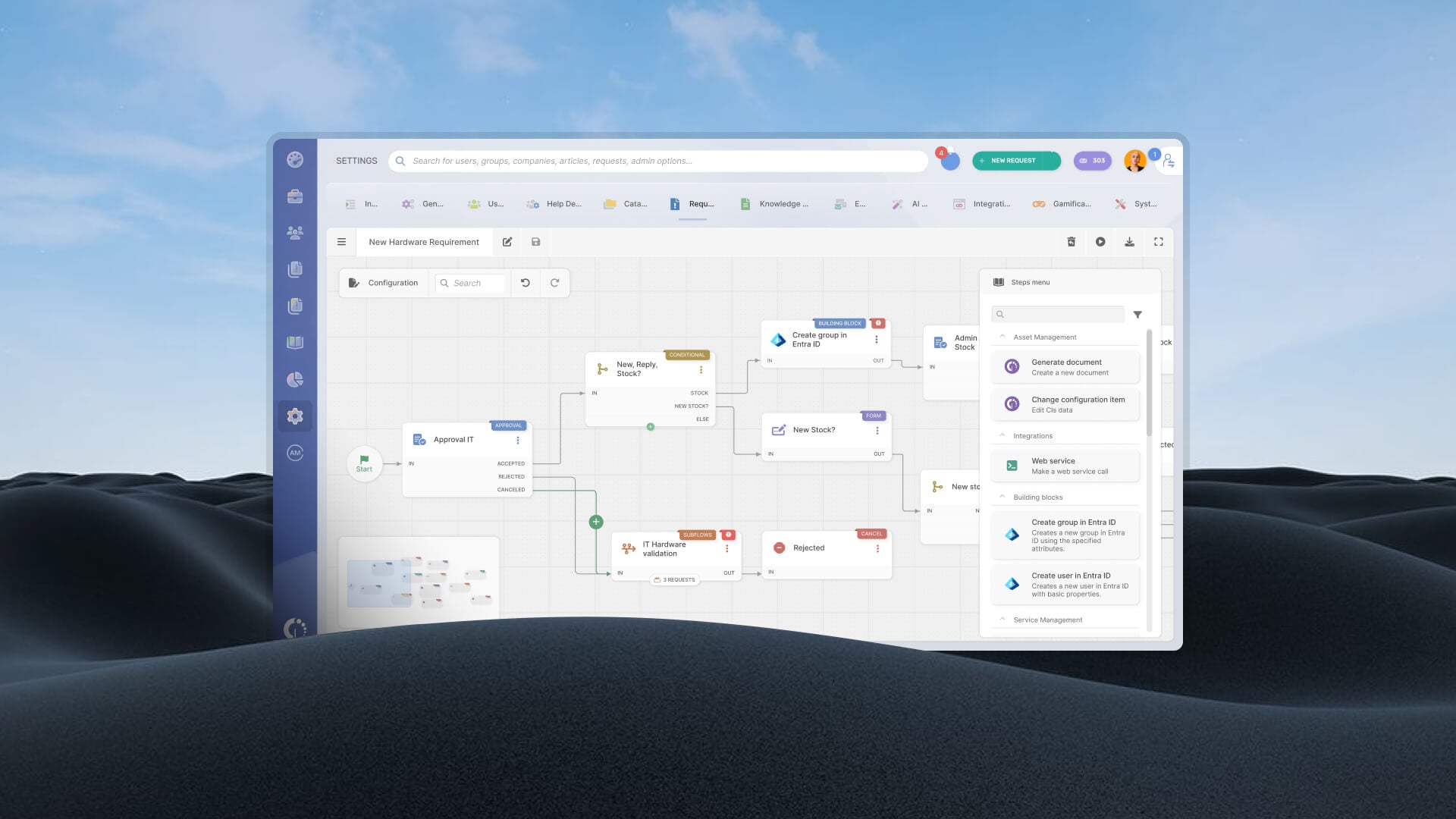
InvGate Service Management is a flexible, no-code ITSM platform for IT teams that want ITIL-aligned structure and full control over their workflows without professional-services overhead. On the Okta side, its Action Connector brings identity actions directly into the no-code workflow builder — reading users, groups, and app assignments, and writing changes such as profile edits and group membership — so onboarding, offboarding, and access approvals run as automated workflows.
Key features:
- Okta Connector actions inside the no-code Workflow Builder: list and retrieve users, groups, and app assignments, plus edit user profiles and add users to groups. This removes manual lookups and external scripts from identity-driven workflows and unblocks automation for onboarding, offboarding, and access-approval scenarios.
- No-code workflow builder with drag-and-drop automation for approvals, routing, and provisioning tasks.
- Service catalog and self-service portal for structured access and onboarding requests.
- ITIL-aligned request, incident, problem, and change management out of the box.
- Self-service deflection and AI-assisted response support for agents.
- Reporting and dashboards for request volumes, resolution times, SLA compliance, and more.
Request an InvGate Service Management 30-day trial to see the Okta Connector actions and workflow builder in context.
2. ServiceNow®
An enterprise-grade ITSM platform built for large organizations with complex processes and dedicated administrators to run it. Its Okta integration pairs SSO with SCIM provisioning and a workflow-driven access model, where a catalog request in ServiceNow triggers Okta to provision the app and group access.
Key features:
- SSO and SCIM provisioning through the Okta Integration Network
- Self-service app and group access requests from the ServiceNow catalog that trigger Okta provisioning
- Automated onboarding and offboarding coordinated across both systems
- Schema discovery for mapping custom attributes between ServiceNow and Okta
3. Freshservice®
A cloud-native ITSM tool known for a familiar interface and quick onboarding, widely used by mid-market teams and organizations already in the Freshworks ecosystem. Its Okta integration combines SAML SSO with a Marketplace provisioning app that creates and updates requesters from Okta.
Key features:
- SAML single sign-on via Okta
- Okta provisioning (SCIM) Marketplace app that automatically creates and updates requesters
- Custom attribute mapping between Okta profiles and Freshservice user fields
- Compatibility with Okta Workflows for identity-centric automation
4. Jira® Service Management
A service management tool from Atlassian, favored by development-centric organizations that want IT support and engineering work in the same ecosystem. Its Okta integration runs through the Atlassian Cloud app in the Okta Integration Network, covering SSO and provisioning across Atlassian products.
Key features:
- SSO and SCIM provisioning via the Atlassian Cloud app in the Okta Integration Network
- Automated user and group provisioning and deprovisioning
- Group push to map Okta groups to Atlassian product access
- Centralized identity control through Atlassian Guard
5. ManageEngine® ServiceDesk Plus
An ITIL-oriented help desk and ITSM suite popular with SMBs and enterprises that want asset and project management alongside the service desk. Its Okta integration is available in the Okta Integration Network for SSO and provisioning, with Okta Workflows handling lifecycle actions.
Key features:
- SSO (SAML and OIDC) through the Okta Integration Network
- User provisioning with schema discovery for custom attributes
- Okta Workflows lifecycle to create requesters and technicians from Okta group membership
- Deprovisioning tied to changes in Okta groups
Disclaimer: All product names, logos, and brands are property of their respective owners. All company, product, and service names used on this site are for identification purposes only. Use of these names, trademarks, and brands does not imply endorsement. Comparisons are based on publicly available information as of July 2026 and are provided for informational purposes only. ServiceNow is a registered trademark of ServiceNow, Inc. InvGate is not affiliated with, sponsored by, or endorsed by ServiceNow.
How to choose
The integration is one piece of the decision. The platform it plugs into is what your team works in every day, so weigh the surrounding capabilities as heavily as the connection itself.
Two questions tend to settle it. First, who owns the identity automation? A service desk where onboarding, approvals, and provisioning are built in a visual, no-code workflow builder keeps that logic with the people who run the service desk, with no scripts to maintain and no engineering ticket to change a rule. Second, what surrounds the identity action? A service catalog for clean intake, approval flows, change management, and reporting on resolution times and SLA compliance are what turn a provisioning event into a governed, documented one.
Start from the ITSM platform that fits your operation, then confirm it connects to Okta the way your identity processes need. A tool that pairs a strong service desk with native identity integration will serve you longer than one chosen on the integration alone.
FAQs
What can a service desk actually do with an Okta integration?
At a minimum, it uses Okta for single sign-on so people log in with one set of credentials. Deeper integrations add provisioning, so accounts are created, updated, and deactivated automatically as identities change in Okta. The most capable setups let the service desk read Okta data and make identity changes from inside a workflow, which is what allows onboarding, offboarding, and access requests to run as automated processes.
Is single sign-on the same as an Okta integration?
Single sign-on is the login layer, and it's only the starting point. An integration that stops at SSO still leaves account creation, group membership, and deprovisioning as manual work. Provisioning and lifecycle capabilities are what remove that manual work and connect identity to the rest of the service desk.
Why route identity changes through the service desk instead of managing them in Okta alone?
Okta handles the identity itself. The service desk adds everything around it: the approval, the SLA, the audit trail, and the link to the rest of onboarding, such as hardware and account setup. Running identity changes through the service desk gives you one governed record of who requested access, who approved it, and when it was granted or revoked.