Food and beverage companies run on a distributed footprint: production plants, warehouses and distribution centers, corporate offices, and field sales teams spread across regions. Internal support has to reach every one of them. IT requests still arrive the same way they always have — a phone call to whoever picks up, an email that sits unread, a message passed along at a shift change — with no ticket and no SLA behind any of it.
For manufacturers and processors, a help desk supports far more than office employees. Production supervisors, warehouse staff, maintenance technicians, and corporate teams all depend on the same service operation to report issues, request access, replace equipment, and keep daily work moving across every site.
Key takeaways
- Food and beverage manufacturers need a multi-location help desk that supports plants, distribution centers, corporate offices, and field teams from one system, with routing that reflects how different each site is.
- Plant support and office support have different rhythms and different urgency, and the platform needs to route and escalate accordingly.
- Support scope stays on the IT side of the IT/OT boundary — plant-floor endpoints, shared devices, networking, and ERP access, not the process control systems that plant engineering owns.
- No-code configuration matters because IT teams supporting dozens of sites can't wait on a vendor to add a location or adjust a routing rule.
- InvGate Service Management covers IT, facilities, and multi-site support in one platform, configurable without code and deployable in days — and it's already in production at a dairy manufacturer running multiple plants across LATAM.
Why food and beverage companies need a dedicated help desk
A mid-sized food and beverage manufacturer might run two or three production plants, a network of warehouses and distribution centers, several corporate offices, and a field sales team, all supported by a central IT function. That structure creates support problems a shared inbox or a phone tree can't handle.
The typical failure points:
-
No traceability. A request comes in by phone, email, or a walk-up conversation. There's no ticket, no assigned owner, and no record once it's resolved. When the same issue resurfaces at another plant a month later, the team has nothing to reference.
-
Distributed sites with no local IT staff. Plants and warehouses rarely have dedicated IT on-site. When a shared shop-floor terminal freezes, a label printer stops, or a warehouse scanner drops off the network, staff have no structured way to escalate, and IT has no visibility into what's happening across sites until someone calls.
-
Mixed request types in one queue. IT tickets, facilities and equipment requests, ERP access issues, and onboarding for high-turnover plant and warehouse staff often land in the same inbox. Without routing by request type and site, nothing gets prioritized correctly.
-
Different rhythms by site. An office worker's laptop issue and a plant-floor endpoint failure during a production shift are different categories of request. A generic queue treats them the same; a structured help desk routes and prioritizes them for what they actually are.
A purpose-built help desk doesn't remove the operational complexity of running plants, distribution, and offices together. It gives IT the structure to manage it: centralized intake, SLA enforcement by site, and visibility across every location from one place.
Supporting plants and other sites at the same time
Plants, warehouses, and offices generate different kinds of requests, and treating them identically in the same queue creates problems in both directions.
Plant-floor and warehouse support tends to center on shared devices — kiosk terminals, label and barcode printers, handheld scanners — along with connectivity and the endpoints that sit at the edge of the production environment. Office and field support looks more like standard corporate IT: laptops, accounts, ERP access, collaboration tools. A multi-location help desk lets IT configure separate routing rules and SLAs by site while keeping every ticket visible from a single dashboard, so a plant request can escalate to a different team or threshold than an office request without needing a separate system for each.
One distinction is worth drawing clearly. Process control on the production line — the PLCs, SCADA, and sensors that run manufacturing — is operational technology, and it typically sits with plant engineering or a dedicated automation team, not the IT help desk. What the help desk supports is the IT layer around the line: the shared devices, networking, and endpoints where IT and OT meet, plus the request and facilities work that keeps a site running. Framing the scope that way keeps the tool credible with plant staff and avoids setting an expectation IT can't own.
A consolidated view across sites is the other payoff. Instead of piecing the picture together from site-by-site reports, IT managers get one dashboard showing which plants generate the most recurring issues, which locations are understaffed on support, and where equipment requests cluster.
What to look for in help desk software for food and beverage companies
-
Multi-location support. The platform should handle intake and routing across plants, distribution centers, and offices without manual coordination between sites.
-
ESM capabilities. IT teams in food and beverage often cover facilities and equipment requests alongside IT, and onboarding for high-turnover plant staff. Look for enterprise service management — separate catalogs per department, unified visibility across all of them.
-
No-code configuration. Site rosters and routing rules change as locations open, close, or shift operations. An IT admin should be able to update workflows and catalogs without a development request to the vendor.
-
SLA management with automatic escalation. A ticket approaching its threshold should escalate on its own, based on the site and severity involved, not sit in a queue until someone checks it manually.
-
Self-service portal. A portal where plant, warehouse, and office staff can submit and check on requests reduces the volume of items that would otherwise arrive as an unlogged phone call.
-
Integration with existing channels. If staff already communicate through Microsoft Teams or WhatsApp, the help desk should meet them there, includes support for those channels and more, instead of requiring a new system just for IT requests.
-
Deployment time and adoption curve. IT teams supporting dozens of sites don't have months to configure a new platform. Prioritize options that can be deployed and adopted in days.
Best help desk software for food and beverage companies
Methodology note: InvGate develops ITSM and ITAM software and is one of the vendors evaluated in this list. The analysis below is based on public documentation, official demos, and user reviews on Gartner Peer Insights, G2, and Capterra.
1. InvGate Service Management
InvGate Service Management is a no-code ITSM/ESM platform with an integrated AI Hub that supports plants, distribution centers, and offices from one instance — centralizing IT, facilities, and equipment requests, and enforcing SLAs by site without code or a setup partner.
Key features for food and beverage companies:
- Service catalog configurable by department — IT, facilities, and equipment requests can each run their own catalog.
- Multi-channel self-service portal, accessible via web portal, Microsoft Teams, WhatsApp, and email, and more.
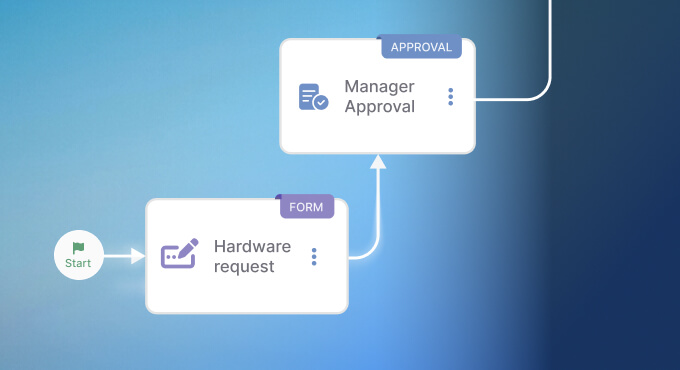
- Drag-and-drop workflow builder for routing rules, approval chains, and escalation logic, configured visually with no code.
- SLA management with automatic escalation and breach alerts, configurable by site.
- Virtual Service Agent for ticket deflection on high-volume, low-complexity requests.
- Customizable dashboards for IT managers tracking volume, SLA compliance, and performance across plants, distribution centers, and offices.
Deployment: Available as cloud and on-premise, with feature parity across both models.
Proof in the industry: Mastellone Hnos., a leader in the LATAM dairy industry, moved off a manual system where users had to call or email IT to open a ticket, rebuilding its support operation on InvGate Service Management and InvGate Asset Management across multiple plants. The team recovered more than 500 hours a year through workflow automation and reached 70% of tickets submitted through the self-service portal.
With InvGate, we have made a significant leap in the visibility and organization of our IT operations. Today, we can demonstrate the value of our work with clear metrics, automate key processes, and be better prepared for future challenges.
— Pablo Pascual, IT Governance Leader at Mastellone Hnos.
Pricing: InvGate Service Management has flexible pricing plans that scale to meet the unique needs of your organization.
- Starter: $24.98/agent/month billed annually, 5 agents minimum — $1,499/year.
- Pro: $500/agent/year, 5–50 agents.
- Enterprise: Custom pricing for larger organizations.
For a hands-on look at the platform, start a 30-day free trial.
2. ManageEngine ServiceDesk Plus
ManageEngine ServiceDesk Plus is an ITSM platform with strong asset and IT operations management features, positioned toward organizations with equipment-heavy, distributed environments like manufacturing.
Key features for food and beverage companies:
- Built-in IT asset management, useful for tracking plant, warehouse, and office equipment.
- Multi-site support with location-based ticket assignment.
- Workflow automation for approvals and escalations.
- Integration with network and endpoint monitoring tools.
Pricing: Standard, Professional, and Enterprise tiers, priced per technician with additional cost for asset management modules. Checked July 2026 (US), official website.
3. Freshservice
Freshservice is a cloud-based ITSM platform from Freshworks with AI capabilities through its Freddy AI layer. It's a mature product with broad adoption among IT teams supporting distributed sites.
Key features for food and beverage companies:
- Multi-department ESM support with separate service portals per team.
- Freddy AI for automated ticket categorization and agent assistance.
- Asset management module included natively, useful for tracking plant and warehouse equipment.
- Pre-built integrations with Microsoft 365, Slack, and Jira.
Pricing: Starts at $19/agent/month (Growth plan). Enterprise plans with full AI features are priced higher. Checked July 2026 (US), official website.
4. BMC Helix ITSM
BMC Helix ITSM is an enterprise-grade ITSM platform with roots in BMC's Remedy heritage, built for mature IT organizations with structured processes, complex approval chains, and strict compliance requirements. It fits large food and beverage manufacturers that run regulated, multi-site operations and need service management to connect with broader IT operations.
Key features for food and beverage companies:
- ITIL-aligned incident, problem, change, and asset management, with a CMDB as a single source of truth across sites.
- Change management with configurable approval workflows, relevant where IT changes carry production risk.
- HelixGPT AI with a bring-your-own-LLM approach for predictive classification, assignment, and routing.
- Multi-channel engagement across email, chat, voice, and mobile, with Microsoft Teams ChatOps.
- Cloud-native and on-premise deployment for regulated environments that keep data in-house.
Pricing: BMC does not publish pricing publicly, and there is no free trial.
5. Jira Service Management
Jira Service Management (JSM) is Atlassian's ITSM platform, tightly integrated with the Jira and Confluence ecosystem. It fits food and beverage IT teams that already run project tracking or documentation in Atlassian tools.
Key features for food and beverage companies:
- Native integration with Jira Software for cross-team visibility.
- ITIL-aligned workflows for incident, problem, and change management.
- Asset and configuration management via Assets (formerly Insight), useful for equipment tracking.
- Forms-based intake configurable per site or department.
Pricing (50-agent deployment):
- Standard: starting at $20.63/agent/month.
- Premium: starting at $52.16/agent/month.
Checked July 2026 (US), official web.
How to choose the right help desk software for your company
The comparison above is a starting point. The decision comes down to how your sites actually operate. Four questions worth answering directly:
How many site types need support — plants, distribution centers, offices, or all of them? A single-plant operation can manage with simpler tooling. A company running plants, warehouses, offices, and field teams needs a multi-location help desk with routing and SLAs that reflect how different each site is.
Does plant-floor support need a different escalation path than office support? If shared-device or connectivity issues during a production shift carry more urgency than a standard office request, confirm the platform supports SLAs and escalation by site and severity, not a single SLA applied uniformly.
Can the IT team configure and maintain the tool without vendor involvement? Site rosters and routing rules change as locations open or close. No-code configuration lets IT adjust workflows directly instead of filing a request with the vendor every time something shifts.
Does the platform need to cover facilities and equipment requests alongside IT? If the answer is yes, confirm ESM scope — separate catalogs, per-department SLAs, and independent agent queues — before the evaluation ends.
FAQs
What features should help desk software for food and beverage companies have? Multi-location ticket routing, SLA enforcement by site, a self-service portal for plant, warehouse, and office staff, and ESM capabilities to cover IT, facilities, and equipment requests from one system. No-code configuration matters for lean IT teams supporting frequently changing site rosters.
Do food and beverage companies need ITSM software or just a ticketing system? A basic ticketing system handles intake and tracking. ITSM software adds SLA management, workflow automation, asset tracking, and multi-location support — capabilities that manufacturers running plants, distribution, and offices together typically need.
Does a help desk manage plant production systems? No. Process control on the production line — PLCs, SCADA, sensors — is operational technology owned by plant engineering or an automation team. An IT help desk supports the IT layer around the line: shared devices, endpoints, networking, and the request and facilities work that keeps a site running.
How is a multi-location help desk different from a single-site ticketing tool? A multi-location help desk routes and reports on tickets by site, applies different SLAs based on the site involved, and gives IT a consolidated view across every plant, distribution center, and office. A single-site tool assumes one location and doesn't structure for that separation.
Can one platform handle IT, facilities, and equipment requests across plants and offices? Yes — platforms with ESM capabilities manage multiple departments from a single instance, with separate catalogs, SLAs, and agent queues per site or department. InvGate Service Management, Freshservice, and ManageEngine ServiceDesk Plus all support this model. Confirm multi-site and asset management scope with each vendor before selecting.
Disclaimer: All product names, logos, and brands are property of their respective owners. All company, product, and service names used on this site are for identification purposes only. Use of these names, trademarks, and brands does not imply endorsement. Comparisons are based on publicly available information as of July 2026 and are provided for informational purposes only.