










Every IT support team wants to resolve more requests without adding more agents. One of the most effective ways to do that is ticket deflection: helping employees find answers or complete common tasks before they submit a support ticket.
Done well, ticket deflection reduces ticket volume without sacrificing the employee experience. Users get answers faster, agents spend less time on repetitive work, and the help desk can focus on requests that require human expertise. The challenge is building a system that people actually use.
In this guide, you'll learn what ticket deflection is, how it works, which strategies produce the best results, and how to measure its impact. We'll also show how you can implement ticket deflection with InvGate Service Management by combining AI-powered support, a knowledge base, and self-service capabilities.
Key takeaways
Ticket deflection is the process of resolving a request or question through self-service resources before a formal ticket is ever created in the service desk. The user finds an answer, completes an action, or gets help from an automated agent — and the ticket never exists. No agent intervention, no queue entry, no handling time.
That distinction matters. Ticket deflection is not the same as closing tickets faster or achieving high first contact resolution (FCR). FCR measures how quickly an existing ticket is resolved without escalation. Deflection happens upstream — before the ticket is logged. Conflating the two leads to programs that optimize for the wrong thing.
A note on deflection by friction. Not every interaction that ends without a ticket is a successful deflection. If the user searches the knowledge base, finds nothing useful, and abandons self-service to create a ticket through a different channel — email, phone, a walk-up to IT — that's not deflection. That's friction. The ticket volume may appear lower in one channel while increasing in another, and the deflection metric looks better than it is. How you measure matters as much as what you measure.
In ITSM, ticket deflection can happen through several mechanisms, depending on the platform. Some of the most common include:
Most IT queues carry a structural problem: a significant portion of incoming tickets are repetitive, low-complexity requests that could be resolved without an agent. Password resets alone can account for roughly 30% of IT tickets in organizations. When those requests hit the queue — manually triaged, manually assigned, manually resolved — they consume time that should go toward higher-priority work.
The operational consequences stack up quickly.
None of this is solved by hiring more agents. It's solved by preventing the tickets that shouldn't exist from entering the queue at all.
Ticket deflection rate is the percentage of potential support interactions that were resolved without creating a ticket. It's the most direct indicator of how effectively self-service is working.
Formula:
Deflection Rate (%) = (Deflected Interactions ÷ Total Potential Interactions) × 100
Defining the variables:
Measurement warnings — without these, the metric can mislead:
Double counting. The same request may be logged in two channels — for example, a user tries the VSA, gives up, and sends an email. If both interactions are counted, the denominator inflates and the rate drops artificially. Define channel attribution clearly before tracking.
Deflection by friction. As noted earlier: the user abandons self-service without resolving and creates a ticket elsewhere. The self-service session counts as "deflected" in some tracking systems, but no value was delivered. A clean measurement distinguishes between sessions that ended with a confirmed resolution and sessions that simply didn't generate a ticket in that channel.
Deflection vacía. The knowledge base surfaces an article that appears to answer the question — but the article is outdated. The user reads it, doesn't find the answer they need, and creates a ticket anyway. The search session may still count as deflected depending on how tracking is configured.
Benchmarks (industry-level, not attributable to InvGate):
These numbers are useful as orientation, not as targets. The right goal isn't the highest deflection rate possible — it's the highest rate where deflections represent real resolutions. A 70% rate where users are resolving their own issues is a strong outcome. A 70% rate where users are abandoning self-service and reopening tickets through other channels delivers no operational benefit and actively erodes trust in the support function.
When an agent closes a ticket, InvGate Service Management can generate a first draft of a knowledge article from that resolution in under 30 seconds, using the ticket's request details and resolution steps as the source material. The agent reviews and edits before publishing — the AI produces a starting point, not a finished article.
Separately, Knowledge Discovery analyzes closed tickets on a recurring basis and extracts smaller units called Knowledge Snippets — patterns and fixes pulled from ticket history that don't require anyone to write a full article. Each Snippet starts invisible and goes through a moderation queue; a reviewer decides whether it's accurate enough to power agent-facing Solution Recommendations, end-user-facing Virtual Service Agent responses, or both.
This is the foundation of a KCS (Knowledge-Centered Service) loop: the knowledge base grows as a byproduct of doing support, not as a separate documentation project that competes with agent time. The practical effect is that the most common ticket types — the ones that drive the highest volume — are also the ones most likely to accumulate good KB coverage over time.
InvGate's service catalog allows teams to organize categories by how users experience their needs — not by how IT classifies them internally. Each category can include the specific data fields required for that type of request, approval logic, and routing rules configured without code.
When the catalog reflects user language and user intent, portal adoption increases and unstructured ticket creation decreases. Users find the right path quickly, submit complete information on the first attempt, and the workflow executes automatically. When the catalog mirrors IT's internal org chart instead, users get confused, pick wrong categories, and create unstructured tickets that require manual rework at every step.
Restructuring the catalog is often the highest-leverage change a team can make to improve deflection rate — and it doesn't require technical implementation.
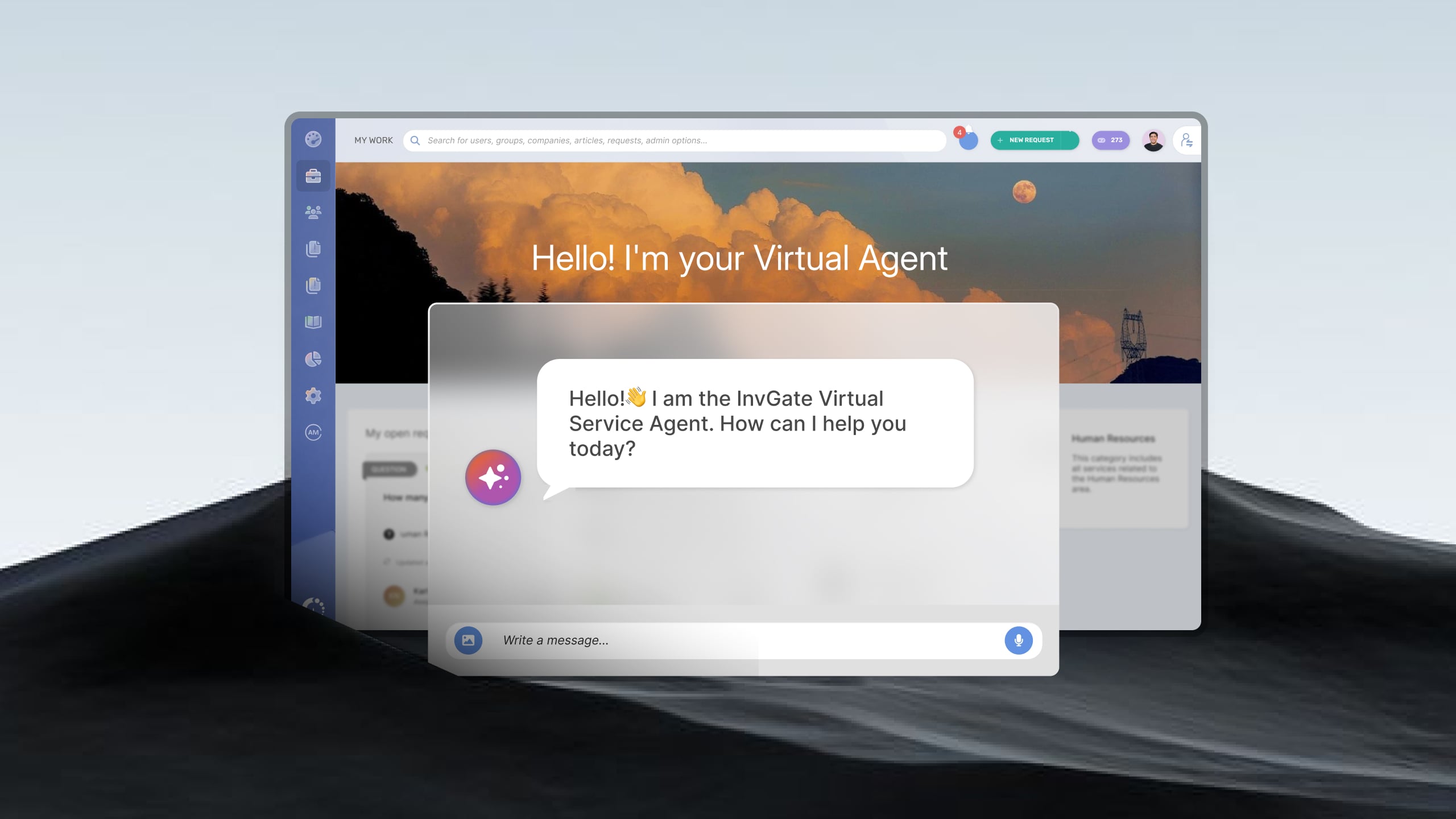
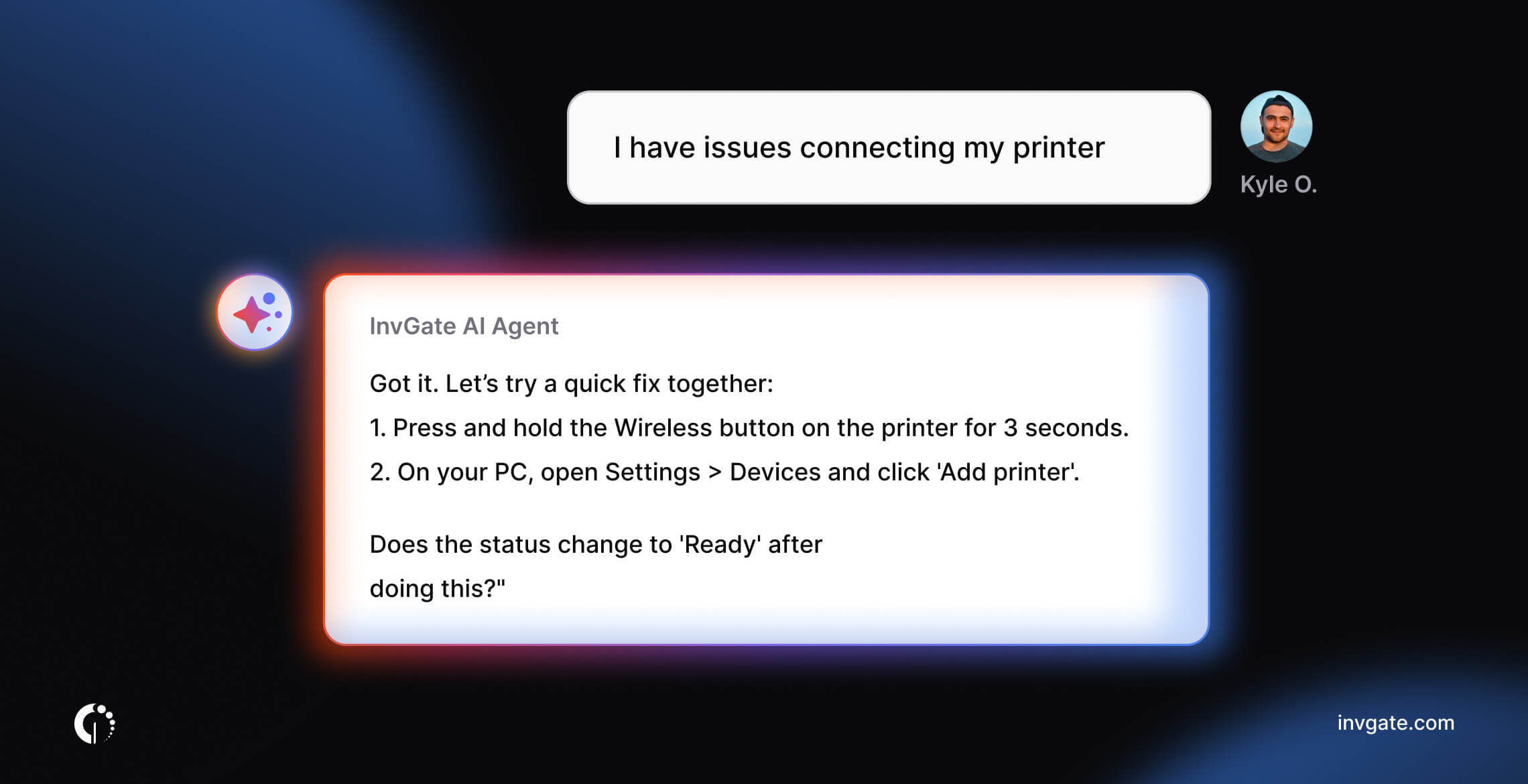
The Virtual Service Agent runs across all three channels from one configuration — no separate setup per channel. It answers using the approved Knowledge Base articles and Snippets described in Step 1, so its quality is a direct function of how well-maintained that layer is, not a separate AI capability.
When it can't resolve the request, escalation carries the full conversation context — what was asked, what was already tried — into the ticket, so the agent doesn't start from a blank ticket and the user doesn't repeat their explanation. For teams already running on Microsoft Teams, this also means support happens without a context switch to a separate portal.
InvGate Service Management includes more than 150 built-in metrics, configurable dashboards, and OLAP reporting — without additional modules. For deflection specifically, the relevant signals are:
These signals identify where the knowledge base has gaps, which catalog categories have high friction, and which request types are generating ticket volume despite self-service being available. That data drives the next iteration: updating the KB, restructuring catalog categories, adjusting VSA response flows.
How do you calculate ticket deflection rate?
Deflection Rate (%) = (Deflected Interactions ÷ Total Potential Interactions) × 100. Deflected interactions are self-service sessions, KB searches, or VSA conversations that ended without a ticket being created. Total potential interactions is the sum of deflected interactions and tickets submitted. The result is the percentage of support demand that was handled without agent involvement.
What is a good ticket deflection rate?
It depends on program maturity. Organizations without an active deflection strategy typically see rates around 23%. Teams with a connected knowledge base and Virtual Service Agent report rates between 40% and 60%. Mature AI-assisted programs can exceed 70% in specific categories. The target isn't the highest number possible — it's the highest rate where deflections represent actual resolutions. A rate built on users abandoning self-service without resolving delivers no real value, regardless of how high the percentage looks.
Can ticket deflection hurt service quality?
Yes — if it's built on friction rather than resolution. When users abandon self-service because they can't find an answer and are forced to create a ticket through a different channel, deflection metrics can look healthy while the actual user experience deteriorates. An outdated knowledge base, a confusing service catalog, or a VSA with poor coverage can all produce "deflections" that are actually failed interactions. Effective ticket deflection improves the user experience; deflection by abandonment erodes it and makes the metric unreliable.

