











The Gartner® Magic Quadrant™ for ITSM platforms is one of the most widely used pieces of research in the IT Service Management market, and the 2026 edition is now out. Choosing an ITSM platform is a long-term commitment — the tool a team selects shapes how it handles incidents, requests, and changes for years — so IT leaders lean on a trusted outside reference before building a shortlist, and this report is often where they start.
The report evaluates the leading vendors and plots them on a single grid, giving buyers a quick read on who competes in the space and how they compare. In this year's edition, InvGate received an Honorable Mention.
In this guide, we walk through what the 2026 report covers, how its four quadrants work, and how to get the most out of it for your own evaluation.
The ITSM Gartner Magic Quadrant is an annual report that analyzes and evaluates vendors in the ITSM market.
Developed by Gartner, a leading research and advisory firm, this report classifies ITSM vendors based on their ability to execute and the completeness of their vision. The resulting two-dimensional grid (known as the Magic Quadrant or MQ) categorizes vendors into four quadrants.
It was first introduced as a way to help businesses make more informed ITSM decisions, and became a trusted source for comparing vendors on a global scale. It offers a clear snapshot of where vendors stand and which ITSM platforms lead the pack in terms of innovation and reliability.
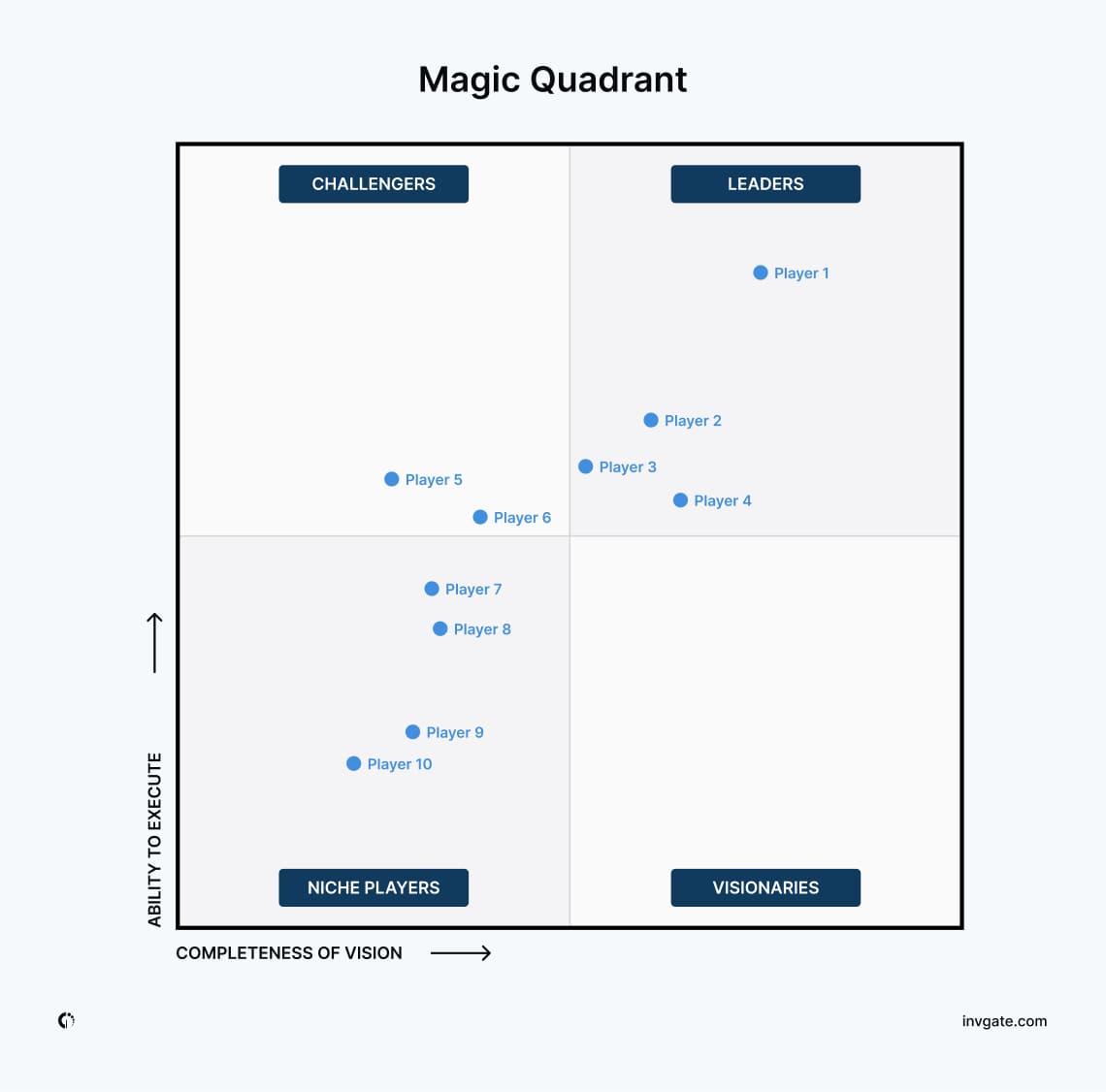
The methodology behind the IT Service Management Magic Quadrant is based on two key dimensions: "ability to execute" and "completeness of vision".
Each vendor is positioned on this chart according to Gartner’s assessment, which combines product analysis, customer feedback, and market criteria.
That placement determines which of the four quadrants they fall into:
Before comparing vendors, the report defines who qualifies to appear. Gartner describes ITSM platforms as "software that provides Workflow Management and automation so organizations can deliver, run, improve, and govern their IT-enabled services", acting as a "system of record for core ITSM practices" and typically delivered as SaaS.
For the 2026 edition, vendors had to offer out-of-the-box support for Incident, Problem, Request, Change, and Knowledge Management, augmented by an integrated Configuration Management system and the ability to define and monitor service levels.
Reading the evaluation criteria closely, we see a profile that points primarily to large organizations — roughly 50,000 or more employees — served by vendors that typically ship one or two major releases a year and run implementations measured in quarters or even years.
That figure is our own read of the characteristics Gartner emphasizes, not a published threshold. At that scale, the Magic Quadrant narrows the field effectively, rewarding vendor maturity, global presence, breadth of capabilities, and long-term product strategy.
A company with 1,000 to 10,000 employees tends to weigh a different set of priorities — especially one that has outgrown a legacy tool and wants enterprise-grade capability without a large vendor's implementation timeline. For that team, success depends more on how quickly the platform goes live, how easily administrators configure workflows, the total cost of ownership, the quality of support, and how readily the product adapts as the organization grows. Those factors aren't absent from the Magic Quadrant, but they may not carry the same weight.
Either way, we consider the Magic Quadrant one of the clearest and most consistent frameworks for evaluating the ITSM market — and the final call should reflect your organization's own priorities, operational requirements, and long-term goals.
InvGate received an Honorable Mention in the 2026 report, a designation Gartner uses to acknowledge noteworthy providers outside the formal Magic Quadrant evaluation.
The way we see it, that placement reflects a design choice. InvGate Service Management is built for speed and self-sufficiency: most teams are up and running in weeks, configure their own workflows and automations, and receive new features on a release cycle that ships every two weeks. Those are the strengths InvGate optimizes for, and they sit apart from the requirements the 2026 criteria center on. For an organization that wants a platform live quickly and improving constantly, that focus is the advantage.
Separately from the Magic Quadrant, InvGate was named a 2025 Gartner® Peer Insights™ Customers' Choice for ITSM Platforms. In the 2025 Gartner® Voice of the Customer™ report for ITSM platforms, InvGate held an overall rating of 4.9 out of 5 and a 94% willingness-to-recommend score, based on 73 reviews as of 31 May 2025. It was also listed among the 20 leading vendors worldwide in the 2025 Gartner® Market Guide for ITSM platforms.
We think the Magic Quadrant is most valuable when you use it to ask better questions, not simply to rank vendors. Start with the vendors that appear to match your organization's needs, then use the report's findings to guide your evaluation.
How much weight to give the report depends on your organization. For the largest enterprises, it works as close to a shortlist. For a leaner IT team that expects frequent updates and needs to be live in weeks, we suggest weighting the evaluation differently.
In short, the report provides a consistent framework for comparing vendors, backed by a well-defined evaluation methodology. You can use that analysis as the foundation for your own assessment, then consider the operational, technical, and business requirements that are specific to your organization.
If you're comparing ITSM platforms, the next step is to see the product against your own processes. Talk to our team about InvGate Service Management and how it fits your requirements.
Yes. Gartner published the Magic Quadrant for IT Service Management Platforms on 27 July 2026, and it is the current edition. It returned the market to the quadrant format — which plots vendors by ability to execute and completeness of vision — after a period when Gartner had used a Market Guide instead.
Gartner evaluates and positions a defined set of vendors across the four quadrants. Among those that have publicly confirmed their placement, Atlassian was named a Leader and ManageEngine was named a Challenger. The complete list of evaluated vendors, with their exact positions, is in the report itself.
InvGate received an Honorable Mention, the designation Gartner uses for noteworthy providers outside the formal quadrant evaluation. Separately, InvGate was named a 2025 Gartner Peer Insights Customers' Choice for ITSM Platforms and was listed among the vendors in the 2025 Market Guide.
The Magic Quadrant scores a defined set of vendors and positions them on a grid, so it reads as a comparative ranking. The Market Guide is broader and more descriptive: it maps the market and covers a wider range of providers without plotting them against each other. InvGate appeared in the 2025 Market Guide for ITSM platforms.
Disclaimer: GARTNER is a trademark of Gartner, Inc. and/or its affiliates.
Gartner does not endorse any vendor, product, or service depicted in its research publications, and does not advise technology users to select only those vendors with the highest ratings or other designation. Gartner research publications consist of the opinions of Gartner's research organization and should not be construed as statements of fact. Gartner disclaims all warranties, expressed or implied, with respect to this research, including any warranties of merchantability or fitness for a particular purpose.


