






11 Lansweeper Alternatives for ITAM (2027): Cloud, On-Premise And Pricing Compared

11 Lansweeper Alternatives for ITAM (2027): Cloud, On-Premise And Pricing Compared

If you are looking for a Lansweeper alternative, there is a good chance the reason has a name: since version 10.4, the default Lansweeper installation links to Lansweeper Cloud, and the local version you installed on your own server is now called Lansweeper Classic.

This guide compares 11 Lansweeper competitors for IT Asset Management (ITAM), with deployment model, discovery method, pricing and review scores checked against official vendor documentation in September 2026. It also explains, using only Lansweeper's own documentation, what changed between Classic and the Platform and why that matters if you never intended to move your inventory to the cloud.
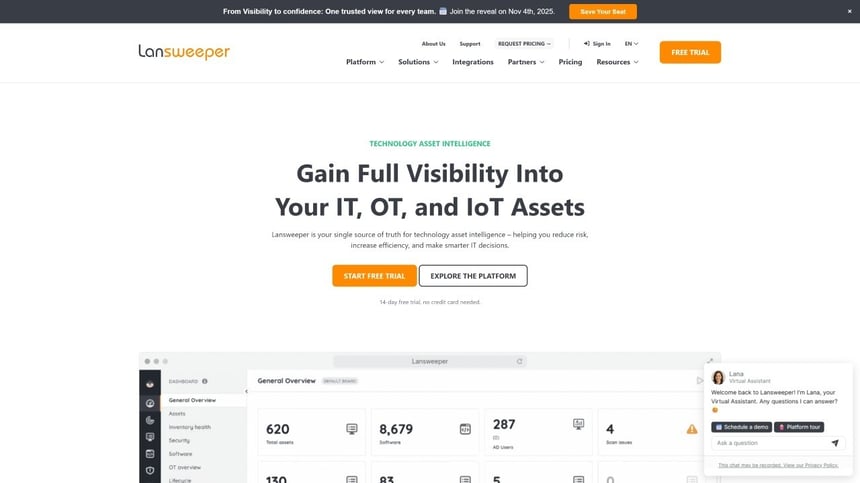
What is Lansweeper?

Screenshot of the Lansweeper website.

Lansweeper is an ITAM and network discovery solution that builds a centralized inventory of everything connected to your network. Its asset discovery page describes a combination of passive detection, which finds devices as soon as they communicate, and credentialed active scanning for full profiling depth, with credential-free recognition that returns manufacturer, model and operating system for assets you have no credentials for.

The scope covers IT, OT, cloud and IoT assets: workstations, servers and network devices, industrial systems on segmented networks, and virtual machines, containers and cloud-native services reached through provider APIs. Lansweeper states that everything above works without an agent, with an agent available as an option for remote endpoints.

Lansweeper is sold in two forms today. Lansweeper Platform is the cloud version, and Lansweeper Classic is the on-premises version that runs on your own Windows servers, with the database on Microsoft SQL Server and the web console hosted in your environment.

Lansweeper features

These are the capabilities Lansweeper publishes on its own product pages, as of September 2026:

  • Agentless discovery with credential-free recognition: Machine learning fingerprinting matched against a library of more than 175 million devices identifies hardware you have no credentials for.
  • Cloud Discovery: Scanning of AWS, Azure, Microsoft Entra ID, Microsoft 365 and Google Cloud Platform, available in the Platform.
  • OT discovery: Detection of operational technology and industrial control systems sitting on segmented networks.
  • Unified inventory: The asset inventory module tracks hardware, software, users, cloud assets and non-IP devices in one place, merging sources and deduplicating records automatically.
  • Vulnerability and lifecycle insights: Lansweeper Insights surfaces which software and assets are exploitable, outdated or approaching end of life.
  • Reporting, dashboards and integrations: Custom reports for audits and patch planning, interactive dashboards, export to BI tools, and a marketplace of ITAM, CMDB, security and service desk connectors.

Lansweeper pros

  • Agentless discovery: Automatically scans and inventories hardware and software across the network without endpoint agents, reducing setup time and overhead.

  • Easy to deploy and use: Users often highlight its quick setup and intuitive interface for building asset inventories.

  • Affordable entry point: After the 14-day trial, small environments can keep using the product free for up to 100 assets.

  • Flexible deployment: Can be installed on-premise or run entirely from the cloud, and an on-premise installation can be linked to a cloud site later.

  • API availability: Includes integration options for connecting asset data with external tools like service desks or CMDBs. Full API access sits in the Enterprise plan.

Lansweeper cons

  • Limited advanced ITAM features: Focuses on discovery and inventory but lacks deeper functionalities like software license compliance, depreciation tracking, or full lifecycle automation.

  • Requires SQL skills for reporting: Building advanced custom reports often demands SQL knowledge, which can be a barrier for non-technical users.

  • No built-in Service Management: The Platform covers help desk work through integrations rather than a native module, so ticketing and workflow automation depend on an external tool.

  • Potential compliance risks from asset deletion: Manual asset deletion can impact traceability if not managed properly.

  • Basic UI/UX limitations: While functional, the interface can feel cluttered or outdated, especially for large environments.

  • New features are delivered to the Platform: In Lansweeper's own Platform and Classic comparison, every capability marked as planned in the discovery tables belongs to the Platform. Risk Insights, custom views, interactive dashboards, network topology diagrams, asset scopes, SSO and the large majority of marketplace integrations are listed as available in the Platform and unavailable in Classic.

  • Renewal increases after the move to per-device licensing: A government customer posting in the Lansweeper community wrote that they "had been paying $800/year with a government discount", that "the licensing models have since changed and now the company is asking us to pay per device", and that the renewal came to "over $8,000", which they described as a 1000% increase. A reviewer on TrustRadius wrote: "Now that they are increasing their pricing by roughly 3 times ROI will decrease." Both comments date from 2018 and 2019, when the per-device model was introduced.

Lansweeper Classic vs Lansweeper Platform: what on-premise users should know

Lansweeper's support portal states that "as of Lansweeper version 10.4, the default installation of Lansweeper will immediately create a link to Lansweeper Cloud, instead of on-premise". The installer can still be run in what Lansweeper calls Classic Mode, which installs extra scanning services, deploys the database to SQL Server and hosts the web console on-premise. An installation built that way can be linked to a cloud site later.

Lansweeper Classic remains documented, supported and available, and its documentation was last updated in August 2026. The difference is where the product is going. The official Platform and Classic comparison lists installation federation, remote access to assets, advanced permissions and scopes, Risk Insights, OT discovery and API access as Platform capabilities, and every item flagged as planned in the discovery tables is planned for the Platform. Classic keeps a handful of things the Platform does not have, such as deployments, scheduled report delivery by email and HP warranty data.

So Classic is not going away, and it is also not where the roadmap lives. If you run Lansweeper on your own server because your environment requires it, this is a reasonable moment to check what else can give you the same inventory without asking you to move it.

11 best Lansweeper competitors in 2027

The list below covers 11 tools that cover IT asset discovery and inventory, either as dedicated ITAM platforms, as Endpoint Management suites, or as Service Management platforms with an asset module. Deployment, discovery method, pricing and trial terms were checked on each vendor's official pages in September 2026, and ratings come from Gartner Peer Insights, G2 and/or Capterra.

  1. InvGate Asset Management.
  2. ConnectWise Automate.
  3. NinjaOne.
  4. Freshservice.
  5. Jira Service Management.
  6. N-able N-Sight RMM.
  7. Domotz.
  8. ServiceNow ITSM.
  9. SysAid.
  10. ManageEngine Endpoint Central.
  11. Ivanti Neurons for ITAM.

Lansweeper alternatives compared

Tool Deployment Discovery method Starting price Free trial
Lansweeper Cloud and on-premise (Classic) Agentless, agent optional From $239/month billed annually, 2,000 assets 14 days, then free up to 100 assets
InvGate Asset Management Cloud and on-premise Agentless network scan, agent, integrations $1,499/year, 500 IP devices 30 days, no credit card
ConnectWise Automate On-premise and ConnectWise-hosted Agent and agentless Not published Trial by request, terms not published
NinjaOne Cloud Agent, with network discovery for unmanaged devices $1.50 to $3.75 per endpoint/month by volume 14 days, no credit card
Freshservice Cloud Agent and agentless probe $19/agent/month billed annually, plus $125/month per 500 Asset Units for ITAM 14 days
Jira Service Management Cloud and Data Center Agentless scanner, agent optional Free up to 3 agents, Standard $20/agent/month 14 days, no payment details
N-able N-Sight RMM Hosted dashboard with agents Agent, plus agentless SNMP for network devices Not published Trial available, no credit card, length not published
Domotz Cloud with a local collector Agentless on endpoints, one collector per network $35 per collector/month or $1.50 per managed device/month 14 days, no credit card
ServiceNow ITSM Cloud Agentless, agent optional, Discovery licensed separately Not published No free trial
SysAid Cloud and on-premise Agentless WMI scan and agent $89/agent/month Trial available, no credit card, length not published
ManageEngine Endpoint Central Cloud and on-premise Agent-based Free up to 25 endpoints, Professional from $795/year for 50 endpoints 30 days
Ivanti Neurons for ITAM Cloud, on-premise or hybrid Active and passive scanning, plus agent data from Endpoint Manager Not published No self-service trial


How this comparison was built

This list is a curated selection of tools that IT teams evaluate when they move away from Lansweeper, and the numbering is an index rather than a ranking. The tools are not ordered by score, priority or recommendation level, and each one answers a different combination of needs, budgets and operational realities.

InvGate develops and markets IT Service Management and IT Asset Management solutions and is an active participant in this market, so it may compete with several of the vendors mentioned here. The objective of this article is to provide accurate, transparent and practical information.

All the information comes from public sources. Feature, deployment and pricing claims come exclusively from each vendor's official documentation, product pages and pricing pages, linked in each section. Ratings come from Gartner Peer Insights. Every data point was accessed in September 2026, and pricing and ratings change, so confirm current terms with the vendor before deciding.

#1. InvGate Asset Management

InvGate Asset Management: 5-minute demo
Video thumbnail


InvGate Asset Management is an ITAM platform for physical, virtual and cloud assets. Its discovery tool scans the network without installing an agent, covering workstations, servers, appliances, mobile devices, cloud VMs and IoT hardware, and a lightweight agent adds depth where you need it. It runs as SaaS or on your own infrastructure, including air-gapped deployments, with feature parity between both.

The difference for a team coming from Lansweeper shows up after the scan. Every asset carries acquisition cost, depreciation, warranty expiration, end-of-life date, owner and location, and every assignment leaves a chain of custody an auditor can follow. Custom fields and Smart Tags are configured without code, and reports need no SQL. Pricing is published, starting at $1,499 per year for 500 IP devices.

InvGate Asset Management features

  • Agentless network discovery, a lightweight agent, and integrations with Microsoft Intune, Jamf, AWS, Azure, VMware and Google Cloud (among others).
  • Hardware lifecycle tracking with acquisition cost, straight-line depreciation, warranty expiration, end-of-life date, location and owner.
  • Software detection with usage and cost data, plus Authorization Policies to classify titles as allowed, under review or prohibited and flag unauthorized installs.
  • CMDB with automatic relationship discovery and assisted mapping.
  • AI capabilities including Smart Search for natural language queries, Atlas as a universal IT database with end-of-life information, and Smart Recommendations.
  • Automations for stock alerts, warranty expiration, contract renewal and depreciation triggers, plus custom rules built from events, conditions and actions.

InvGate Asset Management pros

  • Cloud and on-premise deployment with feature parity, which keeps the on-premise option open without giving up new features.
  • Discovery and full asset lifecycle in one platform, with chain of custody for every assignment.
  • Published pricing, so you can budget without a sales call.
  • No-code configuration and a short learning curve, consistently noted by reviewers.
  • Software license tracking and expiration control tied to the same inventory.
  • Agent reports silently once installed, according to reviewers on Gartner Peer Insights.

InvGate Asset Management cons

  • No Vulnerability Management or patching module, so security remediation needs a separate tool.
  • Dashboard and report customization is more limited than in enterprise suites.
  • Highly conditional, multi-level workflows can hit the limits of what the automation engine covers.
  • Some reviewers report friction integrating with third-party tools.
  • Agent rollout across endpoints takes time when done device by device.

InvGate Asset Management comments and reviews

As of September 2026, InvGate Asset Management holds the following ratings:

InvGate has also been recognized in Gartner’s Market Guide for Hardware Asset Management Tools, where it was named a representative vendor.

InvGate Asset Management pricing

Licensing is based on IP devices, meaning any asset connected to a network with an IP address, and each IP device includes an allowance for two non-IP devices at no additional cost.

  • Starter: $1,499/year, fixed, for 500 IP devices.
  • Pro: $5 per IP device/year, from 500 to 5,000 IP devices, with a $2,500/year minimum.
  • Enterprise: custom, starting at $12,000/year, scaling up to 1,000,000 IP devices.

There is a 30-day free trial with no credit card required. Start a free trial or talk to Sales to see how it maps to your environment.
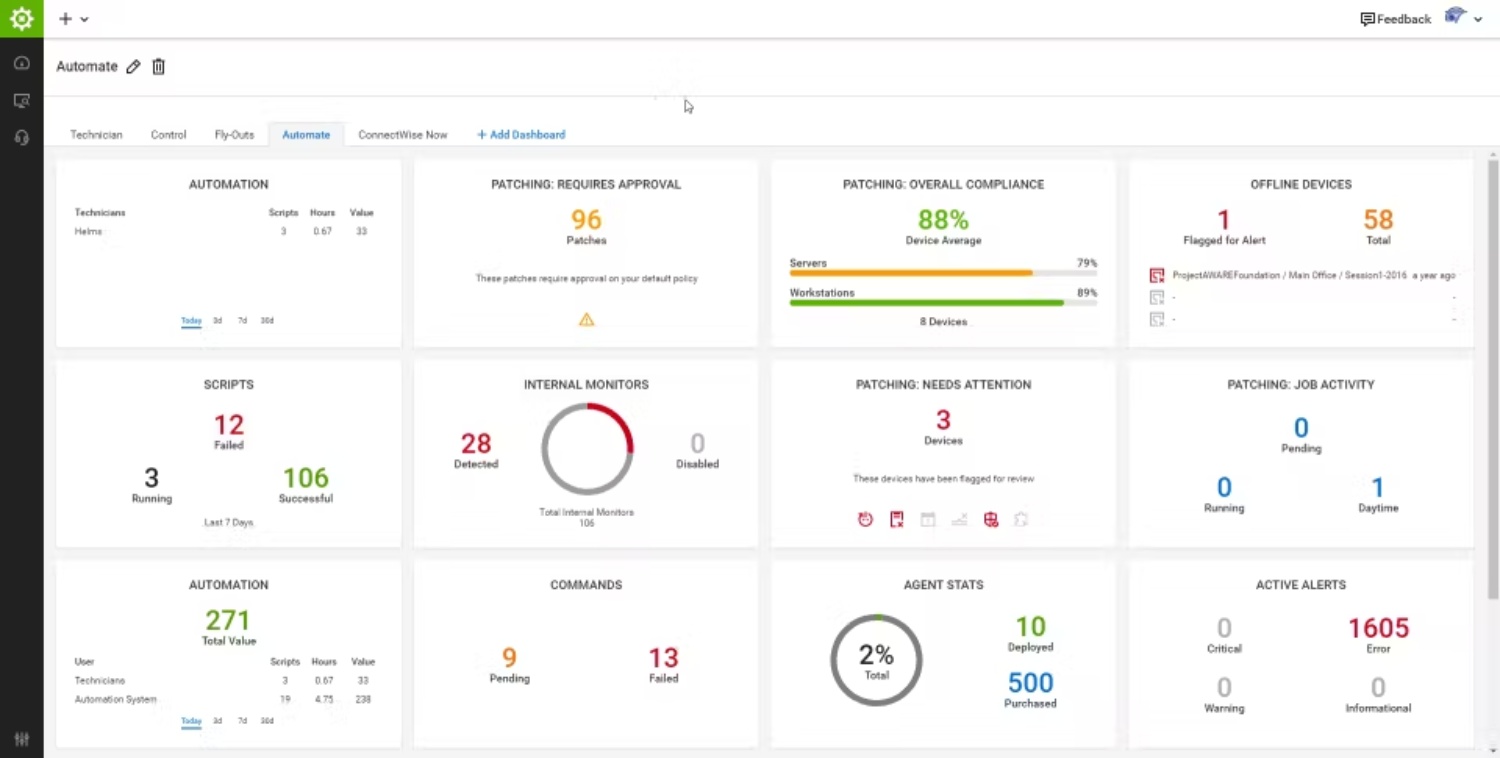
#2: ConnectWise Automate

Connectwise automate - Interface.

ConnectWise Automate (formerly LabTech) is ConnectWise's Remote Monitoring and Management product, positioned around automation so teams can proactively monitor, manage and support client networks. It is the closest thing on this list to Lansweeper's deployment flexibility, because it runs on your own hardware as a single or split server, or hosted by ConnectWise on AWS.

For asset discovery specifically, ConnectWise's asset discovery documentation states that the platform provides both agent and agentless asset inventory, with Network Probe technology scanning IP ranges, classifying devices through detection templates and pushing agents to discovered Windows machines when admin credentials are supplied. It reaches virtual machines and network devices from manufacturers including Cisco, Dell, HP and Juniper.

ConnectWise Automate features

  • Asset discovery across managed networks, with both agent and agentless inventory
  • Endpoint management with direct access to user devices
  • Patch management for Windows and third-party software, with configure, test and install steps
  • Remote monitoring to identify issues before they reach the user
  • IT automation to offload routine workloads
  • ConnectWise Sidekick, an AI assistant that generates PowerShell scripts subject to team approval

ConnectWise Automate pros

  • Deep scripting and automation engine, the main reason teams choose it over lighter RMM tools.
  • Agent and agentless inventory in the same product, including switches, printers and firewalls.
  • On-premise deployment is a documented option, which is rare among modern RMM platforms.
  • Network Probe can deploy agents automatically to discovered Windows devices.
  • Tight integration with ConnectWise PSA and the rest of the ConnectWise stack.
  • Strong alerting tied to ticket SLAs.

ConnectWise Automate cons

  • Reviewers consistently describe the interface as dated and slow to navigate.
  • Steep learning curve and long implementation, hard on small or junior teams.
  • Feature gap between the web console and the native Windows application.
  • Agent reliability issues reported, with connections requiring troubleshooting.
  • macOS support is weaker than Windows support.
  • Pricing is not published and reviewers describe it as higher than competing solutions.

ConnectWise Automate comments and reviews

As of September 2026, ConnectWise Automate holds the following ratings:

ConnectWise Automate pricing

ConnectWise does not publish prices. Its pricing page asks you to fill out a form so the company can put together a quote, and no plan names, rates or billing units are disclosed. A trial request form exists, but the length of the trial and whether a card is required are not published either.
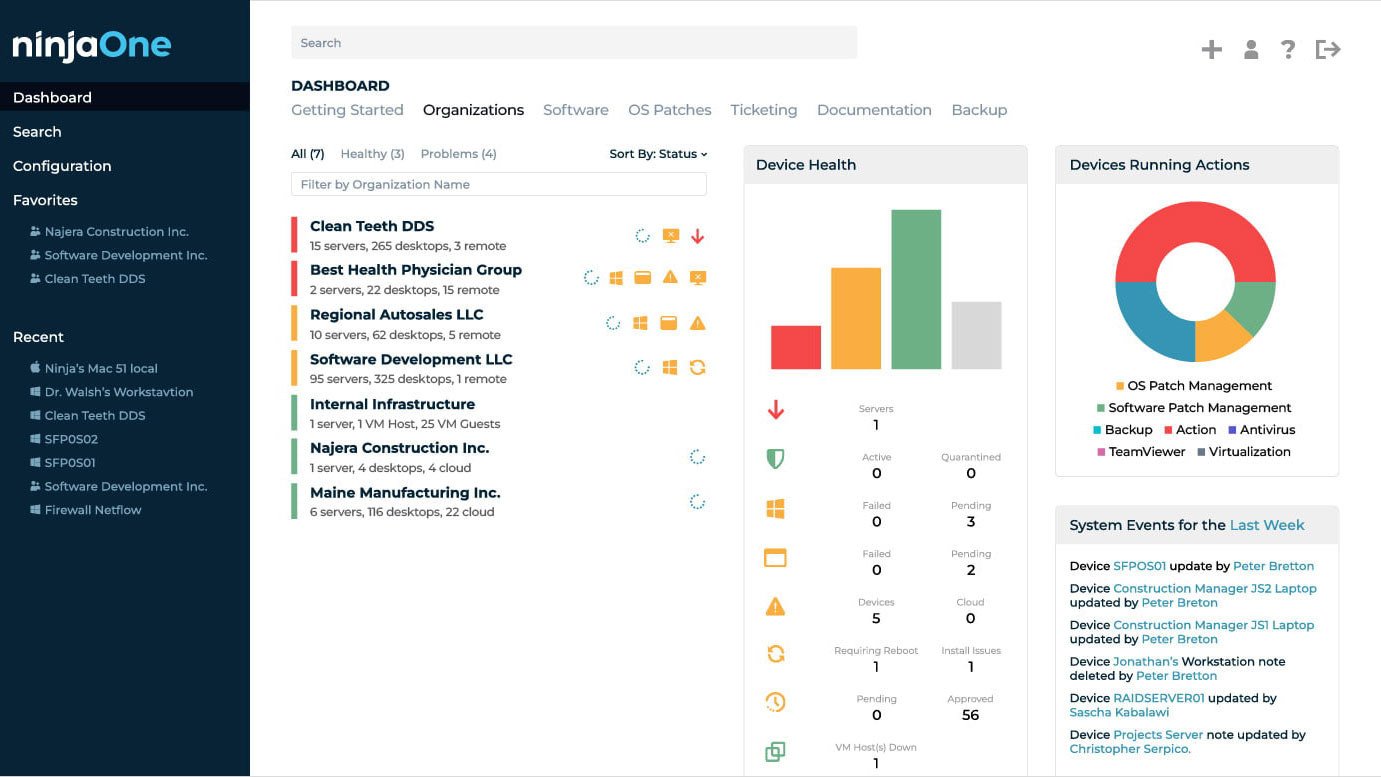
#3: NinjaOne

ninjaone-asset-management

NinjaOne (formerly NinjaRMM) describes itself as a unified IT operations platform for endpoint management, autonomous patching, backup and remote access. It is cloud-native, with no infrastructure to provision, and the vendor states that deployment is completed in under 30 days.

Its IT Asset Management module brings hardware, software and lifecycle records into a single inventory whether the asset is agent-managed, network-discovered or offline, and includes shadow IT detection for unmanaged devices such as IoT hardware, smartboards, desk phones and legacy systems. The management layer itself is agent-based, so the agentless part is the discovery of things the agent cannot reach.

NinjaOne features

  • Autonomous patch management with AI prioritization, covering over 8,800 applications
  • Asset discovery and inventory across agent-managed, network-discovered and offline devices
  • Mobile Device Management for Android and Apple devices
  • Backup for devices, servers and SaaS, including Microsoft 365 and Google Workspace
  • Single-click remote access across Windows, macOS and Linux
  • Endpoint automation and auto-remediation, plus documentation and ticketing

NinjaOne pros

  • Fast time to value, with no server to stand up and deployment measured in days.
  • Modern interface that reviewers describe as clean and intuitive.
  • Consistently high ratings across review platforms.
  • Onboarding, training and support are included rather than sold as premium tiers.
  • Broad third-party patch coverage with AI-driven prioritization.
  • Shadow IT detection captures devices that will never accept an agent.

NinjaOne cons

  • Cloud only, with no on-premise option, which rules it out for air-gapped environments.
  • Cost scales quickly, and the lowest rate requires a very large endpoint count.
  • Final pricing is still quote-based, with no published plan names or module rates.
  • Reviewers report limited backup options for NAS and on-premises targets.
  • Reporting and dashboard customization lags the rest of the product.
  • Designing the policy hierarchy correctly takes more thought than the quick setup suggests.

NinjaOne comments and reviews

As of September 2026, NinjaOne holds the following ratings:

NinjaOne pricing

NinjaOne publishes a price range rather than a full list. Its NinjaOne pricing page states that NinjaOne "starts as low as $1.50 USD per month at 10,000 endpoints, increasing to $3.75 USD at 50 or fewer endpoints", billed per endpoint where the agent is deployed, monthly or annually. The final figure comes from a custom quote. There is a 14-day free trial with full feature access and no credit card required.
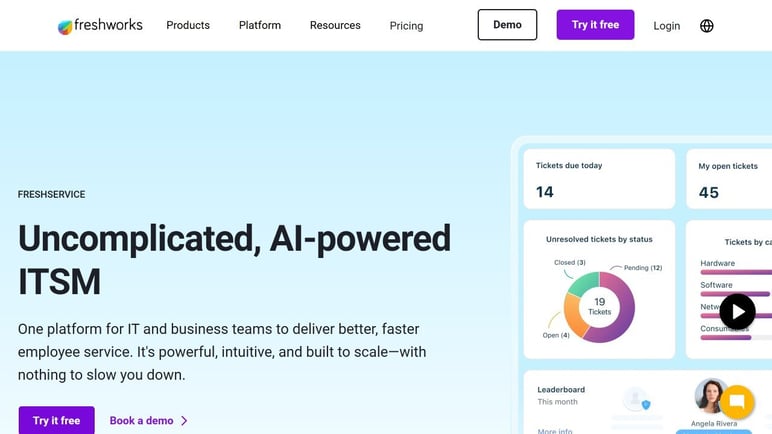
#4: Freshservice (by Freshworks)

Screenshot of the Freshservice website.

Freshservice is Freshworks' ITSM platform, presented as service, operations and assets unified on one system with a shared CMDB. It combines incident, problem, change and release management with IT Asset Management, and is built on ITIL practices.

Its discovery is documented in two forms: a Discovery Agent installed on Windows, Mac or Linux machines, and a Discovery Probe, a Windows application on your own server that scans the network by domain or IP range and integrates with Microsoft SCCM and Active Directory. Cloud discovery covers AWS, Azure and VMware, and Freshworks documents that agent and probe can be combined without duplicating assets.

Freshservice features

  • Automated discovery across on-premises, cloud and hybrid environments
  • Multi-source CMDB for hardware, software and SaaS
  • Software license management for cost control and compliance
  • Dependency mapping between applications, services and infrastructure
  • IP address management to avoid conflicts across the network
  • Data center infrastructure management with CPU, memory and I/O utilization data

Freshservice pros

  • Clean interface with minimal agent training required.
  • Codeless drag-and-drop automation reduces repetitive ticket handling.
  • Asset records link directly to tickets, changes and the CMDB in one system.
  • Agent, agentless probe and native cloud discovery cover hybrid estates.
  • Broad catalog of pre-built integrations plus an open API.
  • SaaS users are treated as a first-class asset type, which catches license waste that hardware-centric tools miss.

Freshservice cons

  • You pay on two axes, per agent and per Asset Unit, which makes budgeting harder.
  • The Asset Unit table is expensive for server-heavy estates, where one server counts as four units.
  • Reporting is described as rigid for specialized or multi-layered data sets.
  • Discovered cloud assets are not categorized by company, a problem for multi-entity organizations.
  • Advanced workflows and asset customization hit limits at enterprise complexity.
  • The mobile app offers less than the desktop experience.

Freshservice comments and reviews

As of September 2026, Freshservice holds the following ratings:

Freshservice pricing

Freshservice prices the service desk per agent and IT Asset Management separately. On the Freshservice plans page, Starter is $19/agent/month, Growth $49, Pro $99 and Enterprise is custom, all billed annually. Asset Management is measured in Asset Units and, according to the ITAM pricing page, starts at $125/month per 500 Asset Units, sold in packs of 500 with a 20% discount for annual billing. Growth is the first plan that includes an ITAM package. There is a 14-day free trial.
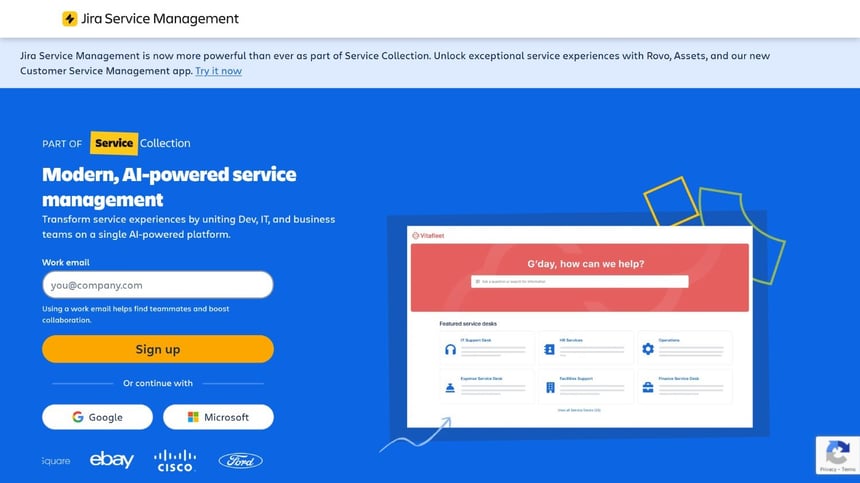
#5: Jira Service Management (by Atlassian)

jira-service-management-screenshot

Jira Service Management handles assets through Assets, Atlassian's native CMDB. Its differentiator is a flexible object schema. You define your own object types and attributes, which lets it hold contracts, people, locations and business services alongside hardware. Assets link natively to requests, incidents, changes and employee workflows.

One caveat matters a lot for this comparison. Atlassian describes it as basic discovery functionality to detect assets and configuration items connected to your local network, and points to integrations with leading discovery solutions like Lansweeper and Flexera to find and import devices into the Assets app. Assets works best as an aggregation layer over discovery you already run, using its 30-plus connectors for Jamf, Intune, SCCM, AWS and Azure.

Jira Service Management features

  • Flexible object-schema CMDB with Common Data Model and Hardware Asset Management templates
  • Assets Data Manager to integrate, cleanse and reconcile data from multiple sources
  • More than 30 out-of-the-box connectors for endpoint and cloud sources
  • Native linkage between assets and support requests, incidents and change requests
  • Dependency mapping, with linked configuration items appearing in incident workflows
  • Lifecycle coverage from procurement to retirement, with Rovo AI for asset search and anomaly detection

Jira Service Management pros

  • Unmatched integration for teams already running Jira Software and Confluence.
  • The object model handles configuration item types that fixed-taxonomy tools cannot.
  • Strong aggregation CMDB, with connectors and a data reconciliation layer.
  • Free forever tier for 3 agents, and a trial that requires no payment details.
  • Premium includes 50,000 Assets objects, enough for most mid-market estates.
  • Data Center gives a self-hosted option with Assets bundled in.

Jira Service Management cons

  • Atlassian itself calls its native discovery basic and points to Lansweeper and Flexera to import devices into Assets.
  • Steep learning curve, the most cited complaint across review platforms.
  • Initial configuration often requires technical expertise or consultant support.
  • Licensing is described as confusing, and the jump from Standard to Premium is steep.
  • Object overage adds a second unpredictable cost axis on top of agent fees.
  • Reviewers discuss the Assets module far less than core ticketing, which suggests it is less exercised.

Jira Service Management comments and reviews

As of September 2026, Jira Service Management holds the following ratings:

Jira Service Management pricing

Jira Service Management is sold per agent, with end users unlicensed. According to the Service Collection pricing page, the Free plan covers 3 agents, Standard is $20 per agent/month, Premium is $51.42 per agent/month and Enterprise is custom, billed annually, with up to 17% savings on annual billing. Asset and configuration management is included from Standard upward. Object allowances are 5,000 on Standard, 50,000 on Premium and 500,000 on Enterprise, with overage starting at $0.02 per object per month. The trial runs 14 days, extendable to 30, with no payment information required.
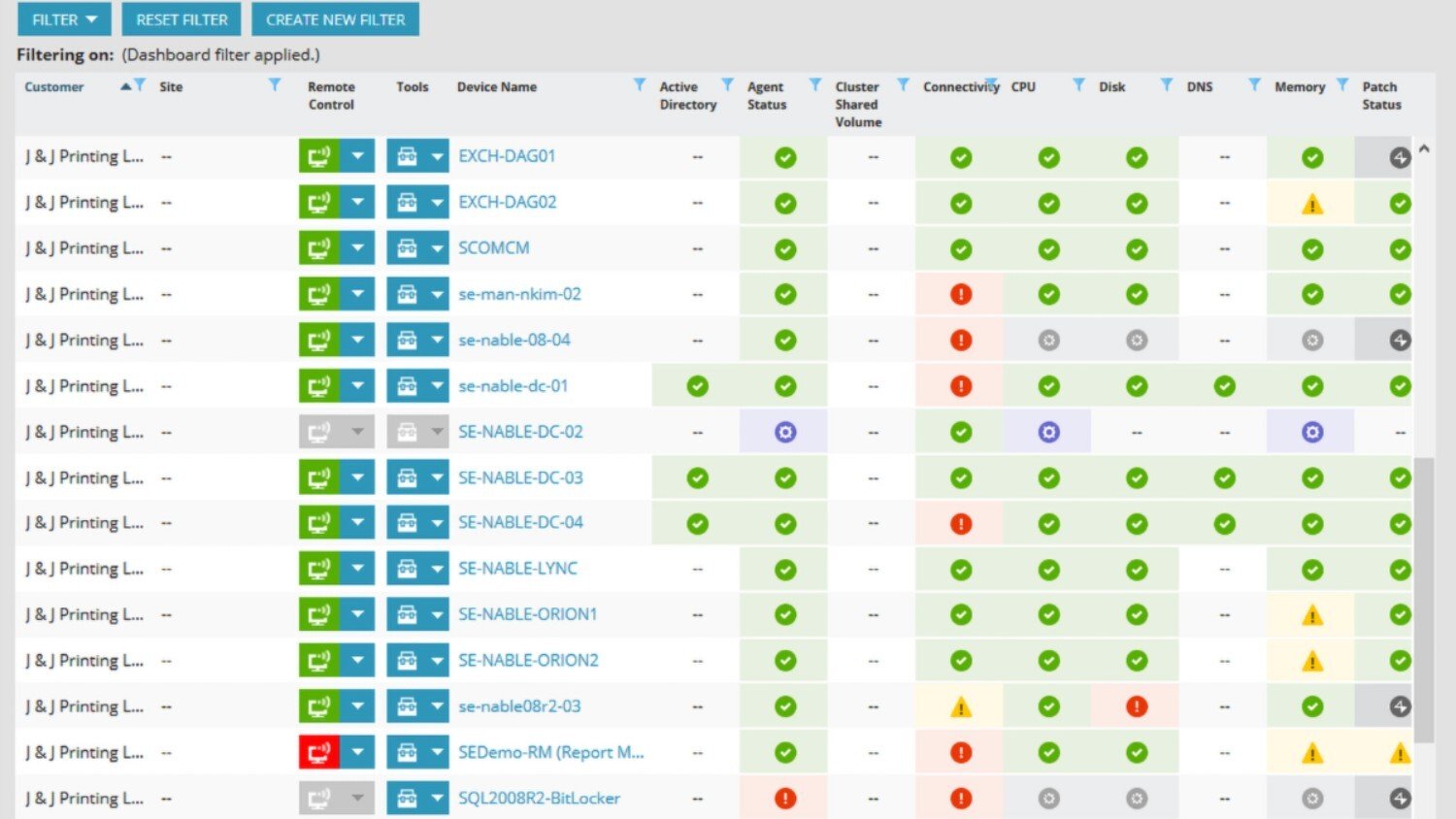
#6: N-able N-Sight RMM (by N-able)

N-able's interface.

N-able N-Sight RMM is an endpoint management and RMM platform aimed at growing MSPs and internal IT teams, bundling monitoring, patching, remote access, ticketing and billing in one subscription. It supports Windows, macOS, iOS and Linux, and N-able has added an AI assistant called N-zo along with a combined vulnerability and patching workflow.

Its discovery works in two layers. The network discovery feature imports devices connected to each managed subnet with details such as MAC address, IP, operating system, firmware version and hostname, reaching printers, firewalls, routers, switches and UPS units over SNMP without an agent. The monitoring agent is then installed on eligible Windows, macOS and Linux devices. There is also an asset tracking only mode for devices you want in the inventory without full management.

N-able N-Sight RMM features

  • Monitoring, alerting and patch management across Windows, macOS, iOS and Linux
  • AI-enhanced vulnerability management and patching in a single workflow
  • Visual automation building with more than 650 pre-configured scripts
  • Take Control remote access, attended and unattended, with file transfer and live chat
  • Ticketing and billing with a brandable customer portal
  • Network device discovery over SNMP with hardware and software visibility

N-able N-Sight RMM pros

  • All-in-one package that includes ticketing and billing, which usually requires a separate PSA.
  • Agentless SNMP discovery of network gear, the closest analogue here to Lansweeper's scanning breadth.
  • Take Control remote access is singled out by reviewers for reliability.
  • Low-friction automation through drag-and-drop building and a large script library.
  • Reviewers describe it as cost-effective relative to alternatives.
  • Active roadmap, with vulnerability management and the AI assistant as recent additions.

N-able N-Sight RMM cons

  • Interface is described as aging and in need of modernization.
  • Patch deployment reliability is the most common functional complaint.
  • Remote control is not natively available on Linux despite a Linux agent existing.
  • Apple device support requires additional configuration work.
  • Reporting customization and filtering are limited, a problem if reporting is why you use Lansweeper.
  • Neither pricing nor trial length is published.

N-able N-Sight RMM comments and reviews

As of September 2026, N-able N-Sight RMM holds the following ratings:

N-able N-Sight RMM pricing

N-able does not publish prices for N-Sight. The product's quote request page asks for business details and shows no rates, plan names or billing units. A free trial is offered with all features and no credit card required, though the duration is not stated on the official pages.
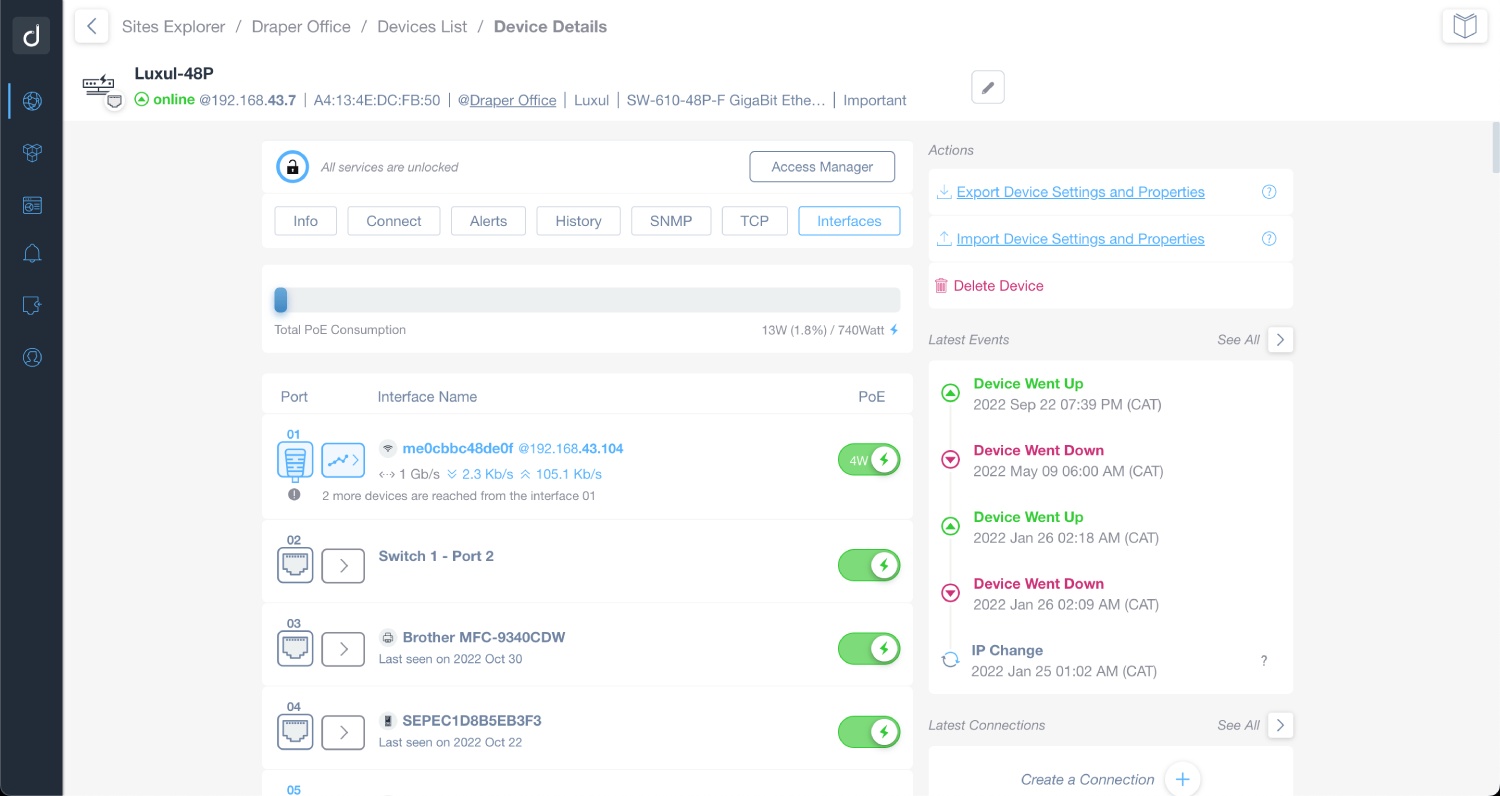
#7: Domotz

Domotz's interface.

Domotz is a network monitoring and remote management platform built around continuous device discovery. A lightweight collector runs on the local network, on Windows, Linux or a hardware appliance, and reports to the Domotz cloud, so endpoints themselves stay agentless. The vendor states deployment takes under 15 minutes.

Where it differs from Lansweeper is emphasis. Domotz is strongest at live network context, topology and remote troubleshooting across many sites, and it identifies devices by MAC address for inventory purposes. It does not publish capabilities for warranty tracking, contract management, software license management or asset disposal, so it covers the discovery half of ITAM and leaves the lifecycle half to another tool.

Domotz features

  • Automatic discovery of every device connected to the network, with manufacturer, model, type, MAC and IP
  • MAC-address-based inventory across distributed infrastructure
  • Network topology mapping and connection path visualization
  • Continuous monitoring and alerting on device health
  • Remote management, diagnostics and secure device access without a VPN
  • Security monitoring, third-party integrations and an MCP Server for AI agents

Domotz pros

  • Intuitive, modern interface that reviewers praise consistently.
  • Very fast setup, with a collector running in minutes.
  • Customizable alerts and continuous monitoring across distributed sites.
  • Responsive and knowledgeable support.
  • Transparent pricing with no feature gating and no annual commitment.
  • Remote device access and power cycling without a dedicated server or VPN.

Domotz cons

  • Network diagrams underperform on flat networks.
  • Alert noise and false positives are reported by several reviewers.
  • Cost climbs across many sites, and users report increases.
  • API support is limited, which constrains integrations.
  • Device identification errors and VLAN monitoring limits appear in reviews.
  • No published warranty, contract, license or disposal management, so it is not a full ITAM replacement.

Domotz comments and reviews

As of September 2026, Domotz has fewer than 10 ratings on Gartner Peer Insights, which is not a large enough sample to publish a score.

Domotz pricing

Domotz publishes two plans on its plans and pricing page. The Collector Plan is $35 per collector per month with full platform access on every device. The Managed Device Plan is $1.50 per managed device per month, billed in bundles of 10 devices at $15 per bundle. Both come without tiers, feature gating, setup fees or annual commitment, and extra team members cost nothing. There is a 14-day trial with no credit card required.

#8: ServiceNow ITSM

ServiceNow ITSM connects incident, problem, change and request management on a single AI platform, with change impact assessed against CMDB dependencies. It is enterprise-grade, built to manage complex service workflows across very large estates.

The structural point for anyone comparing it to Lansweeper is that ITSM, IT Asset Management and Discovery are separately licensed products sharing one platform and one CMDB. The Lansweeper-equivalent capability lives in ServiceNow Discovery, which scans on-premises, cloud and containerized infrastructure without agents through a MID Server, with the Agent Client Collector covering domain controllers, DMZ hosts and endpoints where credentials or firewall exceptions are a problem. Buying ITSM alone does not give you that.

ServiceNow ITSM features

  • ITIL-aligned incident, problem, change, request and knowledge management
  • Agentless infrastructure discovery across on-premises, cloud and container environments
  • Agent-based discovery through the Agent Client Collector for hard-to-reach segments
  • Event-driven cloud discovery that receives configuration events as they occur
  • Full asset lifecycle automation for hardware, software and cloud assets
  • Service Mapping and CMDB dependency modeling for change impact analysis

ServiceNow ITSM pros

  • Incidents, changes, assets and discovery all resolve against one CMDB.
  • Discovery breadth covers on-premises, cloud, containers and zero-trust segments.
  • Change risk scoring uses actual configuration item relationships.
  • Low-code extensibility through Flow Designer and IntegrationHub.
  • Deep automation and native AI for categorization and proactive problem management.
  • Enterprise ITAM depth, including license reconciliation and audit readiness.

ServiceNow ITSM cons

  • Licensing and implementation cost is the dominant complaint, and a barrier for smaller organizations.
  • Steep learning curve that assumes prior platform knowledge.
  • Configuration usually requires dedicated administrators or consultants.
  • The discovery and asset story requires buying three products, not one.
  • Reviewers report interface friction and slow page loads under heavy volume.
  • Some configuration options are rigid and hinder workflow customization.

ServiceNow ITSM comments and reviews

As of September 2026, ServiceNow IT Service Management holds the following ratings:

ServiceNow pricing

ServiceNow publishes package names and no prices. Its ITSM pricing page lists ITSM Foundation, ITSM Advanced and ITSM Prime, and the only route to a number is a custom quote. IT Asset Management is quoted separately. There is no commercial free trial or free edition; a free personal developer instance exists for development work, which is not a production evaluation environment.
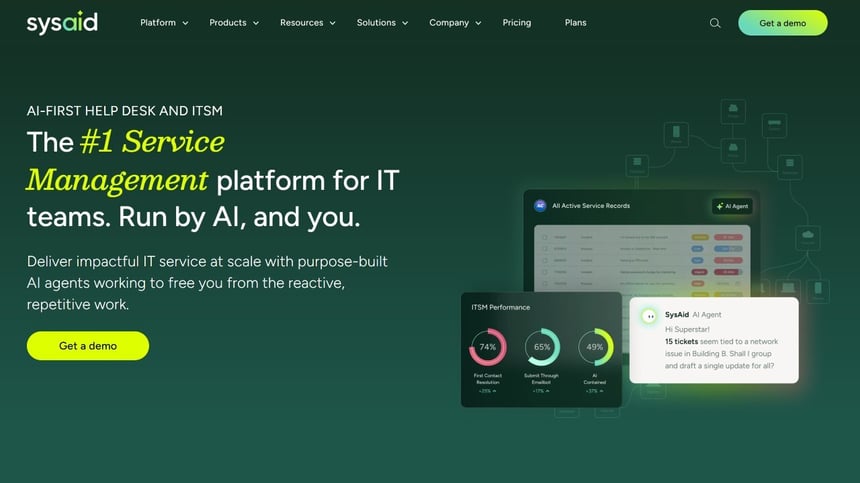
#9: SysAid

Screenshot of SysAid’s current website.

SysAid is an AI-first ITSM platform for IT teams, bundling incident, request, change and problem management with knowledge management, a service catalog and workflow automation, plus built-in IT Asset Management and a CMDB. It also ships native remote support and patch management powered by GFI, which is uncommon at this level.

Discovery works either through an agentless WMI scan or the SysAid agent. One detail deserves attention if discovery is why you are leaving Lansweeper: SysAid's own asset management page states that its Advanced Discovery Network is powered by Lansweeper. SysAid also remains available on-premise, with one to two releases per quarter, though the cloud edition carries features the on-premise edition does not.

SysAid features

  • Automated discovery of network assets across hardware and software
  • CMDB that tracks configuration items and their relationships
  • Software and license management with renewal reminders
  • Network discovery with automatic updates to keep data accurate
  • Patch management for Windows servers and PCs, powered by GFI
  • Lifecycle management from procurement through retirement, inside the service desk

SysAid pros

  • Strong and consistent satisfaction scores across review platforms.
  • Customer support is the most repeated point of praise.
  • AI deflection is measurable, with reviewers reporting large drops in ticket volume.
  • Native patch management, rare in this bracket.
  • On-premise remains a supported option with a regular release cadence.
  • End users are unlimited, so only agents consume licenses.

SysAid cons

  • Advanced discovery runs on Lansweeper technology, which matters if Lansweeper is what you are replacing.
  • The admin interface is described as dated and cluttered.
  • The migration to the new interface is unfinished, so admins work across two generations.
  • Reporting is basic and charts are not customizable.
  • Pricing depends on four variables and is effectively quote-driven.
  • Performance lags reported for very large enterprises with high ticket volumes.

SysAid comments and reviews

As of September 2026, SysAid holds the following ratings:

SysAid pricing

SysAid publishes one list price. On its plans page, Professional is $89 per agent per month and includes 250 managed assets, while Enterprise is custom and starts at 20 agents. Asset monitoring and CMDB are included in both. SysAid's own FAQ states that the final price depends on the number of administrators and assets, the modules selected, the edition and whether you deploy on-premises or in the cloud, so treat $89 as a starting reference. The trial covers all features and modules with no credit card required, though the duration is not stated on the official pages.
#10: ManageEngine Endpoint Central

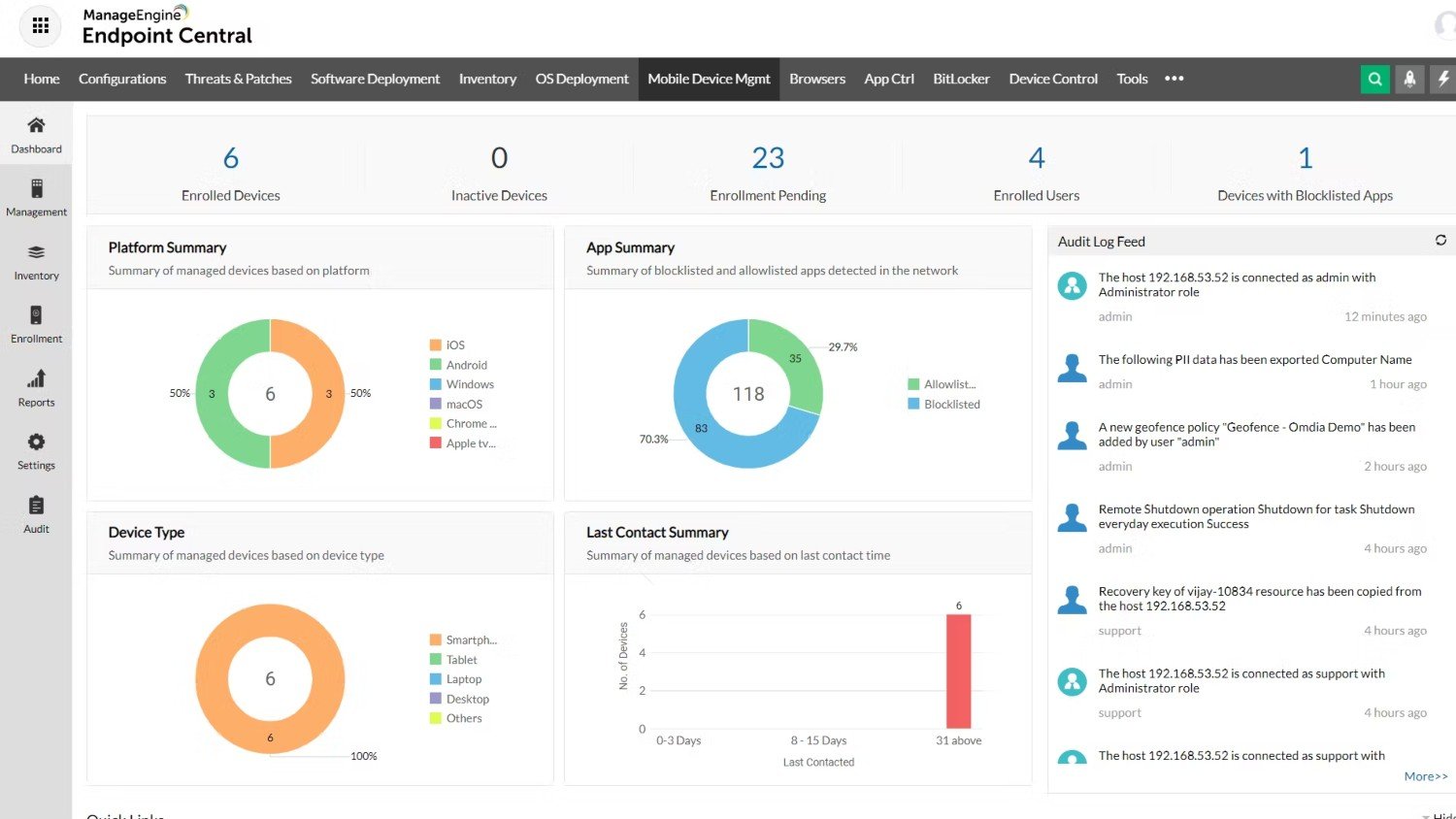
Manageengine Endpoint Central - Interface.

ManageEngine Endpoint Central is a unified endpoint management and security solution for servers, desktops, laptops and mobile devices. It combines patching across Windows, Mac, Linux and third-party applications with software deployment, configuration management, remote troubleshooting and hardware and software inventory in one console, and it is available in both cloud and on-premise editions.

The technical difference with Lansweeper is worth stating plainly. ManageEngine's own user manual specifies that the Endpoint Central agent is required to carry out the inventory scan and that target machines must be managed by Endpoint Central. Inventory therefore covers endpoints where the agent is installed, so devices nobody has onboarded stay invisible to it.

ManageEngine Endpoint Central features

  • Continuous discovery, tracking and reporting of software and hardware by OS, manufacturer, age and device type
  • Hardware and software inventory management with detection of hardware changes
  • Software license management with alerts on expiry, over-usage and under-usage
  • Software metering that collects usage counts and duration to reclaim unused licenses
  • Hardware warranty management covering expired and soon-to-expire warranties
  • Mobile and peripheral controls, including jailbreak detection, geo-fencing and USB device management

ManageEngine Endpoint Central pros

  • Patching, software deployment, remote support and asset management in a single platform.
  • Automated patch management across Windows, macOS and Linux is the most praised capability.
  • Remote support works well for users off the VPN.
  • One console for mixed operating system fleets at scale.
  • Published, self-serve pricing, including perpetual on-premise licensing.
  • A permanent free edition for up to 25 endpoints.

ManageEngine Endpoint Central cons

  • Inventory depends on the agent, so unmanaged or rogue devices are not discovered.
  • Reporting is the most frequent complaint, with built-in reports lacking granularity for compliance audits.
  • The interface is described as cluttered and overwhelming for new administrators.
  • Steep initial learning curve, with documentation reviewers find unclear.
  • Patch support for Mac and Linux is weaker than for Windows.
  • Reviewers report lag and feature breakage after new releases.

ManageEngine Endpoint Central comments and reviews

As of September 2026, ManageEngine Endpoint Central holds the following ratings:

ManageEngine Endpoint Central pricing

ManageEngine publishes a full price list. According to its Endpoint Central pricing page, for 50 endpoints with one technician, the on-premise annual subscription costs $795 for Professional, $945 for Enterprise and $1,095 for UEM, with perpetual licenses at $1,987, $2,362 and $2,738 respectively. Cloud equivalents are $1,045, $1,245 and $1,395 per year. Volume scales published on the same page put Professional at $1,445 per year for 100 endpoints and $8,945 per year for 1,000. The free edition covers up to 25 endpoints permanently, and the 30-day trial has no endpoint limit.
#11: Ivanti Neurons for ITAM

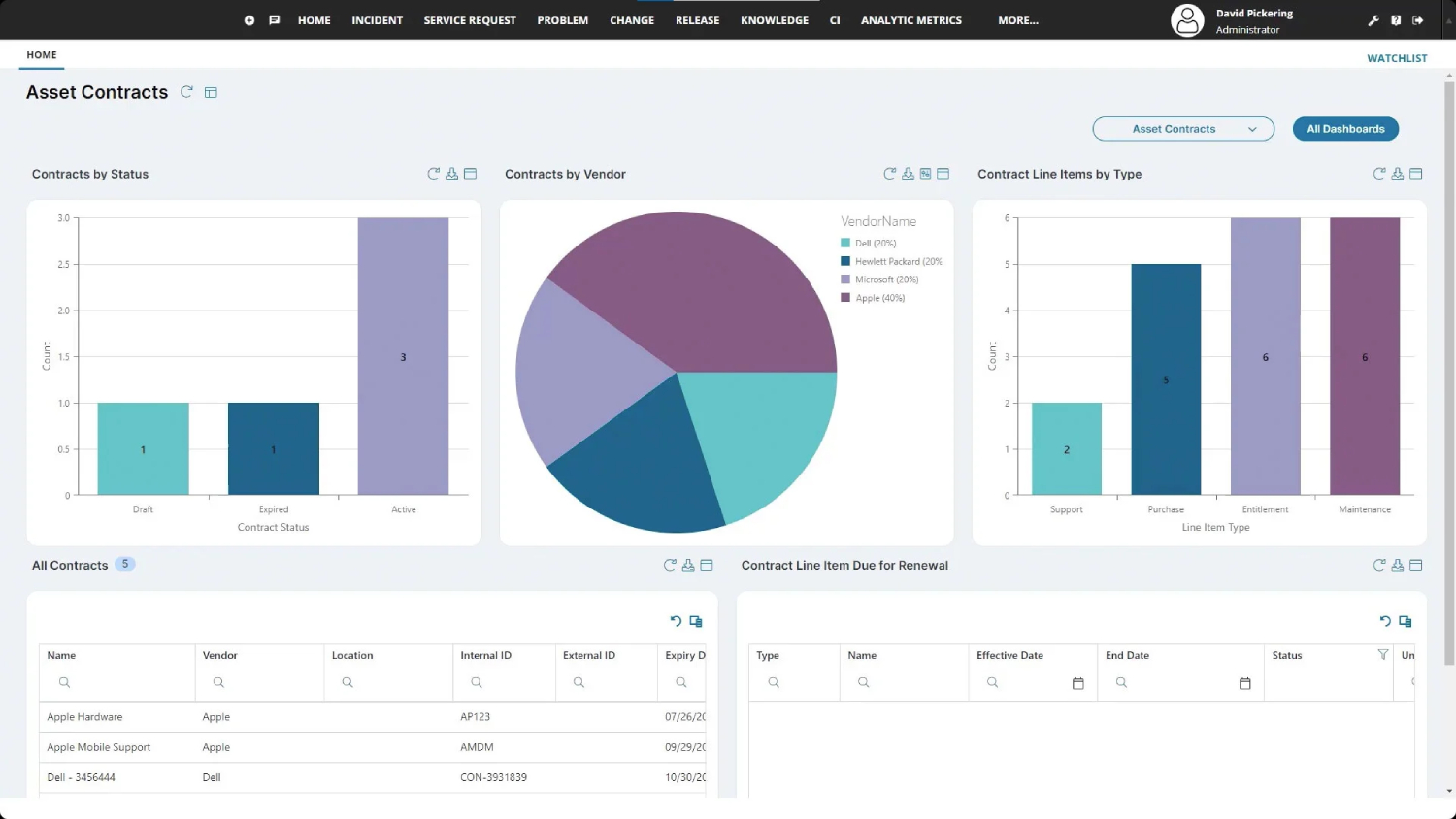
Ivanti Neurons for ITAM - Interface.

Ivanti Neurons for ITAM is the asset management component of the Ivanti Neurons platform, positioned as a trusted system of record that gives continuous visibility into assets, ownership and lifecycle state. Its architecture is built around aggregation: asset data is pulled from Ivanti Asset Discovery, Ivanti Endpoint Manager and third-party sources, then normalized and reconciled into a single CMDB-ready record.

Discovery combines active and passive scanning, which Ivanti describes as finding assets as they appear, including hidden or intermittently connected devices, with agent-sourced data arriving from Endpoint Manager. The federated posture is the clearest differentiator: it consolidates records from Azure AD, AWS, ServiceNow, Jamf and Chrome Enterprise, and ingests vulnerability findings from Tenable, Rapid7 and Qualys onto the asset record.

Ivanti Neurons for ITAM features

  • Central asset repository carrying ownership, lifecycle state and financial data
  • Continuous discovery with active and passive scanning and automatic reconciliation
  • Multi-source aggregation from Azure AD, AWS, ServiceNow, Jamf, Chrome Enterprise and Endpoint Manager
  • Vulnerability data aggregation from Tenable, Rapid7 and Qualys
  • Lifecycle and financial governance with cost, depreciation and end-of-life signals
  • Configuration relationship mapping and mobile barcode scanning for physical audits

Ivanti Neurons for ITAM pros

  • Vendor-neutral aggregation makes it viable over an estate you never standardized.
  • Active and passive scanning finds hidden and intermittently connected devices.
  • Automated discovery runs with low manual maintenance, according to reviewers.
  • Software normalization library streamlines audit preparation and license reconciliation.
  • Tight integration across the Ivanti stack, including service management and endpoint management.
  • Security findings joined to asset records, which is unusual in this category.

Ivanti Neurons for ITAM cons

  • Performance complaints are the most damaging recurring theme, including slow loads and crashes.
  • The interface is described as dense and counterintuitive.
  • It demands a solid understanding of its data model before it becomes useful.
  • Configuration complexity typically requires a dedicated administrator.
  • Data synchronization discrepancies appear between aggregated sources.
  • Round-the-clock support is restricted to premium tiers.

Ivanti Neurons for ITAM comments and reviews

As of September 2026, Ivanti Neurons for ITAM holds the following ratings:

The Capterra listing carries a single review, so there is not a large enough sample to publish a score.

Ivanti Neurons for ITAM pricing

Ivanti publishes no pricing at all, not even edition names. The Neurons for ITAM product page offers a recorded overview and a contact sales route, and its datasheet describes an asset data foundation included in the Neurons platform with complete ITAM capabilities extended through Ivanti service management, without attaching figures to either. There is no self-service trial and no free edition, so evaluation goes through the sales team or a reseller.

Conclusion

Choosing a Lansweeper alternative comes down to two questions. The first is whether you need discovery or discovery plus lifecycle: Domotz and the RMM tools cover the first, while InvGate Asset Management, Freshservice, ServiceNow and Ivanti add procurement, contracts, depreciation and disposal on top. The second is where the product has to run. NinjaOne, Freshservice, Domotz and ServiceNow are cloud platforms, while InvGate Asset Management, ConnectWise Automate, SysAid, ManageEngine Endpoint Central and Jira Service Management Data Center keep a local option open.

If you are looking because the default installer now points at the cloud, the most useful filter is deployment first, then discovery method, then price transparency. A few of them publish their full pricing, and only some support the agentless scanning model you are used to. Run a trial with your own network before committing, because the difference between a tool that finds 70% of your estate and one that finds all of it only shows up against real infrastructure.

Frequently Asked Questions

Is Lansweeper being discontinued?

No. Lansweeper Classic remains available, documented and supported as the on-premises version, and its documentation was updated in August 2026. What changed is that since version 10.4 the default installation links to Lansweeper Cloud, and the installer has to be run in Classic Mode to keep everything local. New capabilities are being delivered to Lansweeper Platform.

What is the best free Lansweeper alternative?

It depends on your estate. ManageEngine Endpoint Central offers a permanent free edition for up to 25 endpoints, and Jira Service Management has a free tier for up to 3 agents that includes no asset management. For anything larger, the free options run out quickly and the realistic comparison is between paid plans, which is why the table above lists starting prices rather than free tiers.

Does InvGate Asset Management replace Lansweeper discovery?

Yes, on the same model. It scans the network to find assets on-premises and in the cloud without installing an agent, covering workstations, servers, appliances, mobile devices, cloud VMs and IoT hardware, and it adds a lightweight agent plus integrations with Intune, Jamf, AWS and Azure when you need deeper inventory. It also runs on-premise with feature parity, so the local deployment stays available.


Disclaimer: All product names, logos, and brands are property of their respective owners. All company, product, and service names used on this site are for identification purposes only. Use of these names, trademarks, and brands does not imply endorsement. Comparisons are based on publicly available information as of September 2026 and are provided for informational purposes only.

ServiceNow is a registered trademark of ServiceNow, Inc. InvGate is not affiliated with, sponsored by, or endorsed by ServiceNow. 

Simplify your IT ecosystem with InvGate Asset Management

30-day free trial - No credit card needed

Clear pricing

No surprises, no hidden fees — just clear, upfront pricing that fits your needs.

View Pricing

Easy migration

Our team ensures your transition to InvGate is fast, smooth, and hassle-free.

View Customer Experience