If you already have InvGate and ServiceNow on your shortlist, the short version is this: ServiceNow is the broader enterprise platform and the safer pick when you need to build custom applications across the whole business or run IT, operations, security and HR on one vendor; InvGate Service Management covers the Service Management work most IT teams actually do, with published pricing and a faster path to production, and fits organizations that outgrewtheir current tools but find ServiceNow oversized for the problem in front of them.
The rest of this comparison backs that up with prices, sources and the criteria where each one comes out ahead, down to where each platform lands on the features you’re shortlisting on.
InvGate vs ServiceNow at a glance
Gartner Peer Insights ratings for the IT Service Management Platforms market, checked October 4, 2026. InvGate is a vendor in this market; prices and ratings below come from each vendor’s official sources on the dates shown. ServiceNow is a registered trademark of ServiceNow, Inc. InvGate is not affiliated with, sponsored by, or endorsed by ServiceNow.
Pricing: published plans vs custom quotes
The clearest difference is visibility. InvGate publishes its plans: Starter from $24.98 per agent per month billed annually, with a 5-agent, $1,499-per-year minimum; a Pro tier at $500 per agent per year for teams of 5 to 50 agents; and a custom Enterprise tier above that (InvGate pricing page, October 2026). You can model a budget before you ever talk to sales.
ServiceNow does not publish list pricing for its IT Service Management product; every deal is a custom quote. The license is also only part of the number. Most ServiceNow deployments carry an implementation partner, one or more dedicated administrators or developers to keep the platform current, and modules or AI packages priced on top of the core subscription — costs that sit outside the license and are easy to miss until the quote arrives. None of that makes ServiceNow expensive by definition; it makes the total harder to predict.
Implementation and time to value
Published pricing and fast setup tend to travel together. InvGate Service Management is designed to be configured by the IT team itself and is typically live in weeks. ServiceNow implementations are usually partner-led and commonly run for months, because the platform’s flexibility is also something that has to be built out before it fits your processes.
TroGroup is a useful data point here, because it moved in this exact direction: after leaving ServiceNow for InvGate, the team cut its backlog of critical incidents by 90%. The lesson for a buyer isn’t that one platform resolves tickets and the other doesn’t — it’s that a lighter tool the team can own and adjust can close the gap between “configured” and “actually working the way we run” faster than a heavier one that depends on outside build cycles.
Making changes: no-code configuration vs platform development
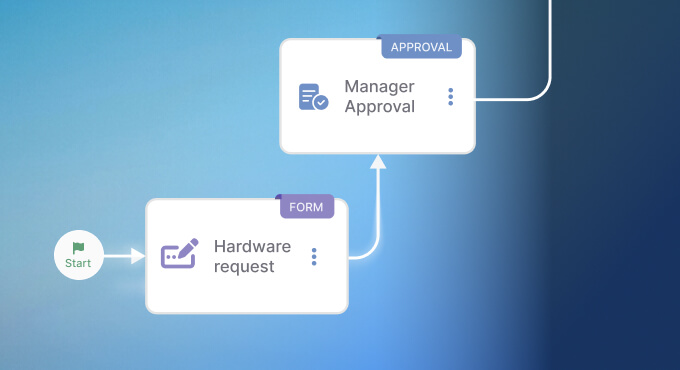
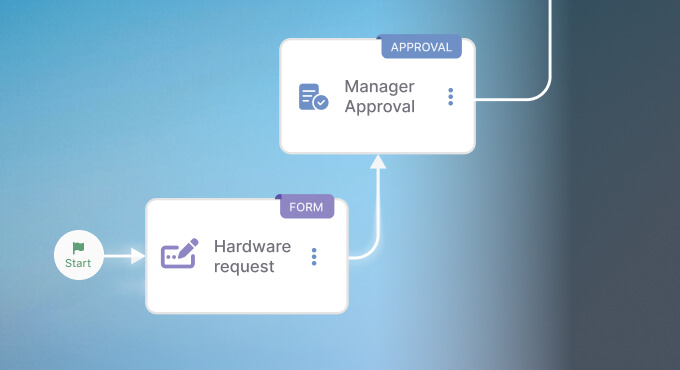
Think about who changes a workflow when a process shifts. In InvGate Service Management, an administrator edits the workflow in the interface — new approval step, new routing rule, new form field — and it’s live the same day, no code. That keeps ongoing ownership inside the IT team.
In ServiceNow, meaningful changes are platform development: scripting, scoped applications, and usually a developer or partner, released through the platform’s change cycles. That’s a genuine strength when you’re building sophisticated, business-specific applications and want the control that comes with a full development platform. It’s a cost when all you needed was to add an approval and you now have a small project to run. The right answer depends entirely on whether you’re building a platform or running a service desk.
AI: InvGate AI Hub vs ServiceNow’s AI packages
InvGate’s AI ships as AI Hub, included on every Service Management and Asset Management plan — cloud and on-premise — with no add-on fee and no credit pool to meter. It works in three layers: agent assistance (solution recommendations, AI-improved responses, ticket summaries, smart assignment), proactive detection and operational insights (major-incident detection with draft announcements, SLA-risk escalation, change risk and impact analysis, resolution-time prediction, sentiment analysis), and Knowledge Management (article generation and automatic extraction of reusable snippets from resolved tickets).
Rounding things out from the Pro plan up, InvGate's Virtual Service Agent brings a conversational assistant into the self-service portal, Microsoft Teams, WhatsApp and Slack, where users can get answers, create tickets, and view their open requests.
ServiceNow’s AI, branded Now Assist, is packaged and priced on top of the core subscription, and the company has moved toward a model that pairs seat-based licensing with consumption-based charges for AI usage while steering customers to higher tiers where more of it is built in. The capability is deep and still expanding into agentic, autonomous workflows; the thing to pin down in a quote is exactly which AI is included at your tier and what is metered on top, because that’s where the two approaches diverge most.
When ServiceNow is the better choice
It's safe to consider that ServiceNow is the stronger fit when Service Management is one of several things you need from a single platform. If you want to build custom applications across the enterprise, or run IT Service Management, IT Operations Management, security operations and HR service delivery on one vendor with shared data, that breadth is exactly what ServiceNow is built for.
Also, its partner ecosystem is large and global, which matters for the biggest, most distributed operations that need local implementation muscle in many regions at once. For organizations at that scale and with that ambition, the platform’s depth justifies its cost and complexity.
When InvGate Service Management is the better choice
InvGate Service Management fits the low-enterprise band particularly well — organizations between 1,000 to 10,000 employees that have outgrown a legacy help desk but find ServiceNow larger than the problem they’re solving.
If what you need is solid workflows, approvals and cross-team processes that run reliably, and you want to stand them up and keep adjusting them without launching a development project, this is the range where InvGate gives you enterprise capability without the setup time, the partner dependency or the per-change build cycle.
Moving from ServiceNow to InvGate
A migration is more manageable when you know what moves and in what order. The usual sequence is to bring over your core Service Management first — request and incident data, categories and your service catalog — then your knowledge base, then asset and configuration data, rebuilding workflows and approvals natively as you go, and finally cutting users over once the processes are validated.
Switching ITSM tools involves costs beyond data migration and licensing. Account for staff time spent mapping existing workflows, rebuilding integrations, validating configurations, training users, and managing a temporary period in which both systems may need to run. These indirect costs depend on the scope of the migration and the internal resources available. Weigh them against the ongoing cost of maintaining and extending the platform you’re leaving.
Ready to see it for yourself? Talk to the InvGate team and get a scoped look at what a switch would mean for your operation.
InvGate vs ServiceNow FAQ
Is InvGate cheaper than ServiceNow?
InvGate publishes its pricing and ServiceNow quotes each deal individually, so a true like-for-like depends on your scope. In practice InvGate’s total cost is lower and far easier to predict, because there’s no mandatory implementation partner and AI is included rather than metered. The honest answer is to price your own requirements against both.
Can InvGate replace ServiceNow?
For IT service management — incidents, requests, problems, changes, approvals, a service catalog, a knowledge base and asset management — yes, and TroGroup is one example of a team that made that move. ServiceNow stays the better fit if you’re also using it as an enterprise platform to build custom applications or to run operations, security and HR on the same system.
Does InvGate offer on-premise?
Yes. InvGate Service Management runs in the cloud or on-premise. ServiceNow is delivered as cloud SaaS, with self-hosted options only in limited cases.
How long does it take to implement each one?
InvGate Service Management is typically live in weeks and configured by your own team. ServiceNow implementations commonly run months and are usually led by an implementation partner.