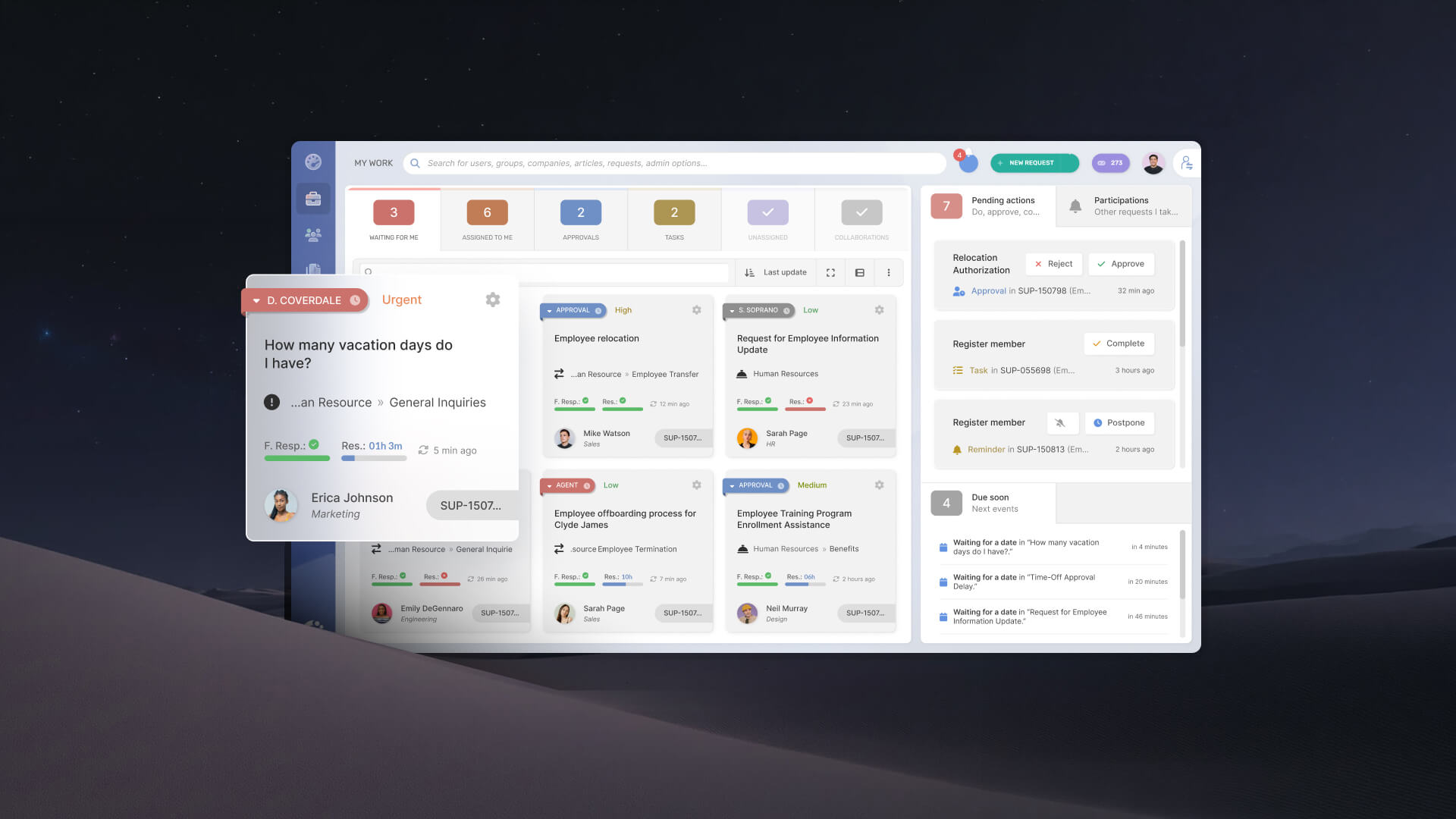
Telecom companies operate in an environment where service interruptions, infrastructure changes, and customer-facing systems can have immediate operational and financial consequences. Internal IT teams support a wide range of services, from employee requests and device management to network-related incidents, vendor coordination, and change management processes.
The help desk platform behind those operations needs to do more than manage tickets. Telecom organizations often require SLA management, automated routing, approval workflows, asset tracking, service catalogs, knowledge management, and reporting capabilities that support both day-to-day operations and service quality objectives.
In this guide, we'll examine the requirements telecom companies should consider when evaluating help desk software, explain the capabilities that matter most for telecommunications environments, and compare the best platforms available today.
Key takeaways
- Telecom IT teams deal with high ticket volumes, 24/7 SLA pressure, and distributed teams — generic help desk tools often lack the process depth to handle that.
- The best options for telecommunications combine ITIL-aligned workflows, SLA configurability, no-code automation, and ESM capabilities to support multiple departments.
- On-premise deployment is a real requirement for regulated telecom environments; not all vendors support it with feature parity.
- A self-service portal and AI-assisted deflection reduce repetitive ticket load without adding headcount.
What to look for in help desk software for telecom
Before comparing vendors, it's worth establishing the criteria that matter specifically in the telecom context. The requirements below aren't generic ITSM features — they're the capabilities that make or break a help desk deployment in an environment with critical infrastructure, distributed teams, and complex service dependencies.
SLA management with multiple tiers
A flat SLA model doesn't work in telecom. A connectivity outage affecting a NOC has a completely different urgency level than a software access request from a sales team member. The platform needs to support SLA configuration by ticket type, category, affected system, and priority level — with escalation rules that trigger automatically before a breach, not after.
No-code workflow automation
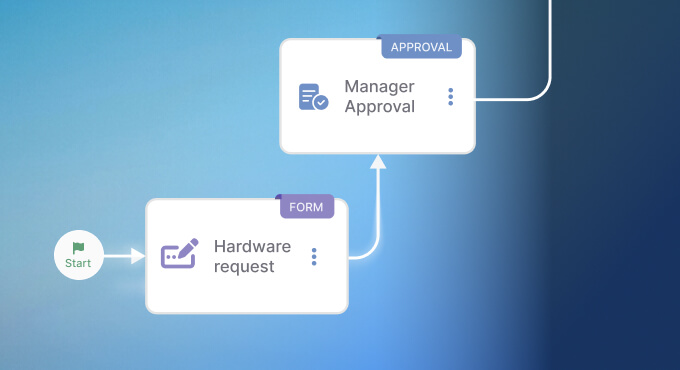
Telecom IT teams don't always have in-house developers available to customize their ITSM tool. The ability to build escalation flows, routing rules, and approval chains through a drag-and-drop builder — without writing code — reduces dependency on vendor professional services and allows the team to iterate on processes as operations evolve.
ESM capabilities
Beyond IT, telecom organizations need service desks for HR, operations, field support, and facilities. A platform with native Enterprise Service Management avoids the proliferation of separate tools for each department, keeps all request data in one place, and reduces the overhead of managing multiple systems with different access controls and reporting.
Omnichannel intake
Field technicians, operations staff, and distributed employees don't always have access to a web portal during their workday. The help desk needs to accept requests through Microsoft Teams, WhatsApp, email, and mobile — not just through a browser-based portal — to ensure coverage across the full workforce.
On-premise or hybrid deployment
Some telecom environments operate under strict data residency and security requirements that make a pure SaaS model impractical or non-compliant. On-premise deployment with full feature parity — not a stripped-down version of the cloud product — is a real differentiator here. See on-premise help desk software for regulated environments for a more detailed breakdown of what to verify before committing.
The 6 best help desk software options for telecommunications
Methodology note: The tools below were selected based on relevance to internal IT and ITSM use cases in telecom organizations, with attention to SLA configurability, deployment flexibility, ESM support, and automation capabilities. InvGate appears first because this is an InvGate blog — all vendors receive the same structural treatment and field set. Gartner review scores referenced below are drawn from Gartner Peer Insights. Pricing details not publicly disclosed are marked as such.
1. InvGate Service Management
InvGate Service Management is a no-code ITSM platform built for teams that need ITIL-aligned processes without the implementation overhead of enterprise-tier platforms. It supports both SaaS and on-premise deployment with full feature parity across both models — a meaningful differentiator for telecom environments with data residency requirements.
Features relevant to telecom:
- Drag-and-drop workflow builder for escalation, routing, and approvals — no code required
- SLA configuration by category, priority, and ticket type, with proactive breach alerts
- Native ESM to extend service desk capabilities to HR, operations, and facilities
- AI Virtual Agent integrated with Microsoft Teams and WhatsApp for ticket deflection
- AI Hub for response suggestions, ticket summaries, and automatic knowledge base article generation from resolved tickets
- 150+ built-in metrics with customizable dashboards for SLA tracking and team performance
- On-premise and SaaS deployment with feature parity
Gartner Peer Insights score: 4.8/5 stars (Gartner Peer Insights, 2025 Customers' Choice for IT Service Management Platforms)
Pricing:
- Starter: 24.98/agent/month billed annually and 5 agents minimum - $1499/year.
- Pro: $500/agent/year. 5 - 50 agents
- Enterprise: Custom pricing for larger organizations.
Best fit: Mid-to-large telecom IT teams that need ITIL depth, ESM coverage, and deployment flexibility without the complexity or cost of enterprise-tier platforms.
See how InvGate Service Management handles telecom-scale IT operations — Get a 30-day free trial.
2. OpenText SMAX
OpenText® Service Management Automation X (SMAX) is a SaaS-first ITSM and ESM platform built on machine learning and analytics. It covers incident, problem, change, service request, and service level management out of the box, with a codeless configuration model that allows IT teams to adapt workflows without developer involvement.
Features relevant to telecom:
- ITIL-certified out-of-the-box processes for incident, problem, change, knowledge, and service level management
- No-code design studio for building business rules and department-specific workflows
- Native ESM to extend service management to HR, finance, and operations
- AI virtual agent (Aviator) for self-service ticket deflection and resolution suggestions
- ITAM integration for configuration management alongside service requests
- On-premise, public cloud, and managed service deployment options
Gartner Peer Insights score: 4.1/5 stars
Pricing: Subscription-based, structured by user count and deployment option. Not publicly listed.
Best fit: Large enterprise telecom organizations that need a centralized ITSM/ESM/ITAM platform with strong governance and process compliance requirements, and have the resources for a longer implementation cycle.
3. ServiceNow ITSM
ServiceNow® is the most widely adopted enterprise ITSM platform globally, built on a unified data model (CMDB) that connects IT, operations, HR, security, and field service under a single platform. Its breadth of modules and ecosystem integrations makes it a natural fit for large, complex telecom organizations that need to consolidate processes at scale.
Features relevant to telecom:
- Full ITIL process coverage: incident, problem, change, request, and knowledge management
- CMDB as a central source of truth for infrastructure and configuration items
- Flow Designer and IntegrationHub for low-code workflow automation and third-party system connections
- AI-powered incident categorization, proactive problem identification, and Now Assist for resolution suggestions and summaries
- Microsoft Teams ChatOps integration for collaborative incident response
- Extensive module ecosystem spanning ITSM, ITOM, IRM, and field service management
Gartner Peer Insights score: 4.3/5 stars
Pricing: Not publicly listed. Custom quotes by package tier (ITSM Standard, Pro, Enterprise).
Best fit: Large telecom carriers and infrastructure operators with dedicated ITSM teams, significant customization requirements, and the budget and timeline for an enterprise-scale deployment.
4. BMC Helix ITSM
BMC Helix ITSM is an enterprise-grade service management platform designed for large organizations with complex IT environments. Telecommunications providers often evaluate it for its incident management, change management, automation, and AIOps capabilities, particularly when managing large operational teams and service infrastructures.
Features relevant to telecom:
- BMC Helix Telco Extensions: out-of-the-box workflows built around eTOM (enhanced Telecom Operations Map) processes for NOC environments
- Incident lifecycle automation from alarm creation to closure, integrated with fault management systems
- Unified workflows across IT and NOC domains, eliminating process silos between IT service management and network operations
- SLA management with contextual support for multiple agreements per incident, tying network faults to customer impact
- AI-driven clustering for major incident detection and AIOps-assisted root cause identification
- Omnichannel service experiences through BMC Helix Digital Workplace
- Cloud-native with on-premise deployment option
Gartner review score: 4.3/5 stars
Pricing: Not publicly listed.
Best fit: Large telecom carriers and Communications Service Providers that operate Network Operations Centers and need unified IT and NOC workflows. Implementation complexity and cost are a consideration for mid-market teams.
5. ManageEngine ServiceDesk Plus
ManageEngine® ServiceDesk Plus is a value-oriented ITSM platform from the enterprise IT management division of Zoho Corporation. It combines a full-featured help desk with integrated ITAM, making it a practical option for telecom IT teams that need consolidated visibility across tickets and assets without a separate ITAM tool.
Features relevant to telecom:
- Incident, problem, change, and service request management with multi-level SLA configuration
- Integrated IT asset management for hardware and software lifecycle tracking alongside tickets
- Workflow automation with configurable escalation rules and approval chains
- AI capabilities (Zia) for predictive categorization, technician assignment, and ticket summarization
- Self-service portal and knowledge base for end-user deflection
- Available as SaaS and on-premise — note that some features are exclusive to the cloud version
- Tiered pricing model by edition and number of technicians
Gartner Peer Insights score: 4.4/5 stars
Pricing: Tiered by edition, technician count, and asset management requirements.
- Standard: Starts from $13 / technician / month
- Professional: Starts from $27 / technician / month
- Enterprise: Starts from $67 / technician / month
- Checked on: June 2026 (US), official website.
Best fit: Telecom IT teams looking for a cost-effective ITSM platform with solid ITAM integration and a manageable implementation footprint.
6. Ivanti Neurons for ITSM
Ivanti Neurons for ITSM is a cloud-based service management platform that combines core ITSM capabilities with strong endpoint management and security integration — an angle relevant to telecom environments where device sprawl across distributed sites is a persistent operational challenge.
Features relevant to telecom:
- 14 ITIL practices supported out of the box
- Automated ticket routing, self-healing remediation, and proactive issue detection
- SLA management tied to automation workflows
- Self-service portal, workflow automation, and knowledge management
- Integration with Ivanti's endpoint management and security tools for device-level visibility
- Modular design that can be deployed quickly and scaled as requirements grow
Gartner Peer Insights score: 4.2/5 stars (Gartner Peer Insights)
Pricing: Subscription-based, licensed per analyst and per asset. Not publicly listed.
Best fit: Telecom IT teams with Endpoint Management complexity that want ITSM and device management under a connected platform.
Disclaimer: All product names, logos, and brands are property of their respective owners. All company, product, and service names used on this site are for identification purposes only. Use of these names, trademarks, and brands does not imply endorsement. Comparisons are based on publicly available information as of April 2026 and are provided for informational purposes only. ServiceNow is a registered trademark of ServiceNow, Inc. InvGate is not affiliated with, sponsored by, or endorsed by ServiceNow.
How to choose the right help desk software for a telecom company
Choosing the right platform depends less on feature lists and more on the operational reality of your specific organization. The questions below help narrow the field.
-
What type of telecom organization are you? A carrier managing a national network has different ITSM requirements than an ISP, a telecom equipment manufacturer, or an internal IT team supporting a mid-sized operator. NOC integration, for example, is a critical requirement for carriers but largely irrelevant for a corporate IT function within a smaller operator.
-
How large is your IT team, and what's their capacity for implementation? Enterprise platforms like ServiceNow and BMC Helix deliver unmatched depth, but they require dedicated teams, longer timelines, and ongoing consulting to configure correctly. If your team is mid-sized and needs to be operational quickly, platforms like InvGate Service Management or ManageEngine offer faster time-to-value with lower implementation overhead.
-
Do you have on-premise or data residency requirements? Not all vendors offer on-premise deployment with full feature parity. If your environment has regulatory or security requirements that restrict where data can be stored, confirm that the platform's on-premise version includes the same SLA, automation, and AI features as its cloud offering.
-
How far beyond IT does your service desk need to reach? If HR, operations, field support, or facilities also need ticketing and request management, native ESM capability becomes a decisive factor. Adding a separate tool for each department creates fragmentation — which is the opposite of what a distributed telecom organization needs.
For a broader view of the market beyond the telecom context, the best help desk software options reviewed provides a comprehensive comparison across industries.
FAQs
What is a telecom help desk?
A telecom help desk is the internal IT support function responsible for managing service requests, incidents, and technical issues within a telecommunications company. It handles requests from employees across departments — IT, network operations, field support, HR, and facilities — and is typically subject to strict SLA requirements given the critical nature of telecom infrastructure.
What features should help desk software have for telecommunications companies?
Help desk software for telecommunications companies should include multi-tier SLA management, no-code workflow automation for escalation and routing, omnichannel intake (including Microsoft Teams and email), ESM capabilities to support non-IT departments, and flexible deployment options — including on-premise — for environments with data residency or security requirements. AI-assisted ticket deflection and a self-service portal are also valuable for managing high request volumes without adding headcount.
Is InvGate Service Management suitable for telecom companies?
Yes. InvGate Service Management addresses the core requirements of telecom IT environments: configurable multi-tier SLAs, no-code automation, native ESM for HR and operations, AI Virtual Agent integration via Microsoft Teams and WhatsApp, and SaaS or on-premise deployment with full feature parity. It's particularly well-suited to mid-to-large telecom IT teams that need ITIL-aligned processes without the implementation complexity of enterprise-tier platforms.
What's the difference between a help desk and a service desk for telecom?
A help desk traditionally focuses on reactive support — resolving incidents and answering user requests as they come in. A service desk is a broader function based on ITIL principles that includes incident management, problem management, change management, and service request fulfillment. In telecom, where infrastructure failures can cascade quickly, the structured processes of a service desk — particularly problem and change management — are more operationally appropriate than a simple ticketing queue.
Can help desk software support both internal IT and customer-facing operations in telecom?
Most ITSM-focused platforms covered in this list are designed primarily for internal IT and employee-facing operations. Some platforms, like ServiceNow, offer modules that can extend to customer-facing service management, but these require separate configuration and licensing. If your requirement spans both internal IT support and external customer operations (such as subscriber support or carrier-facing ticketing), evaluate platforms with explicit multi-tenant or customer service management capabilities, and confirm feature scope before committing.