








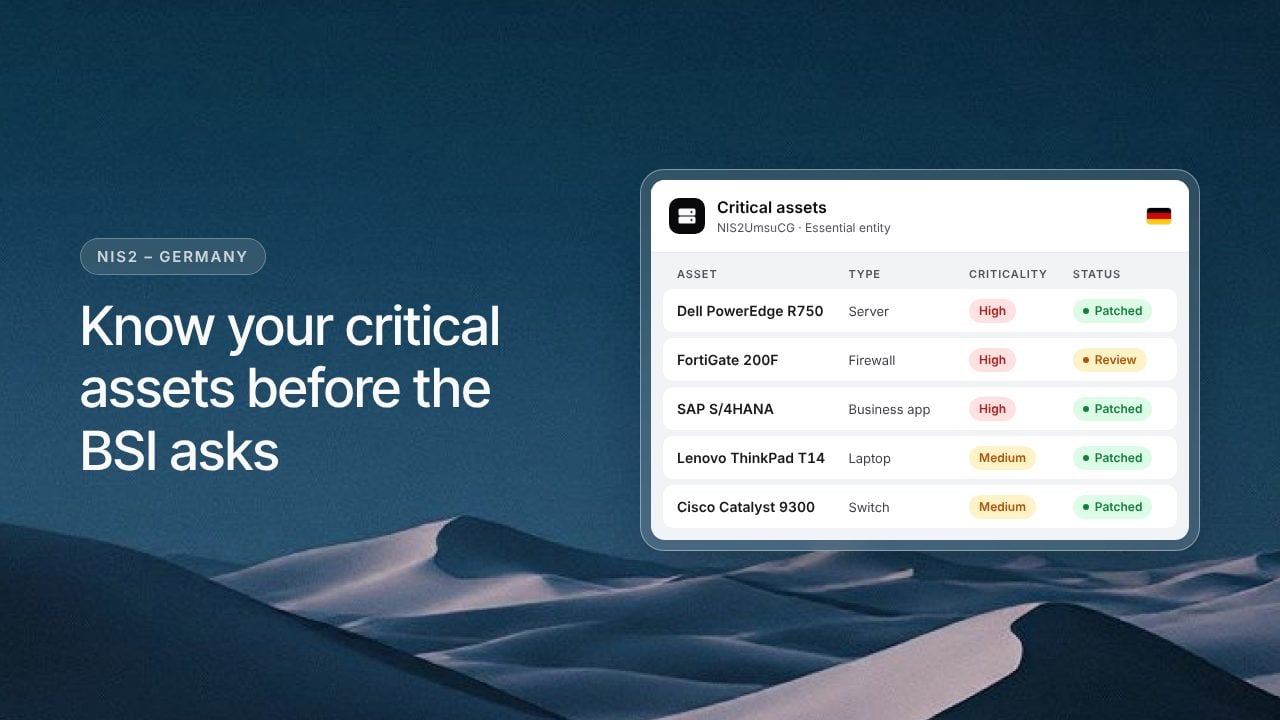

NIS2 compliance in Germany requires covered organizations to identify and manage cybersecurity risks across the IT systems, assets, and services they depend on. Under the German NIS2 Implementation Act (NIS2UmsuCG), IT asset management supports these obligations by providing an accurate inventory, ownership information, and visibility into vulnerabilities and dependencies.
The law has been in effect since December 6, 2025. For IT teams, this means maintaining reliable information about their infrastructure, documenting security measures, and being able to identify affected systems when an incident occurs. This guide explains the German requirements, the reporting deadlines, and what to include in an IT asset inventory.
What is the NIS2UmsuCG and when did it come into force?
The NIS2UmsuCG is Germany's legislation implementing the European Union's NIS2 Directive (EU) 2022/2555. Its full German title is "Gesetz zur Umsetzung der NIS-2-Richtlinie und zur Regelung wesentlicher Grundzüge des Informationssicherheitsmanagements in der Bundesverwaltung." It updates Germany's cybersecurity framework, primarily through a revised Federal Office for Information Security Act (BSI-Gesetz, or BSIG).
According to the Federal Office for Information Security (BSI), the implementation legislation came into force on December 6, 2025. The date also appears in the official text of the BSIG. The law establishes obligations for cybersecurity risk management, significant incident reporting, registration, and management oversight.
The German legislation builds on the EU NIS2 Directive, which sets cybersecurity requirements for essential and important entities. Germany applies these requirements through its national legislation, including specific rules on which organizations are covered and how they must report incidents.
For organizations within scope, the risk management obligations generally applied from the law's effective date. IT teams should therefore treat NIS2 implementation as an ongoing operational responsibility, not simply a registration exercise.
Which organizations does the NIS2UmsuCG cover?
The German BSIG distinguishes between two main categories: "particularly important entities" (besonders wichtige Einrichtungen) and "important entities" (wichtige Einrichtungen). Classification depends on the organization's activities, employee count, and financial thresholds. Certain providers and operators are covered regardless of the usual company-size criteria.
Under Section 28 of the BSIG, particularly important entities include:
- Operators of critical facilities.
- Qualified trust service providers, top-level domain name registries, and DNS service providers.
- Providers of public telecommunications services or operators of public telecommunications networks with at least 50 employees, or both annual turnover and annual balance sheet totals exceeding €10 million.
- Organizations carrying out activities listed in Annex 1 that employ at least 250 people, or have annual turnover exceeding €50 million and an annual balance sheet total exceeding €43 million.
Important entities include other trust service providers and certain telecommunications providers below the particularly important entity thresholds. They also include organizations carrying out activities listed in Annexes 1 or 2 that employ at least 50 people, or have both annual turnover and annual balance sheet totals exceeding €10 million, provided they are not already classified as particularly important.
The sectors listed in Annex 1 include energy, transport, healthcare, water, digital infrastructure, and certain digital service providers. Annex 2 covers additional activities, including postal and courier services, waste management, chemical production, food production and distribution, and certain manufacturing industries.
Company size alone does not determine whether NIS2 applies. The specific activity must also fall within the legislation, and special rules may apply to regulated industries, critical infrastructure operators, and organizations covered by other sector-specific cybersecurity legislation. Section 28 also establishes rules for calculating employee and financial thresholds, including how related companies are treated.
Organizations should check their activities and thresholds against the legislation and use the BSI's official NIS2 applicability assessment. This is particularly important for companies with several business units or services operating across different sectors.
What the NIS2UmsuCG requires from IT asset management
Section 30 of the BSIG requires particularly important and important entities to implement appropriate, proportionate, and effective technical and organizational cybersecurity measures. These measures must address risks to the availability, integrity, and confidentiality of the IT systems, components, and processes used to provide their services. Organizations must also document compliance with these obligations.
The risk management measures in Section 30(2) cover several areas closely connected to IT asset management:
- Risk analysis and information security: Organizations must establish policies for analyzing cybersecurity risks and protecting information systems. An asset inventory provides information about which systems and services need to be assessed.
- Incident handling: Security incidents must be managed through established procedures. Asset records can help identify affected devices, associated services, and dependencies during an investigation.
- Business continuity: Requirements include backup management, disaster recovery, and crisis management. Knowing which infrastructure supports critical services helps teams determine recovery priorities.
- Supply chain security: Organizations must consider security risks associated with their direct suppliers and service providers. Maintaining supplier relationships alongside asset records supports these assessments.
- Secure acquisition, development, and maintenance: The legislation addresses security throughout the acquisition, development, and maintenance of IT systems, including vulnerability handling and disclosure. Software versions, support status, and known vulnerabilities are relevant information for these processes.
- Access control and ICT management: The law requires policies addressing personnel security, access control, and the management of ICT systems, products, and processes. Asset ownership and system responsibility help connect these policies to specific parts of the infrastructure.
The EU NIS2 Directive explicitly includes asset management under Article 21(2)(i). Germany's Section 30 addresses ICT system management and related security controls. The German legislation does not, however, prescribe one universal inventory format or require every organization to record an identical set of asset fields.
This distinction matters when planning compliance work. IT asset management supports the implementation of the law, but purchasing an inventory tool does not establish compliance by itself. Organizations must also implement the required security measures, assess their effectiveness, and maintain the corresponding documentation.
For additional background on how ITAM and ITSM support the broader directive, see our earlier article on NIS2 requirements and asset management. That article covers the EU framework, while the requirements discussed here refer specifically to Germany's implementation legislation.
Incident reporting deadlines
Germany's NIS2 implementation requires covered organizations to report significant security incidents through a staged process. Section 32 of the BSIG establishes the reporting deadlines, starting from the moment an organization becomes aware of a significant incident.
These requirements concern significant security incidents, rather than every routine IT ticket or operational problem. The applicable definition and any sector-specific provisions must be considered when determining whether an incident is reportable.
| Step | Deadline | What to report |
|---|---|---|
| Early warning | Within 24 hours of becoming aware of a significant incident | Initial notification, including whether malicious or unlawful activity is suspected and whether cross-border effects are possible. |
| Incident notification | Within 72 hours of becoming aware of a significant incident | Confirmation or update of the initial information, an initial assessment of severity and impact, and indicators of compromise where available. |
| Intermediate report | Upon request from the BSI | Relevant updates on the status of the incident. |
| Final report | Within one month after submitting the 72-hour incident notification | Detailed description, severity, impact, likely threat or root cause, mitigation measures, and cross-border effects where applicable. |
| Progress report for ongoing incidents | At the one-month reporting point if the incident is still ongoing | Progress information instead of a final report, followed by a final report after the incident has been resolved. |
These deadlines come from Section 32 of the BSIG. The early warning and incident notification must be submitted without undue delay and no later than their respective limits. Operators of critical facilities may also need to report information about affected facilities and critical services.
To support this process, IT teams need a way to identify which systems were affected, understand their relationship to business services, assign responsibility, and document actions taken during the incident. A current asset inventory and consistent incident records can help investigators establish the necessary information before reporting deadlines expire.
Organizations should also confirm their designated reporting channel. The BSI provides the BSI Portal for NIS2 reporting, while operators of critical facilities and federal authorities may continue using established reporting arrangements during the relevant transition period.
Registration with the BSI
Particularly important and important entities, along with domain name registry service providers covered by Section 33, must register with the BSI. Under Section 33 of the BSIG, registration is generally required within three months of an organization first becoming subject to the relevant classification.
Registration takes place through the official BSI Portal. The BSI confirms that NIS2 registration must be completed through this portal rather than its older Reporting and Information Portal (MIP). Separate provisions apply to certain categories of providers and critical infrastructure operators.
Organizations subject to the standard Section 33 registration requirements must provide information including:
- Legal name, legal form, and commercial registration number where applicable.
- Address and current contact details, including email addresses, telephone numbers, and public IP address ranges.
- Relevant sector or industry under Annex 1 or Annex 2 of the BSIG.
- EU member states in which the organization provides the relevant services.
- Relevant federal or state supervisory authorities for the activities concerned.
Registered information must also be maintained. Under Section 33(5), changes to the relevant registration details must be reported without undue delay and generally within two weeks of becoming known.
Registration is separate from implementing cybersecurity measures. An organization can complete its registration and still have outstanding obligations concerning risk management, incident reporting, documentation, and management oversight. Teams should therefore maintain separate records of registration status and operational compliance activities.
NIS2 asset inventory checklist
A reliable IT asset inventory gives security and service management teams a common reference for identifying risks and responding to incidents. For organizations covered by the NIS2UmsuCG, it should support the measures required under Section 30 of the BSIG, including risk analysis, vulnerability management, business continuity, and supply chain security.
The following checklist is a practical starting point. It is not a statutory inventory template, and individual fields are not necessarily mandated by the law in this exact form. Organizations should adapt their records to their infrastructure, risks, and applicable regulatory requirements.
- Hardware assets: Record workstations, laptops, servers, network equipment, and other relevant connected devices. Include identifiers, location, configuration details, and lifecycle status where available.
- Software assets: Document installed applications, operating systems, versions, and relevant license information. Associate software records with the devices or environments in which they operate.
- Cloud services: Maintain records of cloud infrastructure, hosted applications, and externally provided IT services. Identify the provider, service purpose, and relevant systems or business processes.
- Asset ownership: Assign a responsible person or team to each relevant asset or service. Include operational contacts so that incidents, maintenance decisions, and risk reviews can be directed to the appropriate people.
- Criticality: Identify which assets support essential business processes and services. Record their importance to operations and the potential impact of disruption or compromise.
- Known vulnerabilities: Track identified vulnerabilities, affected systems, remediation status, and relevant security updates. Connect this information to the organization's vulnerability management process.
- End-of-life and end-of-support dates: Record whether hardware and software are still supported by their vendors. Use this information to plan upgrades, replacements, and risk mitigation for unsupported technology.
- Suppliers and service providers: Document vendors associated with important assets and services, including relevant contracts and support arrangements. This information can contribute to supply chain security reviews.
Teams should also consider mapping relationships between assets and the services they support. A server inventory may identify an affected device during an incident, but configuration and dependency information helps determine which applications, departments, or critical services depend on it.
Inventory maintenance is an ongoing activity. New devices, software updates, cloud changes, ownership transfers, and asset retirements can quickly make manually maintained records outdated. Discovery capabilities, integrations, and regular reconciliation processes can help keep this information usable for risk assessments and incident investigations.
For more information about available capabilities, discovery methods, and evaluation criteria, see our 2026 IT Asset Management software comparison.
How InvGate helps with NIS2 compliance
Large enterprises preparing for Germany's NIS2 requirements need visibility into their IT environment and consistent processes for addressing security-related incidents. InvGate Asset Management provides centralized inventory and lifecycle management capabilities, while InvGate Service Management supports incident handling, ticket tracking, and workflow automation.
InvGate Asset Management helps organizations discover and document their IT assets across different environments. Its discovery capabilities identify hardware, software, servers, databases, containers, and cloud services using agents, network scanning, integrations, and bulk imports. This information provides a foundation for the asset visibility needed to support cybersecurity risk management.
Several capabilities are relevant to the inventory checklist:
- Asset discovery and inventory: Consolidate information about hardware, software, and cloud infrastructure instead of depending entirely on manually maintained records.
- Asset lifecycle tracking: Follow assets from acquisition to retirement, including ownership changes, maintenance, and decommissioning.
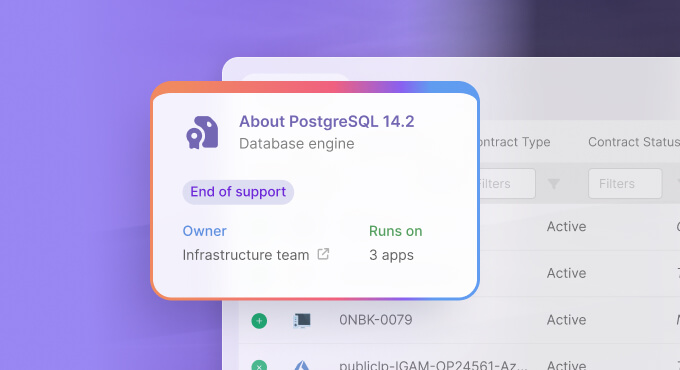
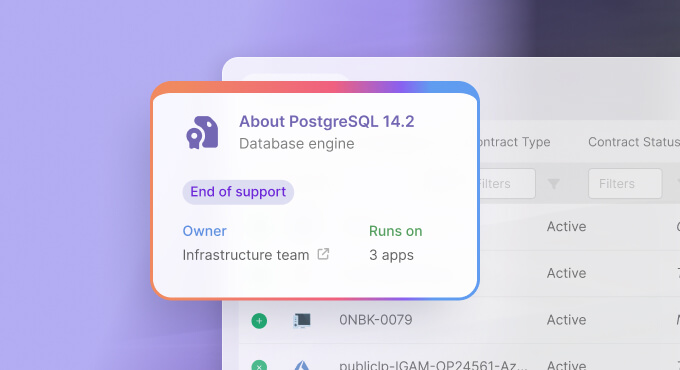
- End-of-life visibility: Use InvGate Atlas to access end-of-life, end-of-support, and version information, helping teams identify outdated technology and plan replacements.
- CMDB and relationships: Map connections between configuration items and infrastructure components to understand dependencies and potential service impact.
- Asset monitoring: Use asset information, health rules, and reporting capabilities to identify risks and monitor changes across the environment.
InvGate Service Management complements these capabilities by providing a structured environment for handling incidents and service requests. IT teams can register incidents, assign responsibility, monitor their progress, and use configurable workflows to coordinate the actions required for investigation and resolution.
The integration between both products allows service desk teams to associate tickets with assets and configuration items. When an incident affects a device or system, agents can access its asset information, view related records, and examine previous incidents. These connections can help teams identify recurring issues and establish which parts of the infrastructure may require attention.
InvGate Service Management also provides reporting and analytics capabilities, including customizable dashboards and service metrics. Organizations can use these functions to monitor incident handling and maintain operational records relevant to internal reviews.
For NIS2-related processes, teams can configure workflows and incident categories to collect information consistently and assign response tasks. The specific reporting information required by Section 32 must still be submitted through the appropriate official channel. InvGate's tools can support internal preparation and documentation, but do not replace BSI registration, regulatory reporting, or the organization's responsibility to implement the required cybersecurity measures.
Both products are available with Enterprise options intended for complex organizations, including on-premises deployment for customers with additional infrastructure requirements. Their combination allows enterprises to connect asset visibility with IT service operations while maintaining separate processes for legal and regulatory compliance.
FAQ
Does NIS2 apply to my company?
In Germany, NIS2 applies to organizations covered by the categories and thresholds established in Section 28 of the BSIG. These include certain critical infrastructure operators, digital service providers, and organizations in sectors such as energy, transport, healthcare, and manufacturing. Applicability depends on the specific activity, company size, and any relevant exceptions or sector-specific rules. The BSI provides an official applicability assessment to help organizations evaluate their status.
When did NIS2 come into force in Germany?
Germany's NIS2 implementation legislation came into force on December 6, 2025, according to the BSI and the official text of the BSIG. The legislation introduced updated cybersecurity risk management, registration, and incident reporting obligations for covered organizations. The requirements are part of Germany's national implementation of the EU NIS2 Directive.
Is an IT asset inventory mandatory under NIS2?
The EU NIS2 Directive explicitly includes asset management among its cybersecurity risk management measures, and Germany's BSIG requires covered organizations to manage risks affecting their IT systems, components, and processes. However, Section 30 does not prescribe a universal inventory template with a fixed set of required fields. Maintaining an accurate inventory is a practical way to support risk assessments, vulnerability management, business continuity, and incident investigations. Organizations should also consider any additional requirements that apply to their sector.
What are the penalties for non-compliance?
Under Section 65 of the BSIG, certain violations of risk management, documentation, and incident reporting obligations can result in fines of up to €10 million for particularly important entities and €7 million for important entities. For entities with total turnover exceeding €500 million, the applicable fines for these violations may instead reach 2% or 1.4% of total turnover, respectively. Other violations have separate limits, including fines of up to €500,000 for certain registration failures. The applicable penalty depends on the entity's classification, the specific infringement, and the relevant statutory provisions.
This article provides general information about Germany's NIS2 implementation and its relationship to IT asset management. It does not constitute legal advice. Organizations should consult the applicable legislation and qualified legal advisers when determining their specific compliance obligations.