









Summarize with
Table of contents
E-commerce companies depend on two service functions that are often evaluated together but serve very different purposes. One supports customers with order inquiries, returns, shipping issues, and product questions. The other supports employees, systems, integrations, and operational processes that keep the business running.
Many buyers searching for "eCommerce help desk software" encounter tools designed for both areas, making comparisons difficult. A platform built for customer service may excel at managing conversations across email, chat, and social channels, while an IT service management (ITSM) platform focuses on incident management, service requests, onboarding workflows, change control, and internal service delivery.
In this guide, we'll explain the differences between customer support software and ITSM platforms for e-commerce organizations, outline the requirements for each use case, and review the best tools in both categories.
Key takeaways
Many e-commerce organizations operate two distinct service functions, each with different workflows, stakeholders, and software requirements.
Customer support platforms are built for interactions with shoppers. Customer service teams use them to manage order inquiries, returns, product questions, delivery issues, and conversations across email, chat, social media, and messaging channels. These platforms typically integrate with commerce systems such as Shopify, WooCommerce, and Magento, allowing agents to access order information and respond efficiently at scale. Tools such as Gorgias, eDesk, Hiver, and Help Scout fall into this category.
IT service management (ITSM) platforms support the internal operations that keep the business running. IT teams use them to manage incidents, service requests, system changes, onboarding processes, access provisioning, and technology-related workflows across departments. Common examples include investigating a payment gateway outage, resolving a failed inventory synchronization between Shopify and an ERP system, provisioning accounts for new warehouse employees, or handling requests from operations and logistics teams. Platforms such as InvGate Service Management, Jira Service Management, and Freshservice are designed for these use cases.
Some vendors position their products as serving both audiences, which can create confusion during software evaluations. In practice, customer support and IT service management platforms address different operational requirements.
A customer support platform may excel at omnichannel communications and order-centric workflows but lack capabilities such as incident management, SLA management, change control, asset management, and internal service request automation. An ITSM platform, on the other hand, is designed for internal service delivery rather than customer-facing commerce support.
Understanding which function you are evaluating—customer service, internal IT operations, or both—makes it much easier to identify the right category of software and compare vendors on the criteria that matter.
Before comparing specific tools, the features that matter vary entirely based on which problem you're solving.
For customer-facing support (CX teams):
For IT internal support (ITSM teams):
A team evaluating both types of software at the same time isn't doing something unusual. Many ecommerce companies run both: a CX team handling consumer tickets on Gorgias or eDesk, and an IT team running the operational backbone on an ITSM platform. Those are separate purchasing decisions.
This section covers tools for IT teams supporting the internal operations of an ecommerce business — incidents, integrations, service requests, and cross-department workflows. These tools are not designed for consumer-facing support.
Best for:e-commerce IT teams that need fast deployment, with no-code ESM and SLA-enforced operations.
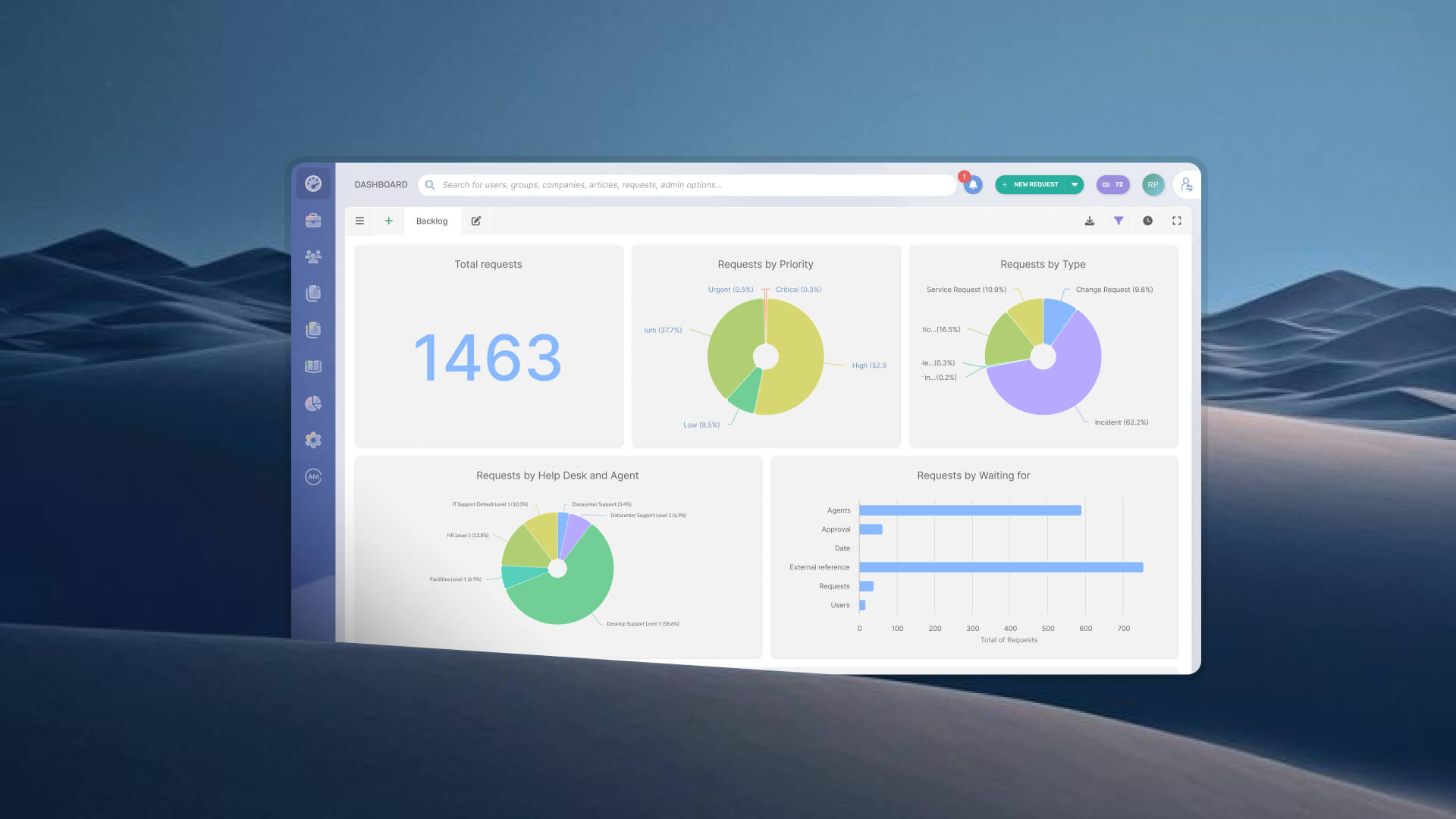
InvGate Service Management is an ITSM and ESM platform built for IT teams managing internal service operations. For IT teams handling e-commerce operations, that means handling platform incidents, managing IT infrastructure changes, automating employee onboarding and offboarding workflows, and extending service delivery beyond IT to departments like HR, Logistics, and Facilities — all from a single platform.
The platform is ITIL-certified across 15 practices and uses a no-code workflow builder that lets IT admins build and modify processes — incident routing, change approvals, service catalog categories, escalation logic — without writing code or paying for consulting. InvGate's AI hub includes ticket summarization, and ticket grouping to detect problems and major incidents, useful for on-call teams handling high-volume incidents — useful for ecommerce teams that need to detect and correlate infrastructure alerts during peak periods
Key capabilities relevant to e-commerce IT teams:
Want to see how it works for your IT team? Request an InvGate Service Management demo.
Best for: e-commerce IT teams already embedded in the Atlassian ecosystem.
Jira Service Management (JSM) is Atlassian's ITSM platform, built for development and IT operations teams that already work inside Jira Software and Confluence. For ecommerce companies with engineering teams — common at mid-size to large digital-native retailers — the tight integration between service requests and development backlogs is a meaningful advantage: when a platform bug generates a customer-impacting incident, support agents and developers share the same thread.
JSM covers the full ITIL lifecycle: incident management, problem management, change management with approval workflows, and asset/CMDB tracking.
Key capabilities:
Consideration: JSM's learning curve is steep for teams new to Atlassian. The platform rewards investment in configuration, but teams that need simple workflows without extensive setup may find InvGate Service Management or Freshservice faster to deploy. Advanced features like asset management require the Premium tier.
Best for: E-commerce IT teams that want modern ITSM without enterprise complexity
Freshservice is Freshworks' ITSM platform, positioned as the accessible alternative to heavier enterprise tools. It covers incident, problem, change, and asset management in a single product, with a cleaner interface than most ITSM platforms and an AI layer (Freddy AI) that handles ticket triage, routing, and virtual agent queries in Slack and Microsoft Teams.
For ecommerce IT teams at growing companies that need to move from shared inbox chaos to structured ITSM, Freshservice is a fast path.
Key capabilities:
This section covers tools for customer support teams managing consumer-facing tickets: orders, returns, shipping questions, and omnichannel interactions. InvGate Service Management is not in this category — it's designed for IT and ESM internal operations, not consumer inbox management.
Gorgias — Best for Shopify-native DTC brands focused on revenue attribution
Gorgias is a customer service platform built specifically for ecommerce, with deep Shopify integration at its core. When an agent opens a ticket, the customer's entire order history, subscriptions, and loyalty status appear in the sidebar — no tab-switching required. Agents can modify orders, issue refunds, and cancel subscriptions directly from inside the ticket.
Key capabilities:
eDesk — Best for multichannel ecommerce sellers across marketplaces
eDesk is purpose-built for sellers managing support across multiple marketplaces and platforms. Its Smart Inbox consolidates 250+ channels — Amazon, eBay, Shopify, Walmart, Etsy, and social platforms — into one interface, with full order data attached to each ticket automatically. For teams managing Amazon SLA compliance alongside Shopify DMs and email, eDesk handles marketplace-specific workflows (policy-aware templates, 24-hour Amazon response tracking) that generic platforms can't replicate.
Key capabilities:
Hiver — Best for support teams that live in Google Workspace
Hiver turns Gmail into a multi-channel help desk. Rather than asking teams to adopt an entirely new platform, it adds collaborative inbox features — shared drafts, @mentions, SLA tracking, and ticket assignments — directly inside Google Workspace. In 2026, Hiver's AI capabilities include automatic intent and sentiment detection, tag suggestions, and AI-drafted replies before agents open a thread.
Key capabilities:
Help Scout — Best for small ecommerce teams that value simplicity over feature depth
Help Scout is a straightforward shared inbox platform built for small and mid-size support teams. Its Docs knowledge base builder and Beacon widget let teams create a self-service layer quickly. The interface is clean and easy to learn, and the Shopify integration gives agents access to basic order data within the support sidebar.
Key capabilities:
Zendesk — Best for enterprise ecommerce teams with complex reporting and customization needs
Zendesk is a general-purpose enterprise help desk with broad ecommerce capabilities through third-party integrations and its app marketplace. It handles omnichannel ticket management, advanced reporting, and complex automation at scale. For large ecommerce operations with dedicated IT resources for configuration and ongoing maintenance, Zendesk provides the customization depth that purpose-built tools may not. Zendesk requires third-party apps for most native marketplace integrations. Configuration is resource-intensive, and costs scale significantly with team size and feature tier.
Key capabilities:
Most growing ecommerce operations end up running both types of software — and that's the correct architecture. The mistake is trying to force one tool to do both jobs.
Here's what a realistic dual-stack setup looks like, and where the handoffs happen.
The customer-facing layer (Gorgias, eDesk, Hiver, Help Scout, Zendesk) handles everything that originates from a consumer: order questions, return requests, shipping complaints, social media messages. Your CX team works here. Volume is high, urgency is medium, and the key metric is response time and customer satisfaction.
The IT operations layer (InvGate Service Management, Jira Service Management, Freshservice) handles everything that originates from internal staff or from system failures: a platform integration that stopped working, a payment gateway outage, an employee who needs access to the inventory system on their first day, a logistics team that needs to submit a recurring IT request without calling the IT department. Your IT team works here. Volume is lower, urgency can be critical, and the key metrics are SLA compliance, mean time to resolution, and operational continuity.
Where these two layers connect:
There are moments when a consumer-facing problem is actually an IT problem in disguise. A spike in "I can't complete my order" tickets might signal a checkout flow bug — that's an IT incident, not a CX response task. The CX team surfaces the symptom; the IT team owns the root cause.
A practical protocol for this handoff:
This doesn't require the two tools to be integrated (though that's possible via API if your ITSM platform supports it). It requires a documented escalation process and shared language between CX and IT about what constitutes an incident versus a service request.
There is no single answer — it depends on which problem you're solving. If your team manages consumer tickets (orders, returns, shipping questions), tools like Gorgias or eDesk are strong candidates depending on whether you sell primarily on Shopify or across multiple marketplaces. If your team is the IT department supporting the technology that runs the ecommerce operation — platform incidents, integrations, employee onboarding, multi-department service requests — an ITSM platform like InvGate Service Management, Jira Service Management, or Freshservice is the right category. Many ecommerce companies need both, running them as separate tools for separate teams.
Yes. Modern ecommerce operations depend on complex infrastructure: payment processors, inventory management systems, order management platforms, warehouse integrations, marketing automation, and internal tools used by operations, HR, and logistics teams. When something breaks — a Shopify-ERP sync fails, a payment gateway returns errors, a new employee can't access their systems — there needs to be a structured process to assign ownership, track resolution, and enforce response times. Without an IT help desk, those issues get managed through Slack messages, email chains, and informal escalations, which means slower resolution and no visibility into patterns or recurring problems.
A customer service help desk manages inquiries from external consumers: questions, complaints, and requests related to orders or products. An IT service desk manages requests and incidents from internal employees related to technology: access provisioning, hardware issues, software failures, integrations, and infrastructure changes. In ecommerce, both exist simultaneously. Customer service agents use a CX help desk to respond to shoppers. IT teams use an ITSM platform to maintain the systems those agents — and the rest of the business — depend on. The tools, workflows, and metrics for each are fundamentally different.
Read other articles like this one:
View all postsClear pricing
No surprises, no hidden fees — just clear, upfront pricing that fits your needs.
View PricingEasy migration
Our team ensures your transition to InvGate is fast, smooth, and hassle-free.
View Customer ExperienceService Management
Learn
Compare With

