








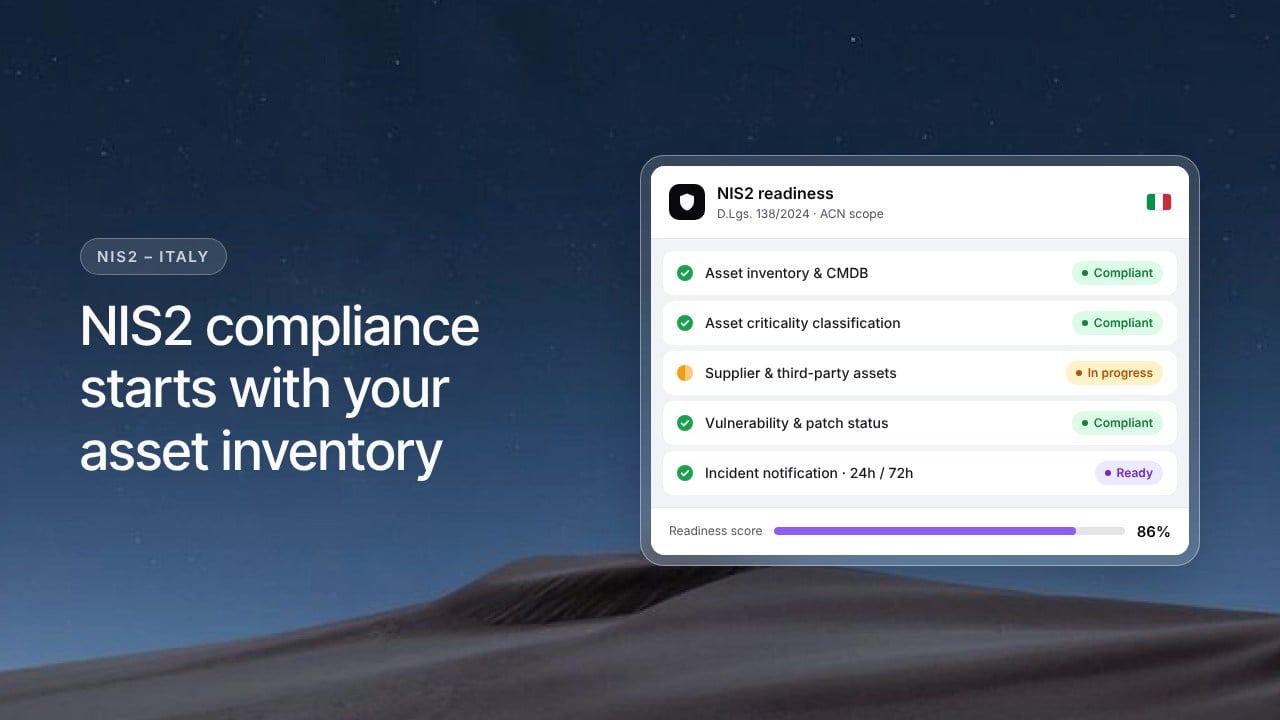

NIS2 in Italy requires covered organizations to manage cybersecurity risks across their IT systems, including maintaining accurate inventories of hardware, software, and services. Under Legislative Decree 138/2024 and the security measures established by the Italian National Cybersecurity Agency (ACN), IT asset management is part of the work required to identify, protect, and monitor the infrastructure supporting essential services.
The decree has been in force since October 16, 2024. Incident reporting obligations started applying to the first group of registered organizations in January 2026, and their deadline for implementing baseline security measures expired in October 2026. For IT teams, this means asset inventory is already an operational compliance requirement, rather than something to address in a future implementation project.
This guide explains which organizations are covered, what the legislation says about asset management, the deadlines established by ACN, and the information IT teams should maintain in their inventories.
What is D.Lgs. 138/2024?
Legislative Decree 138/2024 is Italy's national implementation of the European Union's NIS2 Directive (EU) 2022/2555. It establishes cybersecurity obligations for organizations operating in critical sectors, including risk management, incident reporting, and management accountability.
The decree was published in the Italian Official Gazette on October 1, 2024, and entered into force on October 16, 2024. Its full text is available through Normattiva, Italy's official legislation database.
The law identifies the Agenzia per la Cybersicurezza Nazionale (ACN) as Italy's competent national authority for NIS2. ACN oversees implementation, maintains the register of covered organizations, establishes detailed cybersecurity requirements, and coordinates incident reporting through CSIRT Italia.
The decree sets out the general obligations, while ACN's implementing determinations provide the technical specifications and timelines organizations must follow. These include requirements for maintaining IT inventories, managing vulnerabilities, documenting security measures, and reporting significant incidents.
For IT departments, the legislation affects more than security policies. It also involves the information used to understand the organization's infrastructure: which systems exist, what services they support, who is responsible for them, and how their security risks are managed.
Which organizations does it cover?
D.Lgs. 138/2024 applies to public and private organizations operating in sectors identified by the legislation. Article 3 defines the scope, while Article 6 distinguishes between two categories: essential entities (soggetti essenziali) and important entities (soggetti importanti).
The classification depends on the organization's sector, size, and specific activities. Certain entities are covered regardless of their size.
Annex I identifies highly critical sectors, including:
- Energy.
- Transport.
- Banking and financial market infrastructure.
- Healthcare.
- Drinking water and wastewater.
- Digital infrastructure.
- Business-to-business ICT service management.
- Public administration.
- Space.
Annex II identifies other critical sectors, including:
- Postal and courier services.
- Waste management.
- Manufacturing and distribution of chemicals.
- Food production, processing, and distribution.
- Manufacturing of certain products, including electronic equipment, machinery, and vehicles.
- Digital providers, including certain online platforms.
- Research organizations.
The decree also addresses public administration bodies and additional types of organizations through Annexes III and IV.
As a general rule, the legislation covers medium-sized and larger organizations operating in the relevant sectors. This includes organizations with at least 50 employees, subject to the applicable financial thresholds and classification rules. The decree also establishes exceptions for certain providers and critical entities regardless of company size.
Under Article 6, essential entities include large organizations operating in highly critical sectors, alongside specified providers and public bodies. Other organizations meeting the applicable criteria are generally classified as important entities.
The distinction matters because supervision, security requirements, and financial penalties differ between the two categories.
Organizations should verify their classification against Articles 3 and 6 of the decree and ACN's official guidance. ACN maintains a registration process through its digital services portal and communicates inclusion in the national list of NIS entities.
Being a supplier to a covered organization does not automatically make a company an NIS entity. However, the legislation requires covered organizations to address supply chain cybersecurity risks, which can result in security and documentation requirements for their suppliers.
What the decree requires from IT asset management
Article 24 of D.Lgs. 138/2024 requires essential and important entities to adopt appropriate and proportionate technical, operational, and organizational measures to manage cybersecurity risks. These measures cover the network and information systems used in the organization's operations and services.
IT asset management is expressly included among the areas addressed by the legislation. Article 24(2) covers risk analysis, incident management, business continuity, supply chain security, vulnerability management, access control, and asset management.
The ACN's implementation guidance provides additional information about the security measures and their implementation deadlines. The agency's baseline security specifications, established through its implementing determinations, translate the legal requirements into more specific controls.
Several requirements concern the information organizations maintain about their assets:
- Hardware inventory: Maintain updated records of the physical equipment making up the organization's network and information systems. The ACN specifications address IT devices, mobile equipment, and relevant IoT and operational technology assets.
- Software and systems inventory: Maintain updated records of software applications, systems, and IT services. These include commercial, open-source, and internally developed applications.
- Cloud and supplier services: Identify relevant services provided by external suppliers, including cloud services. This information supports supply chain security and helps organizations understand which external systems their operations depend on.
- Network relationships: Document relevant communication flows and relationships between systems, according to the requirements applicable to the organization's classification.
- Vulnerability management: Identify vulnerabilities affecting IT systems and maintain information needed to support their assessment and treatment.
- Asset management and access control: Connect the management of IT assets with the organization's access control policies and security responsibilities.
These controls are connected. An inventory may identify a server and its installed operating system, but vulnerability management also requires knowing whether that system is affected by a known security issue. If an incident occurs, the team needs to identify which services depend on the affected system.
ACN's requirements make the maintenance of inventory information a continuing responsibility. The relevant records must reflect the infrastructure being managed, including changes that occur after the initial inventory has been completed.
The requirements also differ according to whether an organization is classified as essential or important. IT teams should consult the applicable annexes of ACN's baseline security specifications rather than assuming that every control applies identically to both categories.
Asset inventory is only one part of NIS2 compliance. Organizations must also implement the required security policies, incident response processes, business continuity arrangements, and management oversight. Inventory software can support those activities, but it cannot establish compliance on its own.
For a broader introduction to the European directive and its relationship with ITAM, see our earlier article on NIS2 requirements and asset management. The requirements discussed here refer specifically to Italy's national implementation.
ACN deadlines and incident reporting
Italy introduced NIS2 obligations through a phased implementation process. According to the ACN's published implementation calendar, the first group of organizations included in the national NIS list had to begin reporting significant cybersecurity incidents in January 2026 and complete their baseline cybersecurity measures in October 2026.
As of November 2026, the October deadline has passed for organizations covered by that initial implementation schedule. Organizations added to the NIS list in subsequent years are subject to the applicable ACN implementation timetable, so the date of inclusion matters when determining individual deadlines.
Article 25 of D.Lgs. 138/2024 establishes the reporting process for significant cybersecurity incidents. Covered entities must notify CSIRT Italia without undue delay when an incident meets the relevant reporting criteria.
The reporting process includes an initial warning, a more detailed notification, and a final report. The statutory deadlines are calculated from when the organization becomes aware of a significant incident, except for the final report, which is measured from the incident notification.
| Step | Deadline | What to do |
|---|---|---|
| Decree enters into force | October 16, 2024 | Italy's NIS2 implementation legislation becomes effective. |
| Incident reporting obligations begin for the initial NIS cohort | January 2026 | Organizations included in the 2025 NIS list begin reporting significant incidents according to the applicable ACN requirements. |
| Baseline security measures for the initial NIS cohort | October 2026 - deadline passed | Complete implementation of the applicable baseline cybersecurity measures, including asset inventory controls. |
| Early incident warning | Within 24 hours of becoming aware of a significant incident | Send a preliminary notification to CSIRT Italia, indicating possible malicious activity and cross-border effects where known. |
| Incident notification | Within 72 hours of becoming aware of a significant incident | Provide an initial assessment of the incident's severity and impact, including indicators of compromise where available. |
| Intermediate report | Upon request from CSIRT Italia | Provide relevant updates on the incident's status. |
| Final incident report | Within one month after submitting the 72-hour notification | Document the incident, its impact, probable cause, mitigation measures, and any known cross-border effects. |
These incident reporting deadlines are established in Article 25 of D.Lgs. 138/2024. If an incident is still ongoing when the final report is due, the decree provides for progress reporting and a subsequent final report after resolution. Special reporting provisions also apply to certain types of providers.
The reporting obligation concerns significant incidents, not every service interruption or help desk ticket. An incident may qualify as significant when it causes, or is capable of causing, serious operational disruption, financial loss, or substantial harm to other people or organizations.
Asset inventory becomes particularly useful during the investigation. Teams need to identify affected systems, determine which applications and services depend on them, and establish who is responsible for the relevant infrastructure. That information can also help assess the incident's operational impact.
IT teams should maintain incident records and asset information in a form that can be reviewed and updated as investigations progress. The official notification still needs to be submitted through the appropriate CSIRT Italia reporting channel.
NIS2 asset inventory checklist
ACN's baseline security measures require covered organizations to maintain inventories of relevant hardware, software, systems, and services. The precise controls depend on the organization's NIS classification.
The following checklist combines those requirements with practical IT asset management information that can support risk assessments, audits, and incident investigations. Not every field below is individually prescribed by the decree. Organizations should adapt the inventory to their applicable ACN measures and internal risk management processes.
- Hardware assets: Record servers, workstations, laptops, network equipment, mobile devices, and relevant IoT or OT devices. Include identifiers, models, locations, and operational status to make individual assets easier to identify and manage.
- Software assets: Maintain records of operating systems, applications, versions, and installed software. Include commercial, open-source, and internally developed applications, along with relevant license information.
- Cloud services: Document cloud infrastructure, hosted applications, and other externally provided IT services. Identify the provider, service purpose, and associated systems so teams can understand dependencies on third-party infrastructure.
- Asset ownership: Assign a responsible person or team to each relevant asset or service. Record ownership changes and maintain contact information for operational and security responsibilities.
- Criticality: Identify assets supporting essential services and business processes. Record their importance and the potential operational impact of their failure or compromise.
- Known vulnerabilities: Maintain information about identified vulnerabilities, affected assets, remediation status, and available security updates. Connect these records with the organization's vulnerability management process.
- End-of-life and end-of-support dates: Identify hardware and software approaching or exceeding vendor support deadlines. Use this information to plan upgrades, replacements, or other risk mitigation measures.
- Suppliers and service providers: Record the vendors associated with important assets, software, and services. Include relevant contracts, service relationships, and dependencies to support supply chain security assessments.
Organizations should also consider documenting relationships between assets, applications, and business services. Knowing which devices exist is useful, but understanding how they depend on one another provides additional context when evaluating vulnerabilities or investigating incidents.
For example, an inventory might show that a particular server runs an unsupported application. The associated service relationships can help determine whether replacing that system should be treated as a routine maintenance task or a priority because it supports a critical business process.
Keeping the inventory current requires regular updates. New equipment, software installations, infrastructure changes, cloud deployments, and asset retirements can all affect its accuracy. Automated discovery and integrations can reduce the amount of manual work involved, while periodic reviews help identify missing or inconsistent records.
Teams should also establish how inventory information will be used as evidence during security reviews. This may include asset reports, records of ownership changes, vulnerability remediation information, and documented procedures for maintaining inventory accuracy.
The objective is to maintain an inventory that can support the organization's security operations, rather than producing a static list that becomes outdated after an audit.
How InvGate helps with NIS2 compliance
Large enterprises implementing Italy's NIS2 requirements need reliable asset information and structured processes for managing incidents. InvGate Asset Management provides centralized inventory, discovery, and lifecycle management capabilities, while InvGate Service Management supports incident handling, ticket management, and workflow automation.
InvGate Asset Management helps organizations identify and manage hardware, software, cloud infrastructure, and other IT assets across their environments. Its discovery capabilities use agents, network scanning, integrations, and bulk imports to consolidate information from different sources.
The platform includes several capabilities relevant to NIS2 inventory and risk management activities:
- Automated asset discovery: Identify devices, servers, databases, containers, software, and cloud resources using multiple discovery methods. This can help teams identify assets that are missing from manually maintained records.
- Centralized inventory and lifecycle management: Maintain records of assets, users, locations, contracts, and lifecycle status, including ownership changes and retirement.
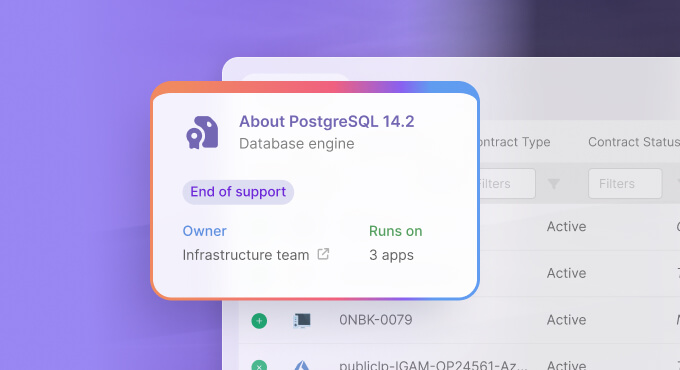
- End-of-life and end-of-support information: Use InvGate Atlas to identify product versions, support status, and relevant lifecycle dates. This information can help teams identify technology that requires replacement or further risk assessment.
- CMDB and dependency mapping: Connect configuration items and visualize relationships between infrastructure components, applications, and business services. Automatic CMDB mapping is available from the Pro plan.
- Health rules and reporting: Define conditions for monitoring asset status and generate reports that support inventory reviews and operational analysis.
These capabilities can support the inventory requirements described in ACN's baseline security measures. For example, teams can use discovery information to identify managed hardware and software, then associate those records with locations, owners, and relevant service relationships.
InvGate Service Management provides complementary capabilities for handling incidents. IT teams can register incidents, assign responsibility, track progress, and document the actions taken during investigation and resolution.
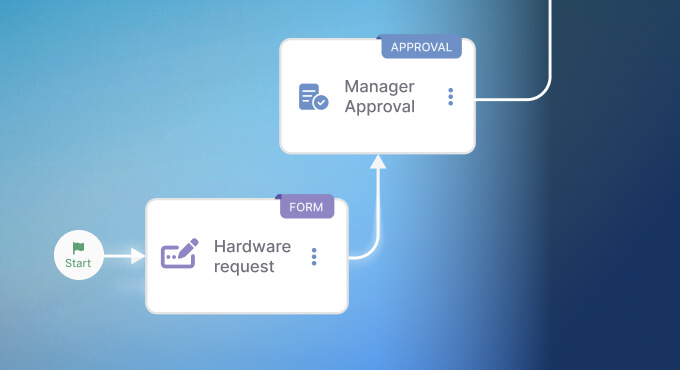
Through the native integration between InvGate Asset Management and InvGate Service Management, support teams can associate tickets with assets and configuration items. This gives them access to asset information when investigating a problem and helps connect incident records with the infrastructure involved.
Workflow automation can also support internal incident response procedures. Teams can configure processes for assigning tasks, requesting approvals, and coordinating actions across departments. Reporting and dashboards provide additional visibility into service desk operations and incident handling.
For organizations operating in complex environments, both products offer Enterprise deployment options. These include on-premises hosting, allowing customers to operate the platforms within their own infrastructure when required.
InvGate can support NIS2-related inventory management, documentation, and incident workflows. However, the products do not automatically establish compliance with D.Lgs. 138/2024 or replace the organization's legal reporting obligations. Teams remain responsible for assessing applicable requirements, implementing security measures, and submitting notifications to CSIRT Italia through the official channels.
FAQ
Does NIS2 apply to my company in Italy?
NIS2 applies to public and private organizations that meet the criteria established by D.Lgs. 138/2024, including those operating in sectors identified in Annexes I, II, III, and IV. The classification depends on activities, organization size, and specific provisions for certain critical entities and providers. Organizations should review Articles 3 and 6 of the decree and verify their position through the ACN registration and classification process.
What is the ACN?
ACN stands for Agenzia per la Cybersicurezza Nazionale, Italy's National Cybersecurity Agency. It is the competent national authority responsible for implementing and overseeing NIS2 requirements in Italy. ACN manages the registration of NIS entities, publishes cybersecurity requirements and implementation guidance, and coordinates incident reporting through CSIRT Italia.
Is an IT asset inventory mandatory under NIS2?
Yes, asset management is explicitly included in the cybersecurity risk management measures established by Article 24 of D.Lgs. 138/2024. ACN's baseline security specifications require applicable organizations to maintain updated inventories of relevant hardware, software, systems, and services. The detailed requirements depend on whether an organization is classified as essential or important. An inventory tool can support these obligations, but using one does not automatically establish NIS2 compliance.
What are the penalties for non-compliance?
Under Article 38 of D.Lgs. 138/2024, certain violations of risk management, governance, and incident reporting obligations can result in administrative fines of up to €10 million or 2% of worldwide annual turnover for essential entities, whichever is higher. For important entities, the corresponding maximum is €7 million or 1.4% of worldwide annual turnover, whichever is higher. Different penalty provisions apply to public administrations and certain other violations, including registration failures. The applicable sanction depends on the organization's classification and the specific infringement.
This article provides general information about Italy's NIS2 implementation and its relationship with IT asset management. It does not constitute legal advice. Organizations should consult the applicable legislation, ACN's current guidance, and qualified legal advisers when determining their compliance obligations.